Event submissions
Published
This submission belongs to the session S4. Zero-Pollution Solutions in Crop Protection of the event The 3rd International Online Conference on Agriculture
Published date
20 Oct, 2025
Academic Editor
'%3e%3cpath%20d='M12.6657%2010.9104C12.4185%2010.325%2012.0599%209.79327%2011.6097%209.34482C11.1609%208.89508%2010.6293%208.5365%2010.0442%208.28888C10.0389%208.28626%2010.0337%208.28495%2010.0285%208.28233C10.8446%207.69279%2011.3752%206.73249%2011.3752%205.64904C11.3752%203.8542%209.92103%202.39999%208.1262%202.39999C6.33136%202.39999%204.87715%203.8542%204.87715%205.64904C4.87715%206.73249%205.40774%207.69279%206.22393%208.28364C6.21869%208.28626%206.21345%208.28757%206.20821%208.29019C5.62129%208.5378%205.09463%208.89284%204.64265%209.34613C4.1929%209.79493%203.83432%2010.3266%203.58671%2010.9117C3.34345%2011.4845%203.21226%2012.0987%203.20023%2012.7209C3.19988%2012.7349%203.20233%2012.7488%203.20744%2012.7619C3.21255%2012.7749%203.22022%2012.7867%203.22998%2012.7968C3.23975%2012.8068%203.25142%2012.8147%203.26431%2012.8202C3.2772%2012.8256%203.29105%2012.8284%203.30504%2012.8284H4.09109C4.14874%2012.8284%204.19459%2012.7825%204.1959%2012.7262C4.2221%2011.7148%204.62823%2010.7676%205.34617%2010.0497C6.08899%209.30683%207.0755%208.89808%208.1262%208.89808C9.17689%208.89808%2010.1634%209.30683%2010.9062%2010.0497C11.6242%2010.7676%2012.0303%2011.7148%2012.0565%2012.7262C12.0578%2012.7838%2012.1037%2012.8284%2012.1613%2012.8284H12.9474C12.9613%2012.8284%2012.9752%2012.8256%2012.9881%2012.8202C13.001%2012.8147%2013.0126%2012.8068%2013.0224%2012.7968C13.0322%2012.7867%2013.0398%2012.7749%2013.0449%2012.7619C13.0501%2012.7488%2013.0525%2012.7349%2013.0522%2012.7209C13.0391%2012.0947%2012.9094%2011.4855%2012.6657%2010.9104ZM8.1262%207.9024C7.52486%207.9024%206.9589%207.6679%206.53312%207.24211C6.10733%206.81633%205.87283%206.25037%205.87283%205.64904C5.87283%205.0477%206.10733%204.48174%206.53312%204.05596C6.9589%203.63018%207.52486%203.39567%208.1262%203.39567C8.72753%203.39567%209.29349%203.63018%209.71927%204.05596C10.1451%204.48174%2010.3796%205.0477%2010.3796%205.64904C10.3796%206.25037%2010.1451%206.81633%209.71927%207.24211C9.29349%207.6679%208.72753%207.9024%208.1262%207.9024Z'%20fill='%235D1EE1'/%3e%3c/g%3e%3c/svg%3e) Azucena Gonzalez-Coloma
Azucena Gonzalez-ColomaCitation
Chijioke Christopher Uhegwu, Christian Kosisochukwu Anumudu, Reducing Pesticide Dependence through Genetically Modified Crops: Adoption Barriers and Yield Benefits in Sub-Saharan Africa, in Proceedings of The 3rd International Online Conference on Agriculture, 22 October–24 October 2025, MDPI: Basel, Switzerland
Share
Email
Facebook
Twitter
LinkedIn
Reducing Pesticide Dependence through Genetically Modified Crops: Adoption Barriers and Yield Benefits in Sub-Saharan Africa
'%3e%3cpath%20d='M12.6647%2010.9104C12.4176%2010.325%2012.0589%209.7933%2011.6088%209.34485C11.16%208.89511%2010.6283%208.53653%2010.0432%208.28891C10.038%208.28629%2010.0327%208.28498%2010.0275%208.28236C10.8437%207.69282%2011.3743%206.73252%2011.3743%205.64907C11.3743%203.85423%209.92005%202.40002%208.12522%202.40002C6.33038%202.40002%204.87618%203.85423%204.87618%205.64907C4.87618%206.73252%205.40677%207.69282%206.22296%208.28367C6.21772%208.28629%206.21248%208.2876%206.20724%208.29022C5.62031%208.53783%205.09365%208.89287%204.64167%209.34616C4.19192%209.79496%203.83334%2010.3266%203.58573%2010.9117C3.34247%2011.4846%203.21128%2012.0987%203.19925%2012.721C3.1989%2012.735%203.20135%2012.7489%203.20646%2012.7619C3.21157%2012.7749%203.21924%2012.7868%203.22901%2012.7968C3.23877%2012.8068%203.25045%2012.8148%203.26334%2012.8202C3.27623%2012.8256%203.29007%2012.8284%203.30406%2012.8284H4.09012C4.14776%2012.8284%204.19362%2012.7825%204.19493%2012.7262C4.22113%2011.7148%204.62726%2010.7676%205.34519%2010.0497C6.08802%209.30686%207.07452%208.89811%208.12522%208.89811C9.17592%208.89811%2010.1624%209.30686%2010.9052%2010.0497C11.6232%2010.7676%2012.0293%2011.7148%2012.0555%2012.7262C12.0568%2012.7839%2012.1027%2012.8284%2012.1603%2012.8284H12.9464C12.9604%2012.8284%2012.9742%2012.8256%2012.9871%2012.8202C13%2012.8148%2013.0117%2012.8068%2013.0214%2012.7968C13.0312%2012.7868%2013.0389%2012.7749%2013.044%2012.7619C13.0491%2012.7489%2013.0515%2012.735%2013.0512%2012.721C13.0381%2012.0947%2012.9084%2011.4856%2012.6647%2010.9104ZM8.12522%207.90243C7.52388%207.90243%206.95792%207.66793%206.53214%207.24215C6.10636%206.81636%205.87185%206.2504%205.87185%205.64907C5.87185%205.04773%206.10636%204.48177%206.53214%204.05599C6.95792%203.63021%207.52388%203.3957%208.12522%203.3957C8.72655%203.3957%209.29252%203.63021%209.7183%204.05599C10.1441%204.48177%2010.3786%205.04773%2010.3786%205.64907C10.3786%206.2504%2010.1441%206.81636%209.7183%207.24215C9.29252%207.66793%208.72655%207.90243%208.12522%207.90243Z'%20fill='%235D1EE1'/%3e%3c/g%3e%3c/svg%3e)
Chijioke Christopher Uhegwu 1

Christian Kosisochukwu Anumudu 1,2
1. Department of Microbiology, Federal University Otuoke, 650211, Bayelsa State, Nigeria
2. School of Chemical Engineering, University of Birmingham, Edgbaston B15 2TT, UK
Abstract
Introduction: This study investigates the role of genetically modified (GM) crops in reducing pesticide dependence in sub-Saharan Africa, with an emphasis on yield benefits, environmental sustainability, and socio-economic implications. Although GM crops such as Bt cotton, pest-resistant cowpea, and pest-resistant maize have demonstrated potential to lower pesticide use and increase crop yield, their widespread adoption remains limited across sub-Saharan Africa. Thus, this study examines the barriers to the adoption of GM crops and the strategies that can enhance their uptake for more sustainable and resilient crop production in the region. Methodology: Using a systematic review approach, the impact of GM crops on pesticide use, farm productivity, and the well-being of farmers was evaluated across three focus countries: Nigeria, South Africa, and Burkina Faso. Cross-country comparisons were conducted to highlight the lessons learned from successful and stalled GM crop programs, such as Nigeria’s Bt cotton and cowpea rollout, South Africa’s adoption of GM maize, and the suspension of Bt cotton cultivation in Burkina Faso. The key regulatory, socio-cultural, and economic factors influencing adoption were identified, alongside the potential environmental benefits of reduced pesticide application. Results: Findings show that while GM crops can significantly reduce pesticide usage and production costs, challenges such as public hesitancy, regulatory hurdles, limited farmer awareness, and concerns about trade restrictions hinder wider uptake. In climates where GM crops have been successfully adopted, it was demonstrated that supportive policy frameworks, transparent biosafety regulations, established risk assessment platforms, and community engagement can increase farmer confidence and speed up GM crop adoption. Conclusion: For GM crops to be speedily adopted for sustainable crop protection in sub-Saharan Africa, governments and stakeholders must strengthen biosafety systems, invest in farmer education, and facilitate public–private partnerships. Furthermore, pilot projects tailored to local conditions and the promotion of genetic literacy among both politicians and the public are crucial in removing the contradictory attitudes towards GM crops and further enhancing uptake, helping the region transition towards lower pollution and more resilient agricultural systems.
Keywords
Pesticide Reduction
Genetically Modified Crops
Sustainable Agriculture
Sub-Saharan Africa
Yield Improvement
Food Security
Poster
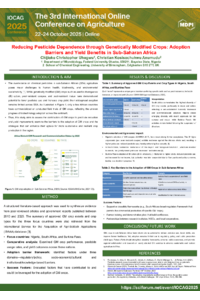
Reducing Pesticide Dependence through Genetically Modified Crops - MDPI Poster Presentation.pdf
OCCURRENCE AND MOLECULAR CHARACTERIZATION OF ENTOMOPATHOGENIC FUNGI ASSOCIATED WITH SPODOPTERA FRUGIPERDA IN TANZANIAN MAIZE FARMS
Field Evaluation of Different Application Frequencies of Extracts from
Tubli Roots (Derris elliptica) against Diamondback Moth
(Plutella xylostella) and Their Effects on Pechay (Brassica rapa L.)
Tubli Roots (Derris elliptica) against Diamondback Moth
(Plutella xylostella) and Their Effects on Pechay (Brassica rapa L.)