Event submissions
Published
This submission belongs to the session S4. Zero-Pollution Solutions in Crop Protection of the event The 3rd International Online Conference on Agriculture
Published date
20 Oct, 2025
Academic Editor
'%3e%3cpath%20d='M12.6657%2010.9104C12.4185%2010.325%2012.0599%209.79327%2011.6097%209.34482C11.1609%208.89508%2010.6293%208.5365%2010.0442%208.28888C10.0389%208.28626%2010.0337%208.28495%2010.0285%208.28233C10.8446%207.69279%2011.3752%206.73249%2011.3752%205.64904C11.3752%203.8542%209.92103%202.39999%208.1262%202.39999C6.33136%202.39999%204.87715%203.8542%204.87715%205.64904C4.87715%206.73249%205.40774%207.69279%206.22393%208.28364C6.21869%208.28626%206.21345%208.28757%206.20821%208.29019C5.62129%208.5378%205.09463%208.89284%204.64265%209.34613C4.1929%209.79493%203.83432%2010.3266%203.58671%2010.9117C3.34345%2011.4845%203.21226%2012.0987%203.20023%2012.7209C3.19988%2012.7349%203.20233%2012.7488%203.20744%2012.7619C3.21255%2012.7749%203.22022%2012.7867%203.22998%2012.7968C3.23975%2012.8068%203.25142%2012.8147%203.26431%2012.8202C3.2772%2012.8256%203.29105%2012.8284%203.30504%2012.8284H4.09109C4.14874%2012.8284%204.19459%2012.7825%204.1959%2012.7262C4.2221%2011.7148%204.62823%2010.7676%205.34617%2010.0497C6.08899%209.30683%207.0755%208.89808%208.1262%208.89808C9.17689%208.89808%2010.1634%209.30683%2010.9062%2010.0497C11.6242%2010.7676%2012.0303%2011.7148%2012.0565%2012.7262C12.0578%2012.7838%2012.1037%2012.8284%2012.1613%2012.8284H12.9474C12.9613%2012.8284%2012.9752%2012.8256%2012.9881%2012.8202C13.001%2012.8147%2013.0126%2012.8068%2013.0224%2012.7968C13.0322%2012.7867%2013.0398%2012.7749%2013.0449%2012.7619C13.0501%2012.7488%2013.0525%2012.7349%2013.0522%2012.7209C13.0391%2012.0947%2012.9094%2011.4855%2012.6657%2010.9104ZM8.1262%207.9024C7.52486%207.9024%206.9589%207.6679%206.53312%207.24211C6.10733%206.81633%205.87283%206.25037%205.87283%205.64904C5.87283%205.0477%206.10733%204.48174%206.53312%204.05596C6.9589%203.63018%207.52486%203.39567%208.1262%203.39567C8.72753%203.39567%209.29349%203.63018%209.71927%204.05596C10.1451%204.48174%2010.3796%205.0477%2010.3796%205.64904C10.3796%206.25037%2010.1451%206.81633%209.71927%207.24211C9.29349%207.6679%208.72753%207.9024%208.1262%207.9024Z'%20fill='%235D1EE1'/%3e%3c/g%3e%3c/svg%3e) Azucena Gonzalez-Coloma
Azucena Gonzalez-ColomaCitation
Enrique Jr. Elisan Biñas, Field Evaluation of Different Application Frequencies of Extracts fromTubli Roots (Derris elliptica) against Diamondback Moth(Plutella xylostella) and Their Effects on Pechay (Brassica rapa L.), in Proceedings of The 3rd International Online Conference on Agriculture, 22 October–24 October 2025, MDPI: Basel, Switzerland
Share
Email
Facebook
Twitter
LinkedIn
Field Evaluation of Different Application Frequencies of Extracts from
Tubli Roots (Derris elliptica) against Diamondback Moth
(Plutella xylostella) and Their Effects on Pechay (Brassica rapa L.)
Tubli Roots (Derris elliptica) against Diamondback Moth
(Plutella xylostella) and Their Effects on Pechay (Brassica rapa L.)

Enrique Jr. Elisan Biñas 1
1. Agusan del Sur State College of Agriculture and Technology
Abstract
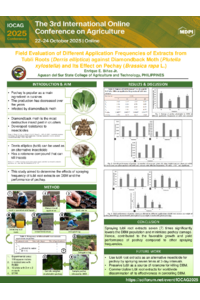
Different application frequencies of tubli root extracts, Derris elliptica, against the diamondback moth (DBM) were assessed to determine the impact on the growth and yield of pechay, Brassica rapa crop. The experiment was arranged in a randomized complete block design, with four treatments replicated three times. The application started a day after transplanting. The treatment of the extract given seven times at 3-day intervals after transplanting (T1 ) significantly resulted in lower mean DBM populations of 1.90, 0.70, and 0.30 at 7, 21, and 28 days after transplanting, respectively. Relative to plants applied with tubli root extracts four times at 6-day intervals after transplanting (T2 ), the mean reductions of the moth were 2.50, 0.96, and 0.83, respectively. It was evident that plants treated with tubli root extracts seven times at 3-day intervals (T1 ) were significant in incurring the minor damage of only 16% at harvest. The treatments helped obtain good crops (98.36 g/hill), a high yield (7.17 kg/plot), and a higher percentage of marketable plants (91.77%/plot) compared to other treatments of the extract with lesser frequencies, like four times at 6-day intervals after transplanting (T2 ), three times at 9-day intervals after transplanting (T3 ), and plants without treatment (T0 ). Overall, the growth of pechay was not affected by the different application frequencies of tubli root extract.
Keywords
Annual Crop
Application frequencies
Alternative Control Measure
Organic Pest Control
Insect Pest
Poster
Poster.pdf
Reducing Pesticide Dependence through Genetically Modified Crops: Adoption Barriers and Yield Benefits in Sub-Saharan Africa
Efficacy of Zinnia (Zinnia violacea) as Intercrop and Oriental Herb Nutrients (OHNs) as Biopesticide in Reducing Pest Incidence and Enhancing Productivity in Squash (Cucurbita maxima)