Event submissions
Published
This submission belongs to the session S4. Zero-Pollution Solutions in Crop Protection of the event The 3rd International Online Conference on Agriculture
Published date
20 Oct, 2025
Academic Editor
'%3e%3cpath%20d='M12.6657%2010.9104C12.4185%2010.325%2012.0599%209.79327%2011.6097%209.34482C11.1609%208.89508%2010.6293%208.5365%2010.0442%208.28888C10.0389%208.28626%2010.0337%208.28495%2010.0285%208.28233C10.8446%207.69279%2011.3752%206.73249%2011.3752%205.64904C11.3752%203.8542%209.92103%202.39999%208.1262%202.39999C6.33136%202.39999%204.87715%203.8542%204.87715%205.64904C4.87715%206.73249%205.40774%207.69279%206.22393%208.28364C6.21869%208.28626%206.21345%208.28757%206.20821%208.29019C5.62129%208.5378%205.09463%208.89284%204.64265%209.34613C4.1929%209.79493%203.83432%2010.3266%203.58671%2010.9117C3.34345%2011.4845%203.21226%2012.0987%203.20023%2012.7209C3.19988%2012.7349%203.20233%2012.7488%203.20744%2012.7619C3.21255%2012.7749%203.22022%2012.7867%203.22998%2012.7968C3.23975%2012.8068%203.25142%2012.8147%203.26431%2012.8202C3.2772%2012.8256%203.29105%2012.8284%203.30504%2012.8284H4.09109C4.14874%2012.8284%204.19459%2012.7825%204.1959%2012.7262C4.2221%2011.7148%204.62823%2010.7676%205.34617%2010.0497C6.08899%209.30683%207.0755%208.89808%208.1262%208.89808C9.17689%208.89808%2010.1634%209.30683%2010.9062%2010.0497C11.6242%2010.7676%2012.0303%2011.7148%2012.0565%2012.7262C12.0578%2012.7838%2012.1037%2012.8284%2012.1613%2012.8284H12.9474C12.9613%2012.8284%2012.9752%2012.8256%2012.9881%2012.8202C13.001%2012.8147%2013.0126%2012.8068%2013.0224%2012.7968C13.0322%2012.7867%2013.0398%2012.7749%2013.0449%2012.7619C13.0501%2012.7488%2013.0525%2012.7349%2013.0522%2012.7209C13.0391%2012.0947%2012.9094%2011.4855%2012.6657%2010.9104ZM8.1262%207.9024C7.52486%207.9024%206.9589%207.6679%206.53312%207.24211C6.10733%206.81633%205.87283%206.25037%205.87283%205.64904C5.87283%205.0477%206.10733%204.48174%206.53312%204.05596C6.9589%203.63018%207.52486%203.39567%208.1262%203.39567C8.72753%203.39567%209.29349%203.63018%209.71927%204.05596C10.1451%204.48174%2010.3796%205.0477%2010.3796%205.64904C10.3796%206.25037%2010.1451%206.81633%209.71927%207.24211C9.29349%207.6679%208.72753%207.9024%208.1262%207.9024Z'%20fill='%235D1EE1'/%3e%3c/g%3e%3c/svg%3e) Azucena Gonzalez-Coloma
Azucena Gonzalez-ColomaCitation
Agustín Jesús Gonzaga Segura, Artemio Hernández-Ruiz, Víctor Rogelio Castrejón-Gómez, Karla Yolanda Flores Maldonado, Biological interactions between epazote Dysphania ambrosioides, the urbícola soft scale insect Pulvinaria urbicula, the ant Dorymyrmex smithi and the parasitoid Coccophagus lycimnia in Mexico, in Proceedings of The 3rd International Online Conference on Agriculture, 22 October–24 October 2025, MDPI: Basel, Switzerland
Share
Email
Facebook
Twitter
LinkedIn
Biological interactions between epazote Dysphania ambrosioides, the urbícola soft scale insect Pulvinaria urbicula, the ant Dorymyrmex smithi and the parasitoid Coccophagus lycimnia in Mexico
'%3e%3cpath%20d='M12.6647%2010.9104C12.4176%2010.325%2012.0589%209.7933%2011.6088%209.34485C11.16%208.89511%2010.6283%208.53653%2010.0432%208.28891C10.038%208.28629%2010.0327%208.28498%2010.0275%208.28236C10.8437%207.69282%2011.3743%206.73252%2011.3743%205.64907C11.3743%203.85423%209.92005%202.40002%208.12522%202.40002C6.33038%202.40002%204.87618%203.85423%204.87618%205.64907C4.87618%206.73252%205.40677%207.69282%206.22296%208.28367C6.21772%208.28629%206.21248%208.2876%206.20724%208.29022C5.62031%208.53783%205.09365%208.89287%204.64167%209.34616C4.19192%209.79496%203.83334%2010.3266%203.58573%2010.9117C3.34247%2011.4846%203.21128%2012.0987%203.19925%2012.721C3.1989%2012.735%203.20135%2012.7489%203.20646%2012.7619C3.21157%2012.7749%203.21924%2012.7868%203.22901%2012.7968C3.23877%2012.8068%203.25045%2012.8148%203.26334%2012.8202C3.27623%2012.8256%203.29007%2012.8284%203.30406%2012.8284H4.09012C4.14776%2012.8284%204.19362%2012.7825%204.19493%2012.7262C4.22113%2011.7148%204.62726%2010.7676%205.34519%2010.0497C6.08802%209.30686%207.07452%208.89811%208.12522%208.89811C9.17592%208.89811%2010.1624%209.30686%2010.9052%2010.0497C11.6232%2010.7676%2012.0293%2011.7148%2012.0555%2012.7262C12.0568%2012.7839%2012.1027%2012.8284%2012.1603%2012.8284H12.9464C12.9604%2012.8284%2012.9742%2012.8256%2012.9871%2012.8202C13%2012.8148%2013.0117%2012.8068%2013.0214%2012.7968C13.0312%2012.7868%2013.0389%2012.7749%2013.044%2012.7619C13.0491%2012.7489%2013.0515%2012.735%2013.0512%2012.721C13.0381%2012.0947%2012.9084%2011.4856%2012.6647%2010.9104ZM8.12522%207.90243C7.52388%207.90243%206.95792%207.66793%206.53214%207.24215C6.10636%206.81636%205.87185%206.2504%205.87185%205.64907C5.87185%205.04773%206.10636%204.48177%206.53214%204.05599C6.95792%203.63021%207.52388%203.3957%208.12522%203.3957C8.72655%203.3957%209.29252%203.63021%209.7183%204.05599C10.1441%204.48177%2010.3786%205.04773%2010.3786%205.64907C10.3786%206.2504%2010.1441%206.81636%209.7183%207.24215C9.29252%207.66793%208.72655%207.90243%208.12522%207.90243Z'%20fill='%235D1EE1'/%3e%3c/g%3e%3c/svg%3e)
Agustín Jesús Gonzaga Segura 1
Artemio Hernández-Ruiz 2
Víctor Rogelio Castrejón-Gómez 1
Karla Yolanda Flores Maldonado 3
1. Center for the Development of Biotic Products, National Polytechnic Institute (IPN), Yautepec, Morelos 62731, Mexico
2. Phytosanitary Consulting “Dr. Artemio”, Mexico
3. Faculty of Engineering and Sciences, Autonomous University of Tamaulipas, Ciudad Victoria 87000, Tamaulipas, Mexico
Abstract
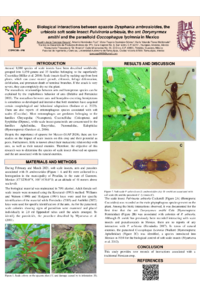
The herb epazote, Dysphania ambrosioides (L. Mosyakin and Clemants) (Amaranthaceae), is affected by species that belong to the Hemiptera order, principally those from the Cocoidea family such as soft scale insects. The latter maintain different biotic interactions with species of ants (Hymenoptera: Formicidae) and a wide variety of parasitoids from the Aphelinidae, Encyrtidae, Pteromalidae and Eulophidae (Hymenoptera) families. During February and March 2024, a study was conducted in a homegarden located in Petatlán, Guerrero, Mexico (17°32'50.0"N 101°16'31. 0"W, at an altitude of 41 metres above sea level), with the aim of identifying the hemipteran insects associated with epazote, as well as their interactions with ants and natural enemies. The urbicola scale insect Pulvinaria urbicola Cockerell (Hemiptera: Coccoidea) was recorded as the main phytophagous species present on the plant. Among the biotic interactions observed, the ant Dorymyrmex smithi Cole (Hymenoptera: Formicidae) was documented for the first time as being associated with colonies of P. urbicola. Although in Mexico, D. smithi has previously been recorded interacting with scale insects and Pseudococcids, there are no reports of any interactions with P. urbicola. As for natural enemies, the parasitoid Coccophagus lycimnia (Walker) (Hymenoptera: Aphelinidae) was identified, a species introduced in Mexico in 1954 for the biological control of soft scale insects. This study provides new records of interactions associated with a traditional crop of Mexico.
Keywords
Pest
Management
host plant
Poster
Biological interactions between epazote Dysphania ambrosioides.pdf
Effects of different lactic acid bacteria in dietary on intestinal flora, morphology,pH and immune organ indexes of Zi geese
Genetic diversity of the Latvian Dark-head sheep breed according to single-nucleotide polymorphisms compared to breeds bred in Latvia