Event submissions
Published
This submission belongs to the session S5. Pharmacogenetics, Omics, and Informatics of the event The 1st International Online Conference on Personalized Medicine
Published date
23 Oct, 2025
Academic Editor
'%3e%3cpath%20d='M12.6657%2010.9104C12.4185%2010.325%2012.0599%209.79327%2011.6097%209.34482C11.1609%208.89508%2010.6293%208.5365%2010.0442%208.28888C10.0389%208.28626%2010.0337%208.28495%2010.0285%208.28233C10.8446%207.69279%2011.3752%206.73249%2011.3752%205.64904C11.3752%203.8542%209.92103%202.39999%208.1262%202.39999C6.33136%202.39999%204.87715%203.8542%204.87715%205.64904C4.87715%206.73249%205.40774%207.69279%206.22393%208.28364C6.21869%208.28626%206.21345%208.28757%206.20821%208.29019C5.62129%208.5378%205.09463%208.89284%204.64265%209.34613C4.1929%209.79493%203.83432%2010.3266%203.58671%2010.9117C3.34345%2011.4845%203.21226%2012.0987%203.20023%2012.7209C3.19988%2012.7349%203.20233%2012.7488%203.20744%2012.7619C3.21255%2012.7749%203.22022%2012.7867%203.22998%2012.7968C3.23975%2012.8068%203.25142%2012.8147%203.26431%2012.8202C3.2772%2012.8256%203.29105%2012.8284%203.30504%2012.8284H4.09109C4.14874%2012.8284%204.19459%2012.7825%204.1959%2012.7262C4.2221%2011.7148%204.62823%2010.7676%205.34617%2010.0497C6.08899%209.30683%207.0755%208.89808%208.1262%208.89808C9.17689%208.89808%2010.1634%209.30683%2010.9062%2010.0497C11.6242%2010.7676%2012.0303%2011.7148%2012.0565%2012.7262C12.0578%2012.7838%2012.1037%2012.8284%2012.1613%2012.8284H12.9474C12.9613%2012.8284%2012.9752%2012.8256%2012.9881%2012.8202C13.001%2012.8147%2013.0126%2012.8068%2013.0224%2012.7968C13.0322%2012.7867%2013.0398%2012.7749%2013.0449%2012.7619C13.0501%2012.7488%2013.0525%2012.7349%2013.0522%2012.7209C13.0391%2012.0947%2012.9094%2011.4855%2012.6657%2010.9104ZM8.1262%207.9024C7.52486%207.9024%206.9589%207.6679%206.53312%207.24211C6.10733%206.81633%205.87283%206.25037%205.87283%205.64904C5.87283%205.0477%206.10733%204.48174%206.53312%204.05596C6.9589%203.63018%207.52486%203.39567%208.1262%203.39567C8.72753%203.39567%209.29349%203.63018%209.71927%204.05596C10.1451%204.48174%2010.3796%205.0477%2010.3796%205.64904C10.3796%206.25037%2010.1451%206.81633%209.71927%207.24211C9.29349%207.6679%208.72753%207.9024%208.1262%207.9024Z'%20fill='%235D1EE1'/%3e%3c/g%3e%3c/svg%3e) Enrico Mini
Enrico MiniCitation
Irina V. Haidukevich, Tatsiana S. Golubeva, Inna M. Halayenka, Victor G. Obedkov, Olga S. Bokut, Gennady V. Sergeev, Tatsiana V. Dakukina, High-risk genetic profiles for Pharmacoresistant Schizophrenia: Insights from Belarusian Patients, in Proceedings of The 1st International Online Conference on Personalized Medicine, 29 October–31 October 2025, MDPI: Basel, Switzerland
Share
Email
Facebook
Twitter
LinkedIn
High-risk genetic profiles for Pharmacoresistant Schizophrenia: Insights from Belarusian Patients
'%3e%3cpath%20d='M12.6647%2010.9104C12.4176%2010.325%2012.0589%209.7933%2011.6088%209.34485C11.16%208.89511%2010.6283%208.53653%2010.0432%208.28891C10.038%208.28629%2010.0327%208.28498%2010.0275%208.28236C10.8437%207.69282%2011.3743%206.73252%2011.3743%205.64907C11.3743%203.85423%209.92005%202.40002%208.12522%202.40002C6.33038%202.40002%204.87618%203.85423%204.87618%205.64907C4.87618%206.73252%205.40677%207.69282%206.22296%208.28367C6.21772%208.28629%206.21248%208.2876%206.20724%208.29022C5.62031%208.53783%205.09365%208.89287%204.64167%209.34616C4.19192%209.79496%203.83334%2010.3266%203.58573%2010.9117C3.34247%2011.4846%203.21128%2012.0987%203.19925%2012.721C3.1989%2012.735%203.20135%2012.7489%203.20646%2012.7619C3.21157%2012.7749%203.21924%2012.7868%203.22901%2012.7968C3.23877%2012.8068%203.25045%2012.8148%203.26334%2012.8202C3.27623%2012.8256%203.29007%2012.8284%203.30406%2012.8284H4.09012C4.14776%2012.8284%204.19362%2012.7825%204.19493%2012.7262C4.22113%2011.7148%204.62726%2010.7676%205.34519%2010.0497C6.08802%209.30686%207.07452%208.89811%208.12522%208.89811C9.17592%208.89811%2010.1624%209.30686%2010.9052%2010.0497C11.6232%2010.7676%2012.0293%2011.7148%2012.0555%2012.7262C12.0568%2012.7839%2012.1027%2012.8284%2012.1603%2012.8284H12.9464C12.9604%2012.8284%2012.9742%2012.8256%2012.9871%2012.8202C13%2012.8148%2013.0117%2012.8068%2013.0214%2012.7968C13.0312%2012.7868%2013.0389%2012.7749%2013.044%2012.7619C13.0491%2012.7489%2013.0515%2012.735%2013.0512%2012.721C13.0381%2012.0947%2012.9084%2011.4856%2012.6647%2010.9104ZM8.12522%207.90243C7.52388%207.90243%206.95792%207.66793%206.53214%207.24215C6.10636%206.81636%205.87185%206.2504%205.87185%205.64907C5.87185%205.04773%206.10636%204.48177%206.53214%204.05599C6.95792%203.63021%207.52388%203.3957%208.12522%203.3957C8.72655%203.3957%209.29252%203.63021%209.7183%204.05599C10.1441%204.48177%2010.3786%205.04773%2010.3786%205.64907C10.3786%206.2504%2010.1441%206.81636%209.7183%207.24215C9.29252%207.66793%208.72655%207.90243%208.12522%207.90243Z'%20fill='%235D1EE1'/%3e%3c/g%3e%3c/svg%3e)
Irina V. Haidukevich 1
Tatsiana S. Golubeva 2
Inna M. Halayenka 2
Victor G. Obedkov 2,3
Olga S. Bokut 1
Gennady V. Sergeev 1
Tatsiana V. Dakukina 1
1. Laboratory of Molecular Diagnostics and Biotechnology, Institute of Bioorganic Chemistry of National Academy of Sciences of Belarus, Minsk, 220084, Belarus
2. Department of Narcology and Clinical-Epidemiological Research, Republican Research and Practice Center for Mental Health, Minsk, 220080, Belarus
3. Department of Psychiatry, Narcology, Psychotherapy and Medical Psychology with a course for advanced training and retraining, Belarusian State Medical University, Minsk, 220080, Belarus
Abstract
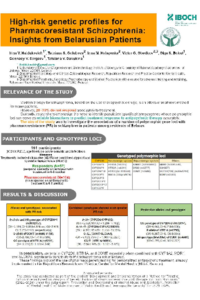
Despite antipsychotic drugs being a key treatment for schizophrenia, 20–30% of patients show an inadequate response. This may be due to genetic factors affecting drugs' metabolism, side effects, and efficacy. This study explored links between genetic polymorphisms and pharmacoresistant (PR) schizophrenia in Belarusian patients.
A total of 161 participants were included: 104 with PR schizophrenia (no response after 6–8 weeks of treatment) and 57 responders. All were diagnosed according to the ICD-10 (F20), aged 18–60, gave informed consent, and had no acute physical illnesses. The treatments included clozapine (42.1%) or combined atypical and typical antipsychotics (39.5%). We genotyped 19 polymorphic loci across 15 genes (e.g., CYP2D6, COMT, HTR1A, MDR1) using a Real-Time PCR or Sanger sequencing. The data were analyzed in SPSS 20.0 using ORs and 95% CIs to evaluate the genotype–phenotype associations.
Significant associations with PR were found for the following:
- The A-allele and AG genotype of CYP2D6*4 (rs3892097) (OR=2.159 and CI=1.018-4.578 and OR=2.975 and CI=1.269-6.977, respectively);
- The G-allele of COMT (rs4680, V158) (OR=2.786; CI=1.414-5.489);
- The CC genotype of HTR1A (rs6295) (OR=2.703; CI=1.151-6.348).
Protective effects were noted for the following:
- The GG genotype of CYP2D6 (rs3892097) (OR=0.463; CI=0.218-0.928);
- The G allele of HTR1A (rs6295) (OR=0.367; CI=0.156-0.864);
- The AA genotype (Met/Met) of COMT (rs4680) (OR=0.359; CI=0.182-0.707).
Combined genotypes showed an even greater PR risk, including the following:
- A-/A- (CYP2D6/CYP1A2) (OR = 2.926; 95% CI = 1.206–7.102);
- A-/A-/T- (CYP2D6/CYP1A2/MDR1) (OR = 4.833; 95% CI = 1.753–13.328)
- G-/LL (COMT/SLC6A4) (OR = 6.923; 95% CI = 1.900–25.227);
- CC/T- (HTR1A/MDR1) (OR = 2.564; 95% CI = 1.120–5.873).
In conclusion, variants in CYP2D6, HTR1A, and COMT, especially when combined with variants in CYP1A2, MDR1, and SLC6A4, significantly contribute to the PR schizophrenia risk in Belarus. These findings support the use of pharmacogenetic testing for personalized antipsychotic treatment, already implemented in the Republican Research and Practice Center for Mental Health (Minsk).
Keywords
pharmacoresistance schizophrenia
antipsychotics
CYP2D6
HTR1A
COMT
pharmacogenetic testing
genetic markers of pharmacoresistance
Poster
Haidukevich_poster_1 (002).pdf
INTEGRATING PATIENT-DERIVED ORGANOIDS AND NATURAL COMPOUNDS FOR DIAGNOSTIC AND THERAPEUTIC INNOVATION IN IBD
Polydopamine-Modified Engineered E. coli for Synergistic Cancer Therapy via Glucose Oxidase-Mediated Starvation and Prodrug Delivery