Event submissions
Published
This submission belongs to the session S1. Mechanisms of Diseases of the event The 1st International Online Conference on Personalized Medicine
Published date
23 Oct, 2025
Academic Editor
'%3e%3cpath%20d='M12.6657%2010.9104C12.4185%2010.325%2012.0599%209.79327%2011.6097%209.34482C11.1609%208.89508%2010.6293%208.5365%2010.0442%208.28888C10.0389%208.28626%2010.0337%208.28495%2010.0285%208.28233C10.8446%207.69279%2011.3752%206.73249%2011.3752%205.64904C11.3752%203.8542%209.92103%202.39999%208.1262%202.39999C6.33136%202.39999%204.87715%203.8542%204.87715%205.64904C4.87715%206.73249%205.40774%207.69279%206.22393%208.28364C6.21869%208.28626%206.21345%208.28757%206.20821%208.29019C5.62129%208.5378%205.09463%208.89284%204.64265%209.34613C4.1929%209.79493%203.83432%2010.3266%203.58671%2010.9117C3.34345%2011.4845%203.21226%2012.0987%203.20023%2012.7209C3.19988%2012.7349%203.20233%2012.7488%203.20744%2012.7619C3.21255%2012.7749%203.22022%2012.7867%203.22998%2012.7968C3.23975%2012.8068%203.25142%2012.8147%203.26431%2012.8202C3.2772%2012.8256%203.29105%2012.8284%203.30504%2012.8284H4.09109C4.14874%2012.8284%204.19459%2012.7825%204.1959%2012.7262C4.2221%2011.7148%204.62823%2010.7676%205.34617%2010.0497C6.08899%209.30683%207.0755%208.89808%208.1262%208.89808C9.17689%208.89808%2010.1634%209.30683%2010.9062%2010.0497C11.6242%2010.7676%2012.0303%2011.7148%2012.0565%2012.7262C12.0578%2012.7838%2012.1037%2012.8284%2012.1613%2012.8284H12.9474C12.9613%2012.8284%2012.9752%2012.8256%2012.9881%2012.8202C13.001%2012.8147%2013.0126%2012.8068%2013.0224%2012.7968C13.0322%2012.7867%2013.0398%2012.7749%2013.0449%2012.7619C13.0501%2012.7488%2013.0525%2012.7349%2013.0522%2012.7209C13.0391%2012.0947%2012.9094%2011.4855%2012.6657%2010.9104ZM8.1262%207.9024C7.52486%207.9024%206.9589%207.6679%206.53312%207.24211C6.10733%206.81633%205.87283%206.25037%205.87283%205.64904C5.87283%205.0477%206.10733%204.48174%206.53312%204.05596C6.9589%203.63018%207.52486%203.39567%208.1262%203.39567C8.72753%203.39567%209.29349%203.63018%209.71927%204.05596C10.1451%204.48174%2010.3796%205.0477%2010.3796%205.64904C10.3796%206.25037%2010.1451%206.81633%209.71927%207.24211C9.29349%207.6679%208.72753%207.9024%208.1262%207.9024Z'%20fill='%235D1EE1'/%3e%3c/g%3e%3c/svg%3e) Seungil Ro
Seungil RoCitation
Asbiel Felipe Garibaldi-Ríos, Luis E. Figuera, Belida Claudia Gómez-Meda, Guillermo Moisés Zúñiga-González, Irving Alejandro Carrillo-Dávila, Ingrid Patricia Dávalos-Rodríguez, Martha Patricia Gallegos-Arreola, 3'UTR Variant rs12245 in KRAS and Its Functional Implications in Breast Cancer Susceptibility, in Proceedings of The 1st International Online Conference on Personalized Medicine, 29 October–31 October 2025, MDPI: Basel, Switzerland
Share
Email
Facebook
Twitter
LinkedIn
3'UTR Variant rs12245 in KRAS and Its Functional Implications in Breast Cancer Susceptibility
'%3e%3cpath%20d='M12.6647%2010.9104C12.4176%2010.325%2012.0589%209.7933%2011.6088%209.34485C11.16%208.89511%2010.6283%208.53653%2010.0432%208.28891C10.038%208.28629%2010.0327%208.28498%2010.0275%208.28236C10.8437%207.69282%2011.3743%206.73252%2011.3743%205.64907C11.3743%203.85423%209.92005%202.40002%208.12522%202.40002C6.33038%202.40002%204.87618%203.85423%204.87618%205.64907C4.87618%206.73252%205.40677%207.69282%206.22296%208.28367C6.21772%208.28629%206.21248%208.2876%206.20724%208.29022C5.62031%208.53783%205.09365%208.89287%204.64167%209.34616C4.19192%209.79496%203.83334%2010.3266%203.58573%2010.9117C3.34247%2011.4846%203.21128%2012.0987%203.19925%2012.721C3.1989%2012.735%203.20135%2012.7489%203.20646%2012.7619C3.21157%2012.7749%203.21924%2012.7868%203.22901%2012.7968C3.23877%2012.8068%203.25045%2012.8148%203.26334%2012.8202C3.27623%2012.8256%203.29007%2012.8284%203.30406%2012.8284H4.09012C4.14776%2012.8284%204.19362%2012.7825%204.19493%2012.7262C4.22113%2011.7148%204.62726%2010.7676%205.34519%2010.0497C6.08802%209.30686%207.07452%208.89811%208.12522%208.89811C9.17592%208.89811%2010.1624%209.30686%2010.9052%2010.0497C11.6232%2010.7676%2012.0293%2011.7148%2012.0555%2012.7262C12.0568%2012.7839%2012.1027%2012.8284%2012.1603%2012.8284H12.9464C12.9604%2012.8284%2012.9742%2012.8256%2012.9871%2012.8202C13%2012.8148%2013.0117%2012.8068%2013.0214%2012.7968C13.0312%2012.7868%2013.0389%2012.7749%2013.044%2012.7619C13.0491%2012.7489%2013.0515%2012.735%2013.0512%2012.721C13.0381%2012.0947%2012.9084%2011.4856%2012.6647%2010.9104ZM8.12522%207.90243C7.52388%207.90243%206.95792%207.66793%206.53214%207.24215C6.10636%206.81636%205.87185%206.2504%205.87185%205.64907C5.87185%205.04773%206.10636%204.48177%206.53214%204.05599C6.95792%203.63021%207.52388%203.3957%208.12522%203.3957C8.72655%203.3957%209.29252%203.63021%209.7183%204.05599C10.1441%204.48177%2010.3786%205.04773%2010.3786%205.64907C10.3786%206.2504%2010.1441%206.81636%209.7183%207.24215C9.29252%207.66793%208.72655%207.90243%208.12522%207.90243Z'%20fill='%235D1EE1'/%3e%3c/g%3e%3c/svg%3e)
Asbiel Felipe Garibaldi-Ríos 1,2
Luis E. Figuera 1
Belida Claudia Gómez-Meda 3
Guillermo Moisés Zúñiga-González 4
Irving Alejandro Carrillo-Dávila 1
Ingrid Patricia Dávalos-Rodríguez 1

Martha Patricia Gallegos-Arreola 1
1. División de Genética, Centro de Investigación Biomédica de Occidente (CIBO), Centro Médico Nacional de Occidente (CMNO), Instituto Mexicano del Seguro Social (IMSS), Guadalajara, Jalisco, 44340, México
2. Centro Universitario de Ciencias de la Salud (CUCS), Universidad de Guadalajara (UdeG), Guadalajara, Jalisco, 44340, México
3. Instituto de Genética Humana “Dr. Enrique Corona Rivera”, Departamento de Biología Molecular y Genómica, CUCS, Universidad de Guadalajara (UdeG), Guadalajara, Jalisco, 44340, México
4. División de Medicina Molecular, Centro de Investigación Biomédica de Occidente (CIBO), Centro Médico Nacional de Occidente (CMNO), Instituto Mexicano del Seguro Social (IMSS), Sierra Mojada 800, Col. Independencia, Guadalajara, Jalisco, 44340, México
Abstract
Introduction
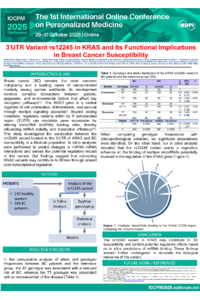
The KRAS gene plays a key role in oncogenic signaling. Regulatory variants within its 3' untranslated region (3'UTR) can affect microRNA (miRNA) binding, influencing post-transcriptional regulation. This study evaluated the potential association between the rs12245 variant in the 3'UTR of KRAS and breast cancer (BC) susceptibility and explored this variant's possible functional relevance through in silico analysis.
Methods
A total of 627 individuals were genotyped for rs12245, including 385 BC patients and 242 individuals forming a reference group. Odds ratios (ORs) and 95% confidence intervals (CIs) were estimated using logistic regression models. Predictions of altered miRNA binding were obtained from miRNASNP-v3 and PolymiRTS. The expression status of the affected miRNAs was examined in dbDEMC. In addition, eQTL analysis was performed using GTEx data for breast mammary tissue.
Results
The AT genotype was associated with a reduced risk of BC (OR = 0.55; 95% CI: 0.40 to 0.77; p = 0.0003), while the TT genotype and recessive model were associated with an increased risk (OR = 1.44; 95% CI: 1.00 to 2.06; p = 0.023). No significant associations were found with clinicopathological variables. In silico analysis suggested that rs12245 may alter the binding of several miRNAs to the KRAS 3'UTR, including hsa-miR-543, hsa-miR-544a, hsa-miR-4803, hsa-miR-5580-3p, hsa-miR-4686, hsa-miR-6738-3p, and hsa-miR-5096, which are deregulated in BC. The GTEx data indicated that rs12245 shows eQTL activity in breast tissue (p = 0.00069; slope = –0.094).
Conclusion
The rs12245 variant in KRAS may contribute to determining BC susceptibility and shows potential regulatory effects based on eQTL and miRNA binding predictions. These findings warrant further investigation to clarify this variant's biological significance.
Keywords
KRAS
rs12245
breast cancer
miRNA binding
eQTL analysis
3'UTR variant
Poster
POSTER MP.pdf
Investigating the Role of CD151 in Systemic Breast Cancer Metastasis
Association of the rs2234909 variant of the FGFR3 gene with colorectal cancer in a Mexican population.