Event submissions
Published
This submission belongs to the session S8. Crop Production of the event The 3rd International Online Conference on Agriculture
Published date
23 Oct, 2025
Academic Editor
'%3e%3cpath%20d='M12.6657%2010.9104C12.4185%2010.325%2012.0599%209.79327%2011.6097%209.34482C11.1609%208.89508%2010.6293%208.5365%2010.0442%208.28888C10.0389%208.28626%2010.0337%208.28495%2010.0285%208.28233C10.8446%207.69279%2011.3752%206.73249%2011.3752%205.64904C11.3752%203.8542%209.92103%202.39999%208.1262%202.39999C6.33136%202.39999%204.87715%203.8542%204.87715%205.64904C4.87715%206.73249%205.40774%207.69279%206.22393%208.28364C6.21869%208.28626%206.21345%208.28757%206.20821%208.29019C5.62129%208.5378%205.09463%208.89284%204.64265%209.34613C4.1929%209.79493%203.83432%2010.3266%203.58671%2010.9117C3.34345%2011.4845%203.21226%2012.0987%203.20023%2012.7209C3.19988%2012.7349%203.20233%2012.7488%203.20744%2012.7619C3.21255%2012.7749%203.22022%2012.7867%203.22998%2012.7968C3.23975%2012.8068%203.25142%2012.8147%203.26431%2012.8202C3.2772%2012.8256%203.29105%2012.8284%203.30504%2012.8284H4.09109C4.14874%2012.8284%204.19459%2012.7825%204.1959%2012.7262C4.2221%2011.7148%204.62823%2010.7676%205.34617%2010.0497C6.08899%209.30683%207.0755%208.89808%208.1262%208.89808C9.17689%208.89808%2010.1634%209.30683%2010.9062%2010.0497C11.6242%2010.7676%2012.0303%2011.7148%2012.0565%2012.7262C12.0578%2012.7838%2012.1037%2012.8284%2012.1613%2012.8284H12.9474C12.9613%2012.8284%2012.9752%2012.8256%2012.9881%2012.8202C13.001%2012.8147%2013.0126%2012.8068%2013.0224%2012.7968C13.0322%2012.7867%2013.0398%2012.7749%2013.0449%2012.7619C13.0501%2012.7488%2013.0525%2012.7349%2013.0522%2012.7209C13.0391%2012.0947%2012.9094%2011.4855%2012.6657%2010.9104ZM8.1262%207.9024C7.52486%207.9024%206.9589%207.6679%206.53312%207.24211C6.10733%206.81633%205.87283%206.25037%205.87283%205.64904C5.87283%205.0477%206.10733%204.48174%206.53312%204.05596C6.9589%203.63018%207.52486%203.39567%208.1262%203.39567C8.72753%203.39567%209.29349%203.63018%209.71927%204.05596C10.1451%204.48174%2010.3796%205.0477%2010.3796%205.64904C10.3796%206.25037%2010.1451%206.81633%209.71927%207.24211C9.29349%207.6679%208.72753%207.9024%208.1262%207.9024Z'%20fill='%235D1EE1'/%3e%3c/g%3e%3c/svg%3e) Bin Gao
Bin GaoCitation
Irene Zunzunegui, Jorge Poveda Arias, Óscar Santamaria Becerril, Jorge Martín García, Biostimulant Potential of Tenebrio molitor Frass in Tomato Cultivation under NFT Hydroponic System, in Proceedings of The 3rd International Online Conference on Agriculture, 22 October–24 October 2025, MDPI: Basel, Switzerland
Share
Email
Facebook
Twitter
LinkedIn
Biostimulant Potential of Tenebrio molitor Frass in Tomato Cultivation under NFT Hydroponic System
'%3e%3cpath%20d='M12.6647%2010.9104C12.4176%2010.325%2012.0589%209.7933%2011.6088%209.34485C11.16%208.89511%2010.6283%208.53653%2010.0432%208.28891C10.038%208.28629%2010.0327%208.28498%2010.0275%208.28236C10.8437%207.69282%2011.3743%206.73252%2011.3743%205.64907C11.3743%203.85423%209.92005%202.40002%208.12522%202.40002C6.33038%202.40002%204.87618%203.85423%204.87618%205.64907C4.87618%206.73252%205.40677%207.69282%206.22296%208.28367C6.21772%208.28629%206.21248%208.2876%206.20724%208.29022C5.62031%208.53783%205.09365%208.89287%204.64167%209.34616C4.19192%209.79496%203.83334%2010.3266%203.58573%2010.9117C3.34247%2011.4846%203.21128%2012.0987%203.19925%2012.721C3.1989%2012.735%203.20135%2012.7489%203.20646%2012.7619C3.21157%2012.7749%203.21924%2012.7868%203.22901%2012.7968C3.23877%2012.8068%203.25045%2012.8148%203.26334%2012.8202C3.27623%2012.8256%203.29007%2012.8284%203.30406%2012.8284H4.09012C4.14776%2012.8284%204.19362%2012.7825%204.19493%2012.7262C4.22113%2011.7148%204.62726%2010.7676%205.34519%2010.0497C6.08802%209.30686%207.07452%208.89811%208.12522%208.89811C9.17592%208.89811%2010.1624%209.30686%2010.9052%2010.0497C11.6232%2010.7676%2012.0293%2011.7148%2012.0555%2012.7262C12.0568%2012.7839%2012.1027%2012.8284%2012.1603%2012.8284H12.9464C12.9604%2012.8284%2012.9742%2012.8256%2012.9871%2012.8202C13%2012.8148%2013.0117%2012.8068%2013.0214%2012.7968C13.0312%2012.7868%2013.0389%2012.7749%2013.044%2012.7619C13.0491%2012.7489%2013.0515%2012.735%2013.0512%2012.721C13.0381%2012.0947%2012.9084%2011.4856%2012.6647%2010.9104ZM8.12522%207.90243C7.52388%207.90243%206.95792%207.66793%206.53214%207.24215C6.10636%206.81636%205.87185%206.2504%205.87185%205.64907C5.87185%205.04773%206.10636%204.48177%206.53214%204.05599C6.95792%203.63021%207.52388%203.3957%208.12522%203.3957C8.72655%203.3957%209.29252%203.63021%209.7183%204.05599C10.1441%204.48177%2010.3786%205.04773%2010.3786%205.64907C10.3786%206.2504%2010.1441%206.81636%209.7183%207.24215C9.29252%207.66793%208.72655%207.90243%208.12522%207.90243Z'%20fill='%235D1EE1'/%3e%3c/g%3e%3c/svg%3e)
Irene Zunzunegui 1
Jorge Poveda Arias 2

Óscar Santamaria Becerril 2
Jorge Martín García 2
1. Department of Plant Production and Sustainable Forestry Resources
2. Department of Plant Production and Sustainable Forestry Resources (University of Valladolid)
Abstract
Introduction
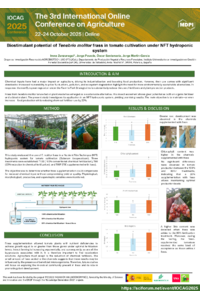
Intensive agriculture has historically relied on chemical inputs to increase crop yields. However, continued use of such inputs has led to negative environmental impacts, including soil and water contamination, biodiversity loss, and a growing dependency on external resources with increasingly volatile costs. In this context, the European Union’s “Farm to Fork” Strategy promotes a reduction of at least 20% in chemical fertilizer use, encouraging the search for more sustainable alternatives [1]. One such alternative is Tenebrio molitor frass, a by-product derived from insect farming using plant-based residues. This material exhibits biofertilizer and biostimulant properties, making it a promising input for environmentally friendly agriculture [2, 3].
Methods
This study evaluated the use of T. molitor frass in a Nutrient Film Technique (NFT) hydroponic system for tomato cultivation (Solanum lycopersicum). Three treatments were established: T100 (100% conventional chemical fertilization), T80 (20% reduction in chemical fertilization), and T80F (T80 supplemented with frass). The objective was to determine whether frass supplementation could compensate for reduced chemical input without compromising yield or quality. Physiological, morphological, productive, and organoleptic variables were monitored.
Results
T80F treatment resulted in a higher chlorophyll content, significant improvements in root development and primary fruit formation, and a total tomato yield comparable to that under T100. Additionally, T80F fruits had higher Brix degrees (sugar content) and received high scores in organoleptic evaluations.
Conclusions
These results support the use of frass as a functional amendment in hydroponic systems, contributing to the reduction of chemical inputs without sacrificing productivity or quality.
References
[1] European Commission. Farm to Fork Strategy; European Commission. (2019).
[2] Poveda, J. Insect frass in the development of sustainable agriculture. A review. Agron. Sustain. Dev. 41, 5. (2021).
[3] Barragán-Fonseca, K.Y., Nurfikari, A., van de Zande, E.M., Wantulla, M., van Loon, J.J. A., de Boer, W., Dicke, M. Insect frass and exuviae to promote plant growth and health. Trends Plant Sci. 7, 646–654. (2022).
Keywords
Tenebrio molitor
frass
hydroponics
tomato
sustainable agriculture
plant growth promotion
Poster
POSTER_SCIFORUM.pdf
Impact of Environmental Conditions on Fungal Growth and Mycotoxin production in Stored Products