Event submissions
Published
This submission belongs to the session F. Sustainable Food Security and Food Systems of the event The 6th International Electronic Conference on Foods
Published date
27 Oct, 2025
Academic Editor
'%3e%3cpath%20d='M12.6657%2010.9104C12.4185%2010.325%2012.0599%209.79327%2011.6097%209.34482C11.1609%208.89508%2010.6293%208.5365%2010.0442%208.28888C10.0389%208.28626%2010.0337%208.28495%2010.0285%208.28233C10.8446%207.69279%2011.3752%206.73249%2011.3752%205.64904C11.3752%203.8542%209.92103%202.39999%208.1262%202.39999C6.33136%202.39999%204.87715%203.8542%204.87715%205.64904C4.87715%206.73249%205.40774%207.69279%206.22393%208.28364C6.21869%208.28626%206.21345%208.28757%206.20821%208.29019C5.62129%208.5378%205.09463%208.89284%204.64265%209.34613C4.1929%209.79493%203.83432%2010.3266%203.58671%2010.9117C3.34345%2011.4845%203.21226%2012.0987%203.20023%2012.7209C3.19988%2012.7349%203.20233%2012.7488%203.20744%2012.7619C3.21255%2012.7749%203.22022%2012.7867%203.22998%2012.7968C3.23975%2012.8068%203.25142%2012.8147%203.26431%2012.8202C3.2772%2012.8256%203.29105%2012.8284%203.30504%2012.8284H4.09109C4.14874%2012.8284%204.19459%2012.7825%204.1959%2012.7262C4.2221%2011.7148%204.62823%2010.7676%205.34617%2010.0497C6.08899%209.30683%207.0755%208.89808%208.1262%208.89808C9.17689%208.89808%2010.1634%209.30683%2010.9062%2010.0497C11.6242%2010.7676%2012.0303%2011.7148%2012.0565%2012.7262C12.0578%2012.7838%2012.1037%2012.8284%2012.1613%2012.8284H12.9474C12.9613%2012.8284%2012.9752%2012.8256%2012.9881%2012.8202C13.001%2012.8147%2013.0126%2012.8068%2013.0224%2012.7968C13.0322%2012.7867%2013.0398%2012.7749%2013.0449%2012.7619C13.0501%2012.7488%2013.0525%2012.7349%2013.0522%2012.7209C13.0391%2012.0947%2012.9094%2011.4855%2012.6657%2010.9104ZM8.1262%207.9024C7.52486%207.9024%206.9589%207.6679%206.53312%207.24211C6.10733%206.81633%205.87283%206.25037%205.87283%205.64904C5.87283%205.0477%206.10733%204.48174%206.53312%204.05596C6.9589%203.63018%207.52486%203.39567%208.1262%203.39567C8.72753%203.39567%209.29349%203.63018%209.71927%204.05596C10.1451%204.48174%2010.3796%205.0477%2010.3796%205.64904C10.3796%206.25037%2010.1451%206.81633%209.71927%207.24211C9.29349%207.6679%208.72753%207.9024%208.1262%207.9024Z'%20fill='%235D1EE1'/%3e%3c/g%3e%3c/svg%3e) Theodoros Varzakas
Theodoros VarzakasCitation
JAYSHREE MAJUMDAR, Shubham Mandliya, Hari Niwas Mishra, Optimisation of tray and microwave drying conditions of sustainable extruded lentil analogue, in Proceedings of The 6th International Electronic Conference on Foods, 28 October–30 October 2025, MDPI: Basel, Switzerland
Share
Email
Facebook
Twitter
LinkedIn
Optimisation of tray and microwave drying conditions of sustainable extruded lentil analogue
'%3e%3cpath%20d='M12.6647%2010.9104C12.4176%2010.325%2012.0589%209.7933%2011.6088%209.34485C11.16%208.89511%2010.6283%208.53653%2010.0432%208.28891C10.038%208.28629%2010.0327%208.28498%2010.0275%208.28236C10.8437%207.69282%2011.3743%206.73252%2011.3743%205.64907C11.3743%203.85423%209.92005%202.40002%208.12522%202.40002C6.33038%202.40002%204.87618%203.85423%204.87618%205.64907C4.87618%206.73252%205.40677%207.69282%206.22296%208.28367C6.21772%208.28629%206.21248%208.2876%206.20724%208.29022C5.62031%208.53783%205.09365%208.89287%204.64167%209.34616C4.19192%209.79496%203.83334%2010.3266%203.58573%2010.9117C3.34247%2011.4846%203.21128%2012.0987%203.19925%2012.721C3.1989%2012.735%203.20135%2012.7489%203.20646%2012.7619C3.21157%2012.7749%203.21924%2012.7868%203.22901%2012.7968C3.23877%2012.8068%203.25045%2012.8148%203.26334%2012.8202C3.27623%2012.8256%203.29007%2012.8284%203.30406%2012.8284H4.09012C4.14776%2012.8284%204.19362%2012.7825%204.19493%2012.7262C4.22113%2011.7148%204.62726%2010.7676%205.34519%2010.0497C6.08802%209.30686%207.07452%208.89811%208.12522%208.89811C9.17592%208.89811%2010.1624%209.30686%2010.9052%2010.0497C11.6232%2010.7676%2012.0293%2011.7148%2012.0555%2012.7262C12.0568%2012.7839%2012.1027%2012.8284%2012.1603%2012.8284H12.9464C12.9604%2012.8284%2012.9742%2012.8256%2012.9871%2012.8202C13%2012.8148%2013.0117%2012.8068%2013.0214%2012.7968C13.0312%2012.7868%2013.0389%2012.7749%2013.044%2012.7619C13.0491%2012.7489%2013.0515%2012.735%2013.0512%2012.721C13.0381%2012.0947%2012.9084%2011.4856%2012.6647%2010.9104ZM8.12522%207.90243C7.52388%207.90243%206.95792%207.66793%206.53214%207.24215C6.10636%206.81636%205.87185%206.2504%205.87185%205.64907C5.87185%205.04773%206.10636%204.48177%206.53214%204.05599C6.95792%203.63021%207.52388%203.3957%208.12522%203.3957C8.72655%203.3957%209.29252%203.63021%209.7183%204.05599C10.1441%204.48177%2010.3786%205.04773%2010.3786%205.64907C10.3786%206.2504%2010.1441%206.81636%209.7183%207.24215C9.29252%207.66793%208.72655%207.90243%208.12522%207.90243Z'%20fill='%235D1EE1'/%3e%3c/g%3e%3c/svg%3e)
JAYSHREE MAJUMDAR 1,2

Shubham Mandliya 3

Hari Niwas Mishra 4,5
1. Research Scholar, INDIAN INSTITUTE OF TECHNOLOGY KHARAGPUR, Kharagpur, 721302, India
2. Guru Nanak Institute of Technology, Kolkata, 700114, India
3. Training Officer, IHRF, BMGF, Indian Institute of Technology Kharagpur (IIT Kharagpur), Kharagpur, 721302, India
4. Emeritus Professor (Food Technology), Agricultural and Food Engineering Department, Indian Institute of Technology Kharagpur, Kharagpur, 721302, India
5. Director, Prasan Solutions India (Pvt) Ltd, Cochin, 682024, India
Director (P), Agri Business Incubation Foundation IIT Kharagpur
Trustee (P), International Life Science Institute (ILSI-India), New Delhi
President (P), Association of Food Scientists &
Abstract
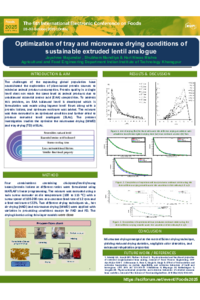
A formulation was made using legume lentil flours along with a protein isolate, and optimum moisture was added. The mixture was then extruded in an optimised condition and further dried to produce extruded lentil analogues (ELAs). The aim of this research is to optimise the microwave drying (MWD) and tray drying (TD) of ELAs. ELA tray drying was conducted at temperatures of 40°C, 50°C, and 60°C, utilizing air velocities of 1 m/s and 0.5 m/s. The MW dryer was utilized to dehydrate ELAs at different microwave power settings ranging from 70W to 200W. The drying rate (Rd) was depicted in relation to drying time (td) and moisture content (X) on a dry basis.
The results indicated an elevated drying constant correlated with an increase in drying temperature during TD. This was associated with enhanced heat intensity and expedited drying process. A swift reduction in drying rate (Rd) of ELAs wasrelative to drying time (td) under all drying conditions. The brief constant rate period in the drying process of ELA indicates that moisture removal took place continuously during the subsequent period of declining rate. TD data exhibited strong alignment with the Page and Henderson model as well as Fick's diffusion model, yielding R² values of 0.99, 0.96, and 0.98, respectively. TD exhibited a superior rehydration ratio.
In case of MWD, increasing microwave power resulted in a reduction of whiteness and yellowness values, while browning index values increased. Comparable trends were observed in hardness; R2 of Henderson, Page, and Pabis model exhibited values within the range of 0.98 to 0.99. Page's equation has been shown to serve as an effective model for accurately fitting drying data across both the drying processes.
Microwave drying emerged as the most efficient drying technique, yielding reduced drying duration, negligible color alteration, and enhanced rehydration properties.
Keywords
extrusion
tray drying
microwave drying
cooking charateristics
Poster
sciforum-135133.pdf
Development of Gluten-Free, Vegan, and Protein-Rich Bread Using Response Surface Methodology