Event submissions
Published
This submission belongs to the session F. Sustainable Food Security and Food Systems of the event The 6th International Electronic Conference on Foods
Published date
27 Oct, 2025
Academic Editor
'%3e%3cpath%20d='M12.6657%2010.9104C12.4185%2010.325%2012.0599%209.79327%2011.6097%209.34482C11.1609%208.89508%2010.6293%208.5365%2010.0442%208.28888C10.0389%208.28626%2010.0337%208.28495%2010.0285%208.28233C10.8446%207.69279%2011.3752%206.73249%2011.3752%205.64904C11.3752%203.8542%209.92103%202.39999%208.1262%202.39999C6.33136%202.39999%204.87715%203.8542%204.87715%205.64904C4.87715%206.73249%205.40774%207.69279%206.22393%208.28364C6.21869%208.28626%206.21345%208.28757%206.20821%208.29019C5.62129%208.5378%205.09463%208.89284%204.64265%209.34613C4.1929%209.79493%203.83432%2010.3266%203.58671%2010.9117C3.34345%2011.4845%203.21226%2012.0987%203.20023%2012.7209C3.19988%2012.7349%203.20233%2012.7488%203.20744%2012.7619C3.21255%2012.7749%203.22022%2012.7867%203.22998%2012.7968C3.23975%2012.8068%203.25142%2012.8147%203.26431%2012.8202C3.2772%2012.8256%203.29105%2012.8284%203.30504%2012.8284H4.09109C4.14874%2012.8284%204.19459%2012.7825%204.1959%2012.7262C4.2221%2011.7148%204.62823%2010.7676%205.34617%2010.0497C6.08899%209.30683%207.0755%208.89808%208.1262%208.89808C9.17689%208.89808%2010.1634%209.30683%2010.9062%2010.0497C11.6242%2010.7676%2012.0303%2011.7148%2012.0565%2012.7262C12.0578%2012.7838%2012.1037%2012.8284%2012.1613%2012.8284H12.9474C12.9613%2012.8284%2012.9752%2012.8256%2012.9881%2012.8202C13.001%2012.8147%2013.0126%2012.8068%2013.0224%2012.7968C13.0322%2012.7867%2013.0398%2012.7749%2013.0449%2012.7619C13.0501%2012.7488%2013.0525%2012.7349%2013.0522%2012.7209C13.0391%2012.0947%2012.9094%2011.4855%2012.6657%2010.9104ZM8.1262%207.9024C7.52486%207.9024%206.9589%207.6679%206.53312%207.24211C6.10733%206.81633%205.87283%206.25037%205.87283%205.64904C5.87283%205.0477%206.10733%204.48174%206.53312%204.05596C6.9589%203.63018%207.52486%203.39567%208.1262%203.39567C8.72753%203.39567%209.29349%203.63018%209.71927%204.05596C10.1451%204.48174%2010.3796%205.0477%2010.3796%205.64904C10.3796%206.25037%2010.1451%206.81633%209.71927%207.24211C9.29349%207.6679%208.72753%207.9024%208.1262%207.9024Z'%20fill='%235D1EE1'/%3e%3c/g%3e%3c/svg%3e) Theodoros Varzakas
Theodoros VarzakasCitation
Gamze Özçakır, Adsorption of natural pigments of mushroom wastes using a heavy metal—nickel, in Proceedings of The 6th International Electronic Conference on Foods, 28 October–30 October 2025, MDPI: Basel, Switzerland
Share
Email
Facebook
Twitter
LinkedIn
Adsorption of natural pigments of mushroom wastes using a heavy metal—nickel
'%3e%3cpath%20d='M12.6647%2010.9104C12.4176%2010.325%2012.0589%209.7933%2011.6088%209.34485C11.16%208.89511%2010.6283%208.53653%2010.0432%208.28891C10.038%208.28629%2010.0327%208.28498%2010.0275%208.28236C10.8437%207.69282%2011.3743%206.73252%2011.3743%205.64907C11.3743%203.85423%209.92005%202.40002%208.12522%202.40002C6.33038%202.40002%204.87618%203.85423%204.87618%205.64907C4.87618%206.73252%205.40677%207.69282%206.22296%208.28367C6.21772%208.28629%206.21248%208.2876%206.20724%208.29022C5.62031%208.53783%205.09365%208.89287%204.64167%209.34616C4.19192%209.79496%203.83334%2010.3266%203.58573%2010.9117C3.34247%2011.4846%203.21128%2012.0987%203.19925%2012.721C3.1989%2012.735%203.20135%2012.7489%203.20646%2012.7619C3.21157%2012.7749%203.21924%2012.7868%203.22901%2012.7968C3.23877%2012.8068%203.25045%2012.8148%203.26334%2012.8202C3.27623%2012.8256%203.29007%2012.8284%203.30406%2012.8284H4.09012C4.14776%2012.8284%204.19362%2012.7825%204.19493%2012.7262C4.22113%2011.7148%204.62726%2010.7676%205.34519%2010.0497C6.08802%209.30686%207.07452%208.89811%208.12522%208.89811C9.17592%208.89811%2010.1624%209.30686%2010.9052%2010.0497C11.6232%2010.7676%2012.0293%2011.7148%2012.0555%2012.7262C12.0568%2012.7839%2012.1027%2012.8284%2012.1603%2012.8284H12.9464C12.9604%2012.8284%2012.9742%2012.8256%2012.9871%2012.8202C13%2012.8148%2013.0117%2012.8068%2013.0214%2012.7968C13.0312%2012.7868%2013.0389%2012.7749%2013.044%2012.7619C13.0491%2012.7489%2013.0515%2012.735%2013.0512%2012.721C13.0381%2012.0947%2012.9084%2011.4856%2012.6647%2010.9104ZM8.12522%207.90243C7.52388%207.90243%206.95792%207.66793%206.53214%207.24215C6.10636%206.81636%205.87185%206.2504%205.87185%205.64907C5.87185%205.04773%206.10636%204.48177%206.53214%204.05599C6.95792%203.63021%207.52388%203.3957%208.12522%203.3957C8.72655%203.3957%209.29252%203.63021%209.7183%204.05599C10.1441%204.48177%2010.3786%205.04773%2010.3786%205.64907C10.3786%206.2504%2010.1441%206.81636%209.7183%207.24215C9.29252%207.66793%208.72655%207.90243%208.12522%207.90243Z'%20fill='%235D1EE1'/%3e%3c/g%3e%3c/svg%3e)
Gamze Özçakır 1
1. Department of Chemical Engineering, Faculty of Engineering, Bilecik Seyh Edebali University, TR 11100, Bilecik, Turkey
Abstract
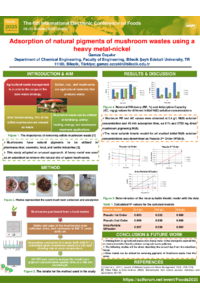
Edible mushroom wastes can be utilized in animal feed, fertilizer, wastewater treatment, and renewable energy, such as bioethanol and biohydrogen [1]. In addition, mushrooms naturally have pigments, and adsorption of these pigments can allow them to be effectively used in the pharmaceutical, cosmetic, food, and textile industries [2]. Nickel, as one of the most studied heavy metals, has been utilized for water cleaning in the literature [3, 4]. Hence, this study aimed to collect these pigments from edible mushroom wastes (stalk and cap) via adsorption. For this purpose, the wastes were first dried at 100 °C. Then, they were processed in a muffle furnace in stable air at 800°C for 1 hour. Then, adsorption was conducted in Ni(II) solutions (0.4-0.8 g/L) with 0.1 g dried mushroom waste at a 200 rpm shaking rate and at room temperature. Another sample was prepared that included only dried mushrooms and water and was subjected to the same adsorption process to observe the effect of nickel on natural pigment removal. At 45 minutes of adsorption, the sample concentrations were recorded as initial levels (t=0 min). Then, concentrations over time were noted (t=10, 20, 45 min). A UV-vis spectrophotometer was used to obtain absorbance values at a 400 nm wavelength. Based on these values, removal efficiency (RE, %) and adsorption capacity (AC, mg/g) were calculated. In addition, the most appropriate kinetic model was determined from the experimental values. Maximum RE and AC values were obtained at a 0.4 g/L Ni(II) solution concentration and a 45 min adsorption time, equaling 61% and 3783 mg dried mushroom pigment/g Ni(II). Furthermore, the most suitable kinetic model for all the studied Ni(II) solution concentrations was determined to be pseudo-second-order (R2≥0.9).
[1] Umor et al. (2021). Journal of Material Cycles and Waste Management, 23(5), 1726-1736.
[2] Téllez & Díaz (2022). Biomolecules from natural sources: Advances and applications, 82-100.
[3] Badshah et al. (2024). Desalination and Water Treatment, 317, 100067.
[4] Jabbari et al. (2025). Talanta, 288, 127702.
Keywords
Muschroom
kitchen waste
waste management
adsorption
environmental remediation
nickel
Poster
FOODS 2025 poster_Ozcakir.pdf
The Baobab Tree Conservation Crisis and Sustainability Potential in Madhya Pradesh, India: A Case for Food Security, Biodiversity, and Community Livelihoods
Valorization of Dairy Whey in Black Wheat Idli: A Functional Food Approach to Enhance Health Markers in Albino Rats