Event submissions
Published
This submission belongs to the session F. Sustainable Food Security and Food Systems of the event The 6th International Electronic Conference on Foods
Published date
27 Oct, 2025
Academic Editor
'%3e%3cpath%20d='M12.6657%2010.9104C12.4185%2010.325%2012.0599%209.79327%2011.6097%209.34482C11.1609%208.89508%2010.6293%208.5365%2010.0442%208.28888C10.0389%208.28626%2010.0337%208.28495%2010.0285%208.28233C10.8446%207.69279%2011.3752%206.73249%2011.3752%205.64904C11.3752%203.8542%209.92103%202.39999%208.1262%202.39999C6.33136%202.39999%204.87715%203.8542%204.87715%205.64904C4.87715%206.73249%205.40774%207.69279%206.22393%208.28364C6.21869%208.28626%206.21345%208.28757%206.20821%208.29019C5.62129%208.5378%205.09463%208.89284%204.64265%209.34613C4.1929%209.79493%203.83432%2010.3266%203.58671%2010.9117C3.34345%2011.4845%203.21226%2012.0987%203.20023%2012.7209C3.19988%2012.7349%203.20233%2012.7488%203.20744%2012.7619C3.21255%2012.7749%203.22022%2012.7867%203.22998%2012.7968C3.23975%2012.8068%203.25142%2012.8147%203.26431%2012.8202C3.2772%2012.8256%203.29105%2012.8284%203.30504%2012.8284H4.09109C4.14874%2012.8284%204.19459%2012.7825%204.1959%2012.7262C4.2221%2011.7148%204.62823%2010.7676%205.34617%2010.0497C6.08899%209.30683%207.0755%208.89808%208.1262%208.89808C9.17689%208.89808%2010.1634%209.30683%2010.9062%2010.0497C11.6242%2010.7676%2012.0303%2011.7148%2012.0565%2012.7262C12.0578%2012.7838%2012.1037%2012.8284%2012.1613%2012.8284H12.9474C12.9613%2012.8284%2012.9752%2012.8256%2012.9881%2012.8202C13.001%2012.8147%2013.0126%2012.8068%2013.0224%2012.7968C13.0322%2012.7867%2013.0398%2012.7749%2013.0449%2012.7619C13.0501%2012.7488%2013.0525%2012.7349%2013.0522%2012.7209C13.0391%2012.0947%2012.9094%2011.4855%2012.6657%2010.9104ZM8.1262%207.9024C7.52486%207.9024%206.9589%207.6679%206.53312%207.24211C6.10733%206.81633%205.87283%206.25037%205.87283%205.64904C5.87283%205.0477%206.10733%204.48174%206.53312%204.05596C6.9589%203.63018%207.52486%203.39567%208.1262%203.39567C8.72753%203.39567%209.29349%203.63018%209.71927%204.05596C10.1451%204.48174%2010.3796%205.0477%2010.3796%205.64904C10.3796%206.25037%2010.1451%206.81633%209.71927%207.24211C9.29349%207.6679%208.72753%207.9024%208.1262%207.9024Z'%20fill='%235D1EE1'/%3e%3c/g%3e%3c/svg%3e) Víctor Manuel Pérez Puyana
Víctor Manuel Pérez PuyanaCitation
Ejigayehu Teshome, Yetenayet Bekele Tola, Habtamu Admassu, Tilahun Abera Teka, Evaluation and Optimization of Extraction Conditions for Protein Isolates from Underutilized Ethiopian Lupinus spp.: Chemical Characterization and Yield Assessment, in Proceedings of The 6th International Electronic Conference on Foods, 28 October–30 October 2025, MDPI: Basel, Switzerland
Share
Email
Facebook
Twitter
LinkedIn
Evaluation and Optimization of Extraction Conditions for Protein Isolates from Underutilized Ethiopian Lupinus spp.: Chemical Characterization and Yield Assessment
'%3e%3cpath%20d='M12.6647%2010.9104C12.4176%2010.325%2012.0589%209.7933%2011.6088%209.34485C11.16%208.89511%2010.6283%208.53653%2010.0432%208.28891C10.038%208.28629%2010.0327%208.28498%2010.0275%208.28236C10.8437%207.69282%2011.3743%206.73252%2011.3743%205.64907C11.3743%203.85423%209.92005%202.40002%208.12522%202.40002C6.33038%202.40002%204.87618%203.85423%204.87618%205.64907C4.87618%206.73252%205.40677%207.69282%206.22296%208.28367C6.21772%208.28629%206.21248%208.2876%206.20724%208.29022C5.62031%208.53783%205.09365%208.89287%204.64167%209.34616C4.19192%209.79496%203.83334%2010.3266%203.58573%2010.9117C3.34247%2011.4846%203.21128%2012.0987%203.19925%2012.721C3.1989%2012.735%203.20135%2012.7489%203.20646%2012.7619C3.21157%2012.7749%203.21924%2012.7868%203.22901%2012.7968C3.23877%2012.8068%203.25045%2012.8148%203.26334%2012.8202C3.27623%2012.8256%203.29007%2012.8284%203.30406%2012.8284H4.09012C4.14776%2012.8284%204.19362%2012.7825%204.19493%2012.7262C4.22113%2011.7148%204.62726%2010.7676%205.34519%2010.0497C6.08802%209.30686%207.07452%208.89811%208.12522%208.89811C9.17592%208.89811%2010.1624%209.30686%2010.9052%2010.0497C11.6232%2010.7676%2012.0293%2011.7148%2012.0555%2012.7262C12.0568%2012.7839%2012.1027%2012.8284%2012.1603%2012.8284H12.9464C12.9604%2012.8284%2012.9742%2012.8256%2012.9871%2012.8202C13%2012.8148%2013.0117%2012.8068%2013.0214%2012.7968C13.0312%2012.7868%2013.0389%2012.7749%2013.044%2012.7619C13.0491%2012.7489%2013.0515%2012.735%2013.0512%2012.721C13.0381%2012.0947%2012.9084%2011.4856%2012.6647%2010.9104ZM8.12522%207.90243C7.52388%207.90243%206.95792%207.66793%206.53214%207.24215C6.10636%206.81636%205.87185%206.2504%205.87185%205.64907C5.87185%205.04773%206.10636%204.48177%206.53214%204.05599C6.95792%203.63021%207.52388%203.3957%208.12522%203.3957C8.72655%203.3957%209.29252%203.63021%209.7183%204.05599C10.1441%204.48177%2010.3786%205.04773%2010.3786%205.64907C10.3786%206.2504%2010.1441%206.81636%209.7183%207.24215C9.29252%207.66793%208.72655%207.90243%208.12522%207.90243Z'%20fill='%235D1EE1'/%3e%3c/g%3e%3c/svg%3e)
Ejigayehu Teshome 1,2
Yetenayet Bekele Tola 1
Habtamu Admassu 3,4
Tilahun Abera Teka 1
1. Department of Post-Harvest Management, College of Agriculture and Veterinary Medicine, Jimma University, P.O Box: 307, Jimma, Ethiopia
2. Department of Food Science and Postharvest Technology, College of Agricultural Sciences, Wachemo University, P.O Box: 667; Hosanna, Ethiopia
3. Department of Chemical Engineering, College of Engineering, Addis Ababa Science & Technology University, P.O Box: 16417; Addis Ababa, Ethiopia
4. Biotechnology and Bioprocess Centre of Excellence, Addis Ababa Science & Technology University, P.O Box: 16417; Addis Ababa, Ethiopia
Abstract
The rapidly growing global population and the socioeconomic shifts increased the demand for plant proteins. Notably, lupine is an underutilized legume crop that is nutritious and recognized for its high crude protein (CP). Therefore, this study was conducted to optimize the pH of protein isolate extraction (EpH) and isoelectric precipitation (IEPpH) in lupine genotypes using a central composite design (CCD). The results indicate significant variations in the chemical composition of lupine genotypes, including moisture content (6.01–7.97 g/100 g), CP (39.9–46.1 g/100 g), ether extract (6.26–13.3 g/100 g), essential amino acid index (EAAI) (62.61–70.7%), and total alkaloid (TA) (1.76–11.1%). Vitabor exhibited its maximum protein isolate purity (PIP) of 92.1% at an EpH of 8.5 and an IEPpH of 4.5. Vitabor achieved a superior protein isolate yield (PIY) of 29.0%, while the local maximum recovery (PIR) was 57.5%. All genotypes show the lowest TA at an EpH of 10 and an IEPpH of 5. The optimized extraction conditions for achieving high yield and desirable chemical compositions were as follows: EpH and IEPpH values of (10, 5) for the local, (9.86, 4.66) for Vitabor, (10, 4.69) for Sanabor, and (9.58, 4.64) for Probor. Under optimized conditions, Vitabor can serve as a sustainable source of protein isolate for low-income countries, offering high CP, EAAI, PIP, PIY, PIR, and the safest limit of TA. Meanwhile, the local and Probor are suitable for food formulations and therapeutics. Further work on the characterization of techno-functional and molecular properties is required.
Keywords
Lupinus albus
Lupinus angustifolius
optimization
protein isolate
protein quality
yield
Poster
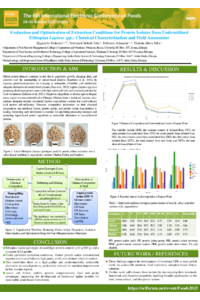
Ejigayehu T. MDPI Foods,2025 Poster.pdf
Development and Evaluation of a New Functional Biscuit: A Hypoallergenic and Bioactive Alternative to Conventional Formulas
Two-step green extraction (SFE-CO₂ + ASE) produces low-contaminant extracts from olive mill wastewater sludge for functional applications