Event submissions
Published
This submission belongs to the session F. Sustainable Food Security and Food Systems of the event The 6th International Electronic Conference on Foods
Published date
27 Oct, 2025
Academic Editor
'%3e%3cpath%20d='M12.6657%2010.9104C12.4185%2010.325%2012.0599%209.79327%2011.6097%209.34482C11.1609%208.89508%2010.6293%208.5365%2010.0442%208.28888C10.0389%208.28626%2010.0337%208.28495%2010.0285%208.28233C10.8446%207.69279%2011.3752%206.73249%2011.3752%205.64904C11.3752%203.8542%209.92103%202.39999%208.1262%202.39999C6.33136%202.39999%204.87715%203.8542%204.87715%205.64904C4.87715%206.73249%205.40774%207.69279%206.22393%208.28364C6.21869%208.28626%206.21345%208.28757%206.20821%208.29019C5.62129%208.5378%205.09463%208.89284%204.64265%209.34613C4.1929%209.79493%203.83432%2010.3266%203.58671%2010.9117C3.34345%2011.4845%203.21226%2012.0987%203.20023%2012.7209C3.19988%2012.7349%203.20233%2012.7488%203.20744%2012.7619C3.21255%2012.7749%203.22022%2012.7867%203.22998%2012.7968C3.23975%2012.8068%203.25142%2012.8147%203.26431%2012.8202C3.2772%2012.8256%203.29105%2012.8284%203.30504%2012.8284H4.09109C4.14874%2012.8284%204.19459%2012.7825%204.1959%2012.7262C4.2221%2011.7148%204.62823%2010.7676%205.34617%2010.0497C6.08899%209.30683%207.0755%208.89808%208.1262%208.89808C9.17689%208.89808%2010.1634%209.30683%2010.9062%2010.0497C11.6242%2010.7676%2012.0303%2011.7148%2012.0565%2012.7262C12.0578%2012.7838%2012.1037%2012.8284%2012.1613%2012.8284H12.9474C12.9613%2012.8284%2012.9752%2012.8256%2012.9881%2012.8202C13.001%2012.8147%2013.0126%2012.8068%2013.0224%2012.7968C13.0322%2012.7867%2013.0398%2012.7749%2013.0449%2012.7619C13.0501%2012.7488%2013.0525%2012.7349%2013.0522%2012.7209C13.0391%2012.0947%2012.9094%2011.4855%2012.6657%2010.9104ZM8.1262%207.9024C7.52486%207.9024%206.9589%207.6679%206.53312%207.24211C6.10733%206.81633%205.87283%206.25037%205.87283%205.64904C5.87283%205.0477%206.10733%204.48174%206.53312%204.05596C6.9589%203.63018%207.52486%203.39567%208.1262%203.39567C8.72753%203.39567%209.29349%203.63018%209.71927%204.05596C10.1451%204.48174%2010.3796%205.0477%2010.3796%205.64904C10.3796%206.25037%2010.1451%206.81633%209.71927%207.24211C9.29349%207.6679%208.72753%207.9024%208.1262%207.9024Z'%20fill='%235D1EE1'/%3e%3c/g%3e%3c/svg%3e) Víctor Manuel Pérez Puyana
Víctor Manuel Pérez PuyanaCitation
Sergio Martínez-Terol, Noelia Pallarés, Pedro V Martínez-Culebras, Emilia Ferrer, Francisco J Martí-Quijal, Francisco J Barba, Two-step green extraction (SFE-CO₂ + ASE) produces low-contaminant extracts from olive mill wastewater sludge for functional applications, in Proceedings of The 6th International Electronic Conference on Foods, 28 October–30 October 2025, MDPI: Basel, Switzerland
Share
Email
Facebook
Twitter
LinkedIn
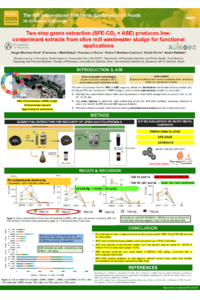
Two-step green extraction (SFE-CO₂ + ASE) produces low-contaminant extracts from olive mill wastewater sludge for functional applications

Sergio Martínez-Terol 1
'%3e%3cpath%20d='M12.6647%2010.9104C12.4176%2010.325%2012.0589%209.7933%2011.6088%209.34485C11.16%208.89511%2010.6283%208.53653%2010.0432%208.28891C10.038%208.28629%2010.0327%208.28498%2010.0275%208.28236C10.8437%207.69282%2011.3743%206.73252%2011.3743%205.64907C11.3743%203.85423%209.92005%202.40002%208.12522%202.40002C6.33038%202.40002%204.87618%203.85423%204.87618%205.64907C4.87618%206.73252%205.40677%207.69282%206.22296%208.28367C6.21772%208.28629%206.21248%208.2876%206.20724%208.29022C5.62031%208.53783%205.09365%208.89287%204.64167%209.34616C4.19192%209.79496%203.83334%2010.3266%203.58573%2010.9117C3.34247%2011.4846%203.21128%2012.0987%203.19925%2012.721C3.1989%2012.735%203.20135%2012.7489%203.20646%2012.7619C3.21157%2012.7749%203.21924%2012.7868%203.22901%2012.7968C3.23877%2012.8068%203.25045%2012.8148%203.26334%2012.8202C3.27623%2012.8256%203.29007%2012.8284%203.30406%2012.8284H4.09012C4.14776%2012.8284%204.19362%2012.7825%204.19493%2012.7262C4.22113%2011.7148%204.62726%2010.7676%205.34519%2010.0497C6.08802%209.30686%207.07452%208.89811%208.12522%208.89811C9.17592%208.89811%2010.1624%209.30686%2010.9052%2010.0497C11.6232%2010.7676%2012.0293%2011.7148%2012.0555%2012.7262C12.0568%2012.7839%2012.1027%2012.8284%2012.1603%2012.8284H12.9464C12.9604%2012.8284%2012.9742%2012.8256%2012.9871%2012.8202C13%2012.8148%2013.0117%2012.8068%2013.0214%2012.7968C13.0312%2012.7868%2013.0389%2012.7749%2013.044%2012.7619C13.0491%2012.7489%2013.0515%2012.735%2013.0512%2012.721C13.0381%2012.0947%2012.9084%2011.4856%2012.6647%2010.9104ZM8.12522%207.90243C7.52388%207.90243%206.95792%207.66793%206.53214%207.24215C6.10636%206.81636%205.87185%206.2504%205.87185%205.64907C5.87185%205.04773%206.10636%204.48177%206.53214%204.05599C6.95792%203.63021%207.52388%203.3957%208.12522%203.3957C8.72655%203.3957%209.29252%203.63021%209.7183%204.05599C10.1441%204.48177%2010.3786%205.04773%2010.3786%205.64907C10.3786%206.2504%2010.1441%206.81636%209.7183%207.24215C9.29252%207.66793%208.72655%207.90243%208.12522%207.90243Z'%20fill='%235D1EE1'/%3e%3c/g%3e%3c/svg%3e)
Noelia Pallarés 1
Pedro V Martínez-Culebras 1
Emilia Ferrer 1
Francisco J Martí-Quijal 1

Francisco J Barba 1
1. Department of Preventive Medicine and Public Health, Food Science, Toxicology and Forensic Medicine, Faculty of Pharmacy and Food Science, Universitat de València, Valencia 46010, Spain
Abstract
Sequential supercritical CO₂ extraction (SFE) followed by accelerated solvent extraction (ASE) was applied to six batches of olive mill wastewater (OMW) sludge (TED 13, 14, 15, 16, 20, and 22) to obtain contaminant-safe extracts. Fresh sludge, the residual SFE cakes, and the resulting oil (SFE) and aqueous (ASE) extracts were analysed for heavy metals (As, Cd, Hg, Pb) and mycotoxins. Heavy metal levels showed high variability among samples. More than 95% of the initial heavy metal content remained in the SFE cakes. The SFE oils contained between 13 and 95 µg/kg of As, 0.07 and 6.1 µg/kg of Cd, 0.10 and 4.1 µg/kg of Hg, and 4.4 and 12.2 µg/kg of Pb. Concentrations in the ASE extracts ranged from 13 to 108 µg/kg for As, 0.4 to 1.0 µg/kg for Cd, 0.10 to 5.6 µg/kg for Hg, and 4.6 to 27.3 µg/kg for Pb. Enniatins were the only mycotoxins detected. In fresh sludge, their concentrations ranged from less than 0.15 mg/kg in TED 16 to more than 1.6 mg/kg in TED 13 and TED 14. In SFE oils, levels ranged from 0.12 to 32 µg/kg, with recovery efficiencies of 75–95 % when the matrix moisture content was equal to or below 13 %, but falling below 10 % when moisture exceeded 45 %. In ASE extracts, only ENN A1 was detected, with values around 16 µg/kg in TED 14, TED 20, and TED 22. Overall, the combined SFE + ASE process produces oil and aqueous extracts whose heavy metal and enniatin concentrations remain below current food safety limits, supporting the green valorisation of olive mill sludge as a functional ingredient within a circular bioeconomy.
Keywords
olive mill wastewater (OMW)
supercritical extraction (SFE)
accelerated solvent extraction (ASE)
heavy metals
enniatins
Poster
Póster S. Martínez-Terol.pdf
Evaluation and Optimization of Extraction Conditions for Protein Isolates from Underutilized Ethiopian Lupinus spp.: Chemical Characterization and Yield Assessment
BIOTECHNOLOGICAL POTENTIAL OF APPLE POMACE AS A SOURCE OF PECTIN FOR FORMULATING FUNCTIONAL JUICES