Event submissions
Published
This submission belongs to the session D. Food Microbiology of the event The 6th International Electronic Conference on Foods
Published date
27 Oct, 2025
Academic Editor
'%3e%3cpath%20d='M12.6657%2010.9104C12.4185%2010.325%2012.0599%209.79327%2011.6097%209.34482C11.1609%208.89508%2010.6293%208.5365%2010.0442%208.28888C10.0389%208.28626%2010.0337%208.28495%2010.0285%208.28233C10.8446%207.69279%2011.3752%206.73249%2011.3752%205.64904C11.3752%203.8542%209.92103%202.39999%208.1262%202.39999C6.33136%202.39999%204.87715%203.8542%204.87715%205.64904C4.87715%206.73249%205.40774%207.69279%206.22393%208.28364C6.21869%208.28626%206.21345%208.28757%206.20821%208.29019C5.62129%208.5378%205.09463%208.89284%204.64265%209.34613C4.1929%209.79493%203.83432%2010.3266%203.58671%2010.9117C3.34345%2011.4845%203.21226%2012.0987%203.20023%2012.7209C3.19988%2012.7349%203.20233%2012.7488%203.20744%2012.7619C3.21255%2012.7749%203.22022%2012.7867%203.22998%2012.7968C3.23975%2012.8068%203.25142%2012.8147%203.26431%2012.8202C3.2772%2012.8256%203.29105%2012.8284%203.30504%2012.8284H4.09109C4.14874%2012.8284%204.19459%2012.7825%204.1959%2012.7262C4.2221%2011.7148%204.62823%2010.7676%205.34617%2010.0497C6.08899%209.30683%207.0755%208.89808%208.1262%208.89808C9.17689%208.89808%2010.1634%209.30683%2010.9062%2010.0497C11.6242%2010.7676%2012.0303%2011.7148%2012.0565%2012.7262C12.0578%2012.7838%2012.1037%2012.8284%2012.1613%2012.8284H12.9474C12.9613%2012.8284%2012.9752%2012.8256%2012.9881%2012.8202C13.001%2012.8147%2013.0126%2012.8068%2013.0224%2012.7968C13.0322%2012.7867%2013.0398%2012.7749%2013.0449%2012.7619C13.0501%2012.7488%2013.0525%2012.7349%2013.0522%2012.7209C13.0391%2012.0947%2012.9094%2011.4855%2012.6657%2010.9104ZM8.1262%207.9024C7.52486%207.9024%206.9589%207.6679%206.53312%207.24211C6.10733%206.81633%205.87283%206.25037%205.87283%205.64904C5.87283%205.0477%206.10733%204.48174%206.53312%204.05596C6.9589%203.63018%207.52486%203.39567%208.1262%203.39567C8.72753%203.39567%209.29349%203.63018%209.71927%204.05596C10.1451%204.48174%2010.3796%205.0477%2010.3796%205.64904C10.3796%206.25037%2010.1451%206.81633%209.71927%207.24211C9.29349%207.6679%208.72753%207.9024%208.1262%207.9024Z'%20fill='%235D1EE1'/%3e%3c/g%3e%3c/svg%3e) Efstathios Giaouris
Efstathios GiaourisCitation
Kham Bahadur Khatri, Praveen Kosuri, Eswari Kanike, Anjana Thankachan, Mary Anne Amalaradjou, Integrating Aerated Water and Peracetic Acid for Effective Salmonella Control on Hatching Eggs , in Proceedings of The 6th International Electronic Conference on Foods, 28 October–30 October 2025, MDPI: Basel, Switzerland
Share
Email
Facebook
Twitter
LinkedIn
Integrating Aerated Water and Peracetic Acid for Effective Salmonella Control on Hatching Eggs
'%3e%3cpath%20d='M12.6647%2010.9104C12.4176%2010.325%2012.0589%209.7933%2011.6088%209.34485C11.16%208.89511%2010.6283%208.53653%2010.0432%208.28891C10.038%208.28629%2010.0327%208.28498%2010.0275%208.28236C10.8437%207.69282%2011.3743%206.73252%2011.3743%205.64907C11.3743%203.85423%209.92005%202.40002%208.12522%202.40002C6.33038%202.40002%204.87618%203.85423%204.87618%205.64907C4.87618%206.73252%205.40677%207.69282%206.22296%208.28367C6.21772%208.28629%206.21248%208.2876%206.20724%208.29022C5.62031%208.53783%205.09365%208.89287%204.64167%209.34616C4.19192%209.79496%203.83334%2010.3266%203.58573%2010.9117C3.34247%2011.4846%203.21128%2012.0987%203.19925%2012.721C3.1989%2012.735%203.20135%2012.7489%203.20646%2012.7619C3.21157%2012.7749%203.21924%2012.7868%203.22901%2012.7968C3.23877%2012.8068%203.25045%2012.8148%203.26334%2012.8202C3.27623%2012.8256%203.29007%2012.8284%203.30406%2012.8284H4.09012C4.14776%2012.8284%204.19362%2012.7825%204.19493%2012.7262C4.22113%2011.7148%204.62726%2010.7676%205.34519%2010.0497C6.08802%209.30686%207.07452%208.89811%208.12522%208.89811C9.17592%208.89811%2010.1624%209.30686%2010.9052%2010.0497C11.6232%2010.7676%2012.0293%2011.7148%2012.0555%2012.7262C12.0568%2012.7839%2012.1027%2012.8284%2012.1603%2012.8284H12.9464C12.9604%2012.8284%2012.9742%2012.8256%2012.9871%2012.8202C13%2012.8148%2013.0117%2012.8068%2013.0214%2012.7968C13.0312%2012.7868%2013.0389%2012.7749%2013.044%2012.7619C13.0491%2012.7489%2013.0515%2012.735%2013.0512%2012.721C13.0381%2012.0947%2012.9084%2011.4856%2012.6647%2010.9104ZM8.12522%207.90243C7.52388%207.90243%206.95792%207.66793%206.53214%207.24215C6.10636%206.81636%205.87185%206.2504%205.87185%205.64907C5.87185%205.04773%206.10636%204.48177%206.53214%204.05599C6.95792%203.63021%207.52388%203.3957%208.12522%203.3957C8.72655%203.3957%209.29252%203.63021%209.7183%204.05599C10.1441%204.48177%2010.3786%205.04773%2010.3786%205.64907C10.3786%206.2504%2010.1441%206.81636%209.7183%207.24215C9.29252%207.66793%208.72655%207.90243%208.12522%207.90243Z'%20fill='%235D1EE1'/%3e%3c/g%3e%3c/svg%3e)
Kham Bahadur Khatri 1
Praveen Kosuri 1
Eswari Kanike 1
Anjana Thankachan 1

Mary Anne Amalaradjou 1
1. Department of Animal Science, University of Connecticut, 17 Manter Road, Storrs, CT, 06269-4040, USA
Abstract
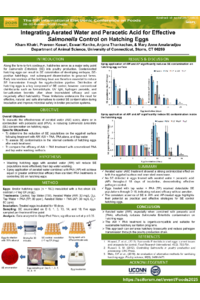
Introduction: Along the farm-to-fork continuum, hatcheries represent a critical control point for the entry of Salmonella Enteritidis (SE) into poultry production. Contaminated hatching eggs can lead to SE colonization of developing embryos, SE-positive hatchlings, and subsequent dissemination to grow-out farms. Therefore, early-stage interventions to reduce SE contamination are essential to minimize transmission through the egg-to-chicken pipeline. This study evaluated novel application of aerated water (AW) as a potential, user-friendly, and natural antimicrobial intervention to reduce SE contamination on broiler hatching eggs.
Methods: Broiler hatching eggs (n=150) were inoculated with a four-strain cocktail of SE (~7 log CFU/egg) and subjected to one of five spray treatments: untreated control, tap water (TW), aerated water (AW; 30 mg/L), tap water + peracetic acid (TP; 80 ppm PAA), and aerated water plus peracetic acid (AP). Eggs were incubated for 18 days, with the SE population enumerated post treatment (day 0) and on days 1, 3, 10, 14, and 18. Five eggs per treatment group were sampled at each time point. Data were analyzed using GraphPad, with significance set at p≤0.05.
Results: Our data demonstrated a clear antimicrobial benefit of AW and AP treatments. AW reduced SE by >1.5 log CFU immediately after treatment (day 0), with no detectable SE recovered at subsequent time points, whereas no SE were recovered in the AP-treated eggs throughout the 18-day incubation period. In contrast, eggs treated with TP maintained a detectable population through day 18, indicating reduced efficacy when PAA was applied without aeration. TW treatment had minimal effect on SE levels, comparable to untreated controls. The sustained reduction in or absence of SE on AW- and AP-treated eggs underscores their effectiveness in disrupting SE persistence during incubation.
Conclusion: Aerated water when combined with PAA, is a highly effective, organic-friendly intervention for reducing Salmonella contamination on hatching eggs. This approach can enhance hatchery biosecurity and significantly limit pathogen transmission within the poultry production chain.
Keywords
Salmonella Enteritidis
Aerated water
PAA
spray application
hatching eggs
decontamination
Poster
Food conference poster_Kham.pdf
BIOTECHNOLOGICAL POTENTIAL OF APPLE POMACE AS A SOURCE OF PECTIN FOR FORMULATING FUNCTIONAL JUICES
Genomic Surveillance of Listeria monocytogenes in Argentina: Analysis of Cases and Isolates, 2023-2024