Event submissions
Published
This submission belongs to the session D. Food Microbiology of the event The 6th International Electronic Conference on Foods
Published date
27 Oct, 2025
Academic Editor
'%3e%3cpath%20d='M12.6657%2010.9104C12.4185%2010.325%2012.0599%209.79327%2011.6097%209.34482C11.1609%208.89508%2010.6293%208.5365%2010.0442%208.28888C10.0389%208.28626%2010.0337%208.28495%2010.0285%208.28233C10.8446%207.69279%2011.3752%206.73249%2011.3752%205.64904C11.3752%203.8542%209.92103%202.39999%208.1262%202.39999C6.33136%202.39999%204.87715%203.8542%204.87715%205.64904C4.87715%206.73249%205.40774%207.69279%206.22393%208.28364C6.21869%208.28626%206.21345%208.28757%206.20821%208.29019C5.62129%208.5378%205.09463%208.89284%204.64265%209.34613C4.1929%209.79493%203.83432%2010.3266%203.58671%2010.9117C3.34345%2011.4845%203.21226%2012.0987%203.20023%2012.7209C3.19988%2012.7349%203.20233%2012.7488%203.20744%2012.7619C3.21255%2012.7749%203.22022%2012.7867%203.22998%2012.7968C3.23975%2012.8068%203.25142%2012.8147%203.26431%2012.8202C3.2772%2012.8256%203.29105%2012.8284%203.30504%2012.8284H4.09109C4.14874%2012.8284%204.19459%2012.7825%204.1959%2012.7262C4.2221%2011.7148%204.62823%2010.7676%205.34617%2010.0497C6.08899%209.30683%207.0755%208.89808%208.1262%208.89808C9.17689%208.89808%2010.1634%209.30683%2010.9062%2010.0497C11.6242%2010.7676%2012.0303%2011.7148%2012.0565%2012.7262C12.0578%2012.7838%2012.1037%2012.8284%2012.1613%2012.8284H12.9474C12.9613%2012.8284%2012.9752%2012.8256%2012.9881%2012.8202C13.001%2012.8147%2013.0126%2012.8068%2013.0224%2012.7968C13.0322%2012.7867%2013.0398%2012.7749%2013.0449%2012.7619C13.0501%2012.7488%2013.0525%2012.7349%2013.0522%2012.7209C13.0391%2012.0947%2012.9094%2011.4855%2012.6657%2010.9104ZM8.1262%207.9024C7.52486%207.9024%206.9589%207.6679%206.53312%207.24211C6.10733%206.81633%205.87283%206.25037%205.87283%205.64904C5.87283%205.0477%206.10733%204.48174%206.53312%204.05596C6.9589%203.63018%207.52486%203.39567%208.1262%203.39567C8.72753%203.39567%209.29349%203.63018%209.71927%204.05596C10.1451%204.48174%2010.3796%205.0477%2010.3796%205.64904C10.3796%206.25037%2010.1451%206.81633%209.71927%207.24211C9.29349%207.6679%208.72753%207.9024%208.1262%207.9024Z'%20fill='%235D1EE1'/%3e%3c/g%3e%3c/svg%3e) Efstathios Giaouris
Efstathios GiaourisCitation
Ariel Gianecini, Lucila Cipolla, Tomás Poklepovich, Paula Etcheverry, Florencia Rocca, Mónica Prieto, Genomic Surveillance of Listeria monocytogenes in Argentina: Analysis of Cases and Isolates, 2023-2024, in Proceedings of The 6th International Electronic Conference on Foods, 28 October–30 October 2025, MDPI: Basel, Switzerland
Share
Email
Facebook
Twitter
LinkedIn
Genomic Surveillance of Listeria monocytogenes in Argentina: Analysis of Cases and Isolates, 2023-2024
'%3e%3cpath%20d='M12.6647%2010.9104C12.4176%2010.325%2012.0589%209.7933%2011.6088%209.34485C11.16%208.89511%2010.6283%208.53653%2010.0432%208.28891C10.038%208.28629%2010.0327%208.28498%2010.0275%208.28236C10.8437%207.69282%2011.3743%206.73252%2011.3743%205.64907C11.3743%203.85423%209.92005%202.40002%208.12522%202.40002C6.33038%202.40002%204.87618%203.85423%204.87618%205.64907C4.87618%206.73252%205.40677%207.69282%206.22296%208.28367C6.21772%208.28629%206.21248%208.2876%206.20724%208.29022C5.62031%208.53783%205.09365%208.89287%204.64167%209.34616C4.19192%209.79496%203.83334%2010.3266%203.58573%2010.9117C3.34247%2011.4846%203.21128%2012.0987%203.19925%2012.721C3.1989%2012.735%203.20135%2012.7489%203.20646%2012.7619C3.21157%2012.7749%203.21924%2012.7868%203.22901%2012.7968C3.23877%2012.8068%203.25045%2012.8148%203.26334%2012.8202C3.27623%2012.8256%203.29007%2012.8284%203.30406%2012.8284H4.09012C4.14776%2012.8284%204.19362%2012.7825%204.19493%2012.7262C4.22113%2011.7148%204.62726%2010.7676%205.34519%2010.0497C6.08802%209.30686%207.07452%208.89811%208.12522%208.89811C9.17592%208.89811%2010.1624%209.30686%2010.9052%2010.0497C11.6232%2010.7676%2012.0293%2011.7148%2012.0555%2012.7262C12.0568%2012.7839%2012.1027%2012.8284%2012.1603%2012.8284H12.9464C12.9604%2012.8284%2012.9742%2012.8256%2012.9871%2012.8202C13%2012.8148%2013.0117%2012.8068%2013.0214%2012.7968C13.0312%2012.7868%2013.0389%2012.7749%2013.044%2012.7619C13.0491%2012.7489%2013.0515%2012.735%2013.0512%2012.721C13.0381%2012.0947%2012.9084%2011.4856%2012.6647%2010.9104ZM8.12522%207.90243C7.52388%207.90243%206.95792%207.66793%206.53214%207.24215C6.10636%206.81636%205.87185%206.2504%205.87185%205.64907C5.87185%205.04773%206.10636%204.48177%206.53214%204.05599C6.95792%203.63021%207.52388%203.3957%208.12522%203.3957C8.72655%203.3957%209.29252%203.63021%209.7183%204.05599C10.1441%204.48177%2010.3786%205.04773%2010.3786%205.64907C10.3786%206.2504%2010.1441%206.81636%209.7183%207.24215C9.29252%207.66793%208.72655%207.90243%208.12522%207.90243Z'%20fill='%235D1EE1'/%3e%3c/g%3e%3c/svg%3e)
Ariel Gianecini 1
Lucila Cipolla 1
Tomás Poklepovich 1
Paula Etcheverry 1
Florencia Rocca 1
Mónica Prieto 1
1. Special Bacteriology Laboratory, Bacteriology Department, National Institute of Infectious Diseases, Ciudad Autónoma de Buenos Aires, C1282AFF, Argentina
Abstract
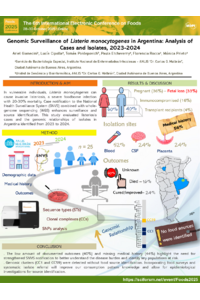
In vulnerable individuals, Listeria monocytogenes can cause invasive listeriosis, a severe foodborne infection with 20-30% mortality. Case notification to the National Health Surveillance System (SNVS) combined with whole-genome sequencing (WGS) enhances surveillance and source identification. This study evaluated listeriosis cases and the genomic relationships of isolates in Argentina identified from 2023 to 2024.
All twenty-five consecutive cases of listeriosis, a nationally notifiable disease, along with their corresponding isolates referred to the National Reference Laboratory between 2023 and 2024, were analyzed. The patients' demographic data, medical history, and outcomes were obtained from the SNVS. The sequence types (STs), clonal complexes (CCs), and relationships between the isolates were determined through WGS using the Nextera XT DNA library preparation kit and the Illumina MiSeq Platform.
Women comprised 60% of the cases and men comprisedd 40%. The patient's medical history was documented in 56% of cases, including whether they were pregnant (n=9), non-HIV-immunocompromised (n=4), or transplant recipients (n=1). Fetal loss occurred in 33.3% of pregnancies. The isolation sites included the blood (n=13), cerebrospinal fluid (n=6), and placenta (n=6). The outcomes were unknown in 60% of cases, while patients were cured/improved in 24% and died in 16%. Four genomic clusters were identified: three associated with hypervirulent CC1 (ST1) and one with CC59 (ST59). Two clusters, CC1 (n=5) and CC59 (n=3), were identified in three provinces. No food sources were identified.
The low amount of documented outcomes (40%) and missing medical history (44%) highlight the need for strengthened SNVS notification to better understand the disease burden and identify key populations at risk. Genomic clusters were detected without food source identification. Incorporating food surveys and systematic isolate referral will improve our consumption pattern knowledge and allow for epidemiological investigations for source identification.
Keywords
Listeriosis
WGS
Surveillance
Poster
gianecini_foods_congress_2025.pdf
Integrating Aerated Water and Peracetic Acid for Effective Salmonella Control on Hatching Eggs
Biopreservation and Control of Staphylococcus aureus in Traditional Goat's Cheese Using Essential Oil of Lavandula mairei