Event submissions
Published
This submission belongs to the session D. Food Microbiology of the event The 6th International Electronic Conference on Foods
Published date
27 Oct, 2025
Academic Editor
'%3e%3cpath%20d='M12.6657%2010.9104C12.4185%2010.325%2012.0599%209.79327%2011.6097%209.34482C11.1609%208.89508%2010.6293%208.5365%2010.0442%208.28888C10.0389%208.28626%2010.0337%208.28495%2010.0285%208.28233C10.8446%207.69279%2011.3752%206.73249%2011.3752%205.64904C11.3752%203.8542%209.92103%202.39999%208.1262%202.39999C6.33136%202.39999%204.87715%203.8542%204.87715%205.64904C4.87715%206.73249%205.40774%207.69279%206.22393%208.28364C6.21869%208.28626%206.21345%208.28757%206.20821%208.29019C5.62129%208.5378%205.09463%208.89284%204.64265%209.34613C4.1929%209.79493%203.83432%2010.3266%203.58671%2010.9117C3.34345%2011.4845%203.21226%2012.0987%203.20023%2012.7209C3.19988%2012.7349%203.20233%2012.7488%203.20744%2012.7619C3.21255%2012.7749%203.22022%2012.7867%203.22998%2012.7968C3.23975%2012.8068%203.25142%2012.8147%203.26431%2012.8202C3.2772%2012.8256%203.29105%2012.8284%203.30504%2012.8284H4.09109C4.14874%2012.8284%204.19459%2012.7825%204.1959%2012.7262C4.2221%2011.7148%204.62823%2010.7676%205.34617%2010.0497C6.08899%209.30683%207.0755%208.89808%208.1262%208.89808C9.17689%208.89808%2010.1634%209.30683%2010.9062%2010.0497C11.6242%2010.7676%2012.0303%2011.7148%2012.0565%2012.7262C12.0578%2012.7838%2012.1037%2012.8284%2012.1613%2012.8284H12.9474C12.9613%2012.8284%2012.9752%2012.8256%2012.9881%2012.8202C13.001%2012.8147%2013.0126%2012.8068%2013.0224%2012.7968C13.0322%2012.7867%2013.0398%2012.7749%2013.0449%2012.7619C13.0501%2012.7488%2013.0525%2012.7349%2013.0522%2012.7209C13.0391%2012.0947%2012.9094%2011.4855%2012.6657%2010.9104ZM8.1262%207.9024C7.52486%207.9024%206.9589%207.6679%206.53312%207.24211C6.10733%206.81633%205.87283%206.25037%205.87283%205.64904C5.87283%205.0477%206.10733%204.48174%206.53312%204.05596C6.9589%203.63018%207.52486%203.39567%208.1262%203.39567C8.72753%203.39567%209.29349%203.63018%209.71927%204.05596C10.1451%204.48174%2010.3796%205.0477%2010.3796%205.64904C10.3796%206.25037%2010.1451%206.81633%209.71927%207.24211C9.29349%207.6679%208.72753%207.9024%208.1262%207.9024Z'%20fill='%235D1EE1'/%3e%3c/g%3e%3c/svg%3e) Efstathios Giaouris
Efstathios GiaourisCitation
Paschalitsa Tryfinopoulou, Eirini Evaggelia Kallianioti, Efstathios Panagiotis Pavlakos, Evaluation of antimicrobial activity of Pine natural extracts against Agri- and Food-related pathogenic bacteria, in Proceedings of The 6th International Electronic Conference on Foods, 28 October–30 October 2025, MDPI: Basel, Switzerland
Share
Email
Facebook
Twitter
LinkedIn
Evaluation of antimicrobial activity of Pine natural extracts against Agri- and Food-related pathogenic bacteria
'%3e%3cpath%20d='M12.6647%2010.9104C12.4176%2010.325%2012.0589%209.7933%2011.6088%209.34485C11.16%208.89511%2010.6283%208.53653%2010.0432%208.28891C10.038%208.28629%2010.0327%208.28498%2010.0275%208.28236C10.8437%207.69282%2011.3743%206.73252%2011.3743%205.64907C11.3743%203.85423%209.92005%202.40002%208.12522%202.40002C6.33038%202.40002%204.87618%203.85423%204.87618%205.64907C4.87618%206.73252%205.40677%207.69282%206.22296%208.28367C6.21772%208.28629%206.21248%208.2876%206.20724%208.29022C5.62031%208.53783%205.09365%208.89287%204.64167%209.34616C4.19192%209.79496%203.83334%2010.3266%203.58573%2010.9117C3.34247%2011.4846%203.21128%2012.0987%203.19925%2012.721C3.1989%2012.735%203.20135%2012.7489%203.20646%2012.7619C3.21157%2012.7749%203.21924%2012.7868%203.22901%2012.7968C3.23877%2012.8068%203.25045%2012.8148%203.26334%2012.8202C3.27623%2012.8256%203.29007%2012.8284%203.30406%2012.8284H4.09012C4.14776%2012.8284%204.19362%2012.7825%204.19493%2012.7262C4.22113%2011.7148%204.62726%2010.7676%205.34519%2010.0497C6.08802%209.30686%207.07452%208.89811%208.12522%208.89811C9.17592%208.89811%2010.1624%209.30686%2010.9052%2010.0497C11.6232%2010.7676%2012.0293%2011.7148%2012.0555%2012.7262C12.0568%2012.7839%2012.1027%2012.8284%2012.1603%2012.8284H12.9464C12.9604%2012.8284%2012.9742%2012.8256%2012.9871%2012.8202C13%2012.8148%2013.0117%2012.8068%2013.0214%2012.7968C13.0312%2012.7868%2013.0389%2012.7749%2013.044%2012.7619C13.0491%2012.7489%2013.0515%2012.735%2013.0512%2012.721C13.0381%2012.0947%2012.9084%2011.4856%2012.6647%2010.9104ZM8.12522%207.90243C7.52388%207.90243%206.95792%207.66793%206.53214%207.24215C6.10636%206.81636%205.87185%206.2504%205.87185%205.64907C5.87185%205.04773%206.10636%204.48177%206.53214%204.05599C6.95792%203.63021%207.52388%203.3957%208.12522%203.3957C8.72655%203.3957%209.29252%203.63021%209.7183%204.05599C10.1441%204.48177%2010.3786%205.04773%2010.3786%205.64907C10.3786%206.2504%2010.1441%206.81636%209.7183%207.24215C9.29252%207.66793%208.72655%207.90243%208.12522%207.90243Z'%20fill='%235D1EE1'/%3e%3c/g%3e%3c/svg%3e)
Paschalitsa Tryfinopoulou 1
Eirini Evaggelia Kallianioti 2
Efstathios Panagiotis Pavlakos 3
1. Laboratory of Microbiology and Biotechnology of Foods, Department of Food Science and Human Nutrition, School of Food and Nutritional Sciences, Agricultural University of Athens, Iera Odos 75, 11855 Athens, Greece
2. Laboratory of Microbiology and Biotechnology of Foods, Department of Food Science and Human Nutrition, Agricultural University of Athens, Iera Odos 75, GR-11855, Athens, Greece
3. Independent Researcher, Odos 46H No 38, GR-19016, Artemis, Greece
Abstract
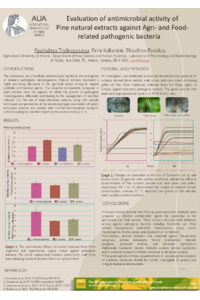
The natural extracts derived from Pine (Pinus halepensis, region Attica, Greece) needles, male cones, and pollen mixed with male cones, were prepared following a green procedure at all stages, using environmentally friendly methods and safe solvents. Seventeen bacterial strains, relevant to agriculture and food, were cultured under optimal conditions. Antibacterial activity was assessed using agar well diffusion to determine inhibition zones followed by broth microdilution method to determine the minimum inhibitory concentrations (MICs) and minimum bactericidal concentrations (MBCs). The highest inhibition zones were observed for pollen mixed with male cones extract against Listeria monocytogenes, while the lowest MIC values were recorded for pine needles extract against Staphylococcus aureus (7.50 ng/mL). The lowest MBC values were observed from the pollen mixed with male cones extract (0.35 mg/mL) against Bacillus cereus. Notably, the pine needles extract was showed antibacterial activity with MIC and MBC values ranging from 7.50 ng/mL - 7.69 mg/mL and 0.48 – 30.75 mg/mL, respectively against Escherichia coli, Vibrio harveyii, Staphylococcus epidermidis, S. aureus, L. monocytogenes, B. cereus, and Agrobacterium tumefaciens. Significant antibacterial activity was recorded for the pine male cones with pollen extract with MIC and MBC values ranging from 0.02 - 22.4 mg/mL and 0.35 – 22.4 mg/mL, respectively against S. aureus, L. monocytogenes, and B. cereus. The pine male cones extract inhibited B. cereus, L. monocytogenes, and S. aureus with MIC values ranging from 3.6 -14 mg/mL, though MBC values were not detected. The extracts show minimal antimicrobial activity against Pseudomonas aeruginosa, Serratia marcescens, Yersinia enterocolitica, Klebsiella aerogenes, Salmonella enterica, and Salmonella typhimurium. Notably, Citrobacter freundii, Klebsiella oxytoca, Serratia liquefaciens, and Citrobacter sakazakii exhibited resistance to all tested extracts. These findings suggest the potential of natural extracts, especially those from pine needles, as antimicrobial agents in the agricultural and food sectors.
Keywords
Antimicrobial agent
natural extracts
Pinus halepensis
Poster
sCIFORUM2025_134910.pdf
Biopreservation and Control of Staphylococcus aureus in Traditional Goat's Cheese Using Essential Oil of Lavandula mairei
Evaluation of a Natural Extract as a Preservative in a Banana Filling for Pastry: A Clean Label Alternative