Event submissions
Published
This submission belongs to the session D. Food Microbiology of the event The 6th International Electronic Conference on Foods
Published date
27 Oct, 2025
Academic Editor
'%3e%3cpath%20d='M12.6657%2010.9104C12.4185%2010.325%2012.0599%209.79327%2011.6097%209.34482C11.1609%208.89508%2010.6293%208.5365%2010.0442%208.28888C10.0389%208.28626%2010.0337%208.28495%2010.0285%208.28233C10.8446%207.69279%2011.3752%206.73249%2011.3752%205.64904C11.3752%203.8542%209.92103%202.39999%208.1262%202.39999C6.33136%202.39999%204.87715%203.8542%204.87715%205.64904C4.87715%206.73249%205.40774%207.69279%206.22393%208.28364C6.21869%208.28626%206.21345%208.28757%206.20821%208.29019C5.62129%208.5378%205.09463%208.89284%204.64265%209.34613C4.1929%209.79493%203.83432%2010.3266%203.58671%2010.9117C3.34345%2011.4845%203.21226%2012.0987%203.20023%2012.7209C3.19988%2012.7349%203.20233%2012.7488%203.20744%2012.7619C3.21255%2012.7749%203.22022%2012.7867%203.22998%2012.7968C3.23975%2012.8068%203.25142%2012.8147%203.26431%2012.8202C3.2772%2012.8256%203.29105%2012.8284%203.30504%2012.8284H4.09109C4.14874%2012.8284%204.19459%2012.7825%204.1959%2012.7262C4.2221%2011.7148%204.62823%2010.7676%205.34617%2010.0497C6.08899%209.30683%207.0755%208.89808%208.1262%208.89808C9.17689%208.89808%2010.1634%209.30683%2010.9062%2010.0497C11.6242%2010.7676%2012.0303%2011.7148%2012.0565%2012.7262C12.0578%2012.7838%2012.1037%2012.8284%2012.1613%2012.8284H12.9474C12.9613%2012.8284%2012.9752%2012.8256%2012.9881%2012.8202C13.001%2012.8147%2013.0126%2012.8068%2013.0224%2012.7968C13.0322%2012.7867%2013.0398%2012.7749%2013.0449%2012.7619C13.0501%2012.7488%2013.0525%2012.7349%2013.0522%2012.7209C13.0391%2012.0947%2012.9094%2011.4855%2012.6657%2010.9104ZM8.1262%207.9024C7.52486%207.9024%206.9589%207.6679%206.53312%207.24211C6.10733%206.81633%205.87283%206.25037%205.87283%205.64904C5.87283%205.0477%206.10733%204.48174%206.53312%204.05596C6.9589%203.63018%207.52486%203.39567%208.1262%203.39567C8.72753%203.39567%209.29349%203.63018%209.71927%204.05596C10.1451%204.48174%2010.3796%205.0477%2010.3796%205.64904C10.3796%206.25037%2010.1451%206.81633%209.71927%207.24211C9.29349%207.6679%208.72753%207.9024%208.1262%207.9024Z'%20fill='%235D1EE1'/%3e%3c/g%3e%3c/svg%3e) Efstathios Giaouris
Efstathios GiaourisCitation
Isabel Rodrigues, Fernanda Cosme, Virgílio Falco, António Inês, Application of Particle Film Influences Yeast Communities on the Surface of Touriga Nacional and Touriga Franca Grape Berries in the Douro Region, in Proceedings of The 6th International Electronic Conference on Foods, 28 October–30 October 2025, MDPI: Basel, Switzerland
Share
Email
Facebook
Twitter
LinkedIn
Application of Particle Film Influences Yeast Communities on the Surface of Touriga Nacional and Touriga Franca Grape Berries in the Douro Region
'%3e%3cpath%20d='M12.6647%2010.9104C12.4176%2010.325%2012.0589%209.7933%2011.6088%209.34485C11.16%208.89511%2010.6283%208.53653%2010.0432%208.28891C10.038%208.28629%2010.0327%208.28498%2010.0275%208.28236C10.8437%207.69282%2011.3743%206.73252%2011.3743%205.64907C11.3743%203.85423%209.92005%202.40002%208.12522%202.40002C6.33038%202.40002%204.87618%203.85423%204.87618%205.64907C4.87618%206.73252%205.40677%207.69282%206.22296%208.28367C6.21772%208.28629%206.21248%208.2876%206.20724%208.29022C5.62031%208.53783%205.09365%208.89287%204.64167%209.34616C4.19192%209.79496%203.83334%2010.3266%203.58573%2010.9117C3.34247%2011.4846%203.21128%2012.0987%203.19925%2012.721C3.1989%2012.735%203.20135%2012.7489%203.20646%2012.7619C3.21157%2012.7749%203.21924%2012.7868%203.22901%2012.7968C3.23877%2012.8068%203.25045%2012.8148%203.26334%2012.8202C3.27623%2012.8256%203.29007%2012.8284%203.30406%2012.8284H4.09012C4.14776%2012.8284%204.19362%2012.7825%204.19493%2012.7262C4.22113%2011.7148%204.62726%2010.7676%205.34519%2010.0497C6.08802%209.30686%207.07452%208.89811%208.12522%208.89811C9.17592%208.89811%2010.1624%209.30686%2010.9052%2010.0497C11.6232%2010.7676%2012.0293%2011.7148%2012.0555%2012.7262C12.0568%2012.7839%2012.1027%2012.8284%2012.1603%2012.8284H12.9464C12.9604%2012.8284%2012.9742%2012.8256%2012.9871%2012.8202C13%2012.8148%2013.0117%2012.8068%2013.0214%2012.7968C13.0312%2012.7868%2013.0389%2012.7749%2013.044%2012.7619C13.0491%2012.7489%2013.0515%2012.735%2013.0512%2012.721C13.0381%2012.0947%2012.9084%2011.4856%2012.6647%2010.9104ZM8.12522%207.90243C7.52388%207.90243%206.95792%207.66793%206.53214%207.24215C6.10636%206.81636%205.87185%206.2504%205.87185%205.64907C5.87185%205.04773%206.10636%204.48177%206.53214%204.05599C6.95792%203.63021%207.52388%203.3957%208.12522%203.3957C8.72655%203.3957%209.29252%203.63021%209.7183%204.05599C10.1441%204.48177%2010.3786%205.04773%2010.3786%205.64907C10.3786%206.2504%2010.1441%206.81636%209.7183%207.24215C9.29252%207.66793%208.72655%207.90243%208.12522%207.90243Z'%20fill='%235D1EE1'/%3e%3c/g%3e%3c/svg%3e)
Isabel Rodrigues 1

Fernanda Cosme 2,3
Virgílio Falco 4,5
António Inês 2,3
1. Centro de Investigação de Montanha (CIMO), ESA, Instituto Politécnico de Bragança, Campus de Santa Apolónia, Bragança, 5300-253, Portugal
2. Centro de Química - Vila Real (CQ-VR), Universidade de Trás-os-Montes e Alto Douro (UTAD), 5000-801, Vila Real, Portugal
3. Departamento de Biologia e Ambiente (DEBA), Escola de Ciências da Vida e do Ambiente (ECVA) Universidade de Trás-os-Montes e Alto Douro, 5000-801, Vila Real, Portugal
4. Centre for the Research and Technology of Agro-Environmental and Biological Sciences (CITAB), Universidade de Trás-os-Montes e Alto Douro (UTAD), Vila Real, 5000-801, Portugal.
5. Laboratory for Green Chemistry (LAQV) of the Network of Chemistry and Technology (REQUIMTE), Universidade do Porto (UP), Porto, 4099-002, Portugal
Abstract
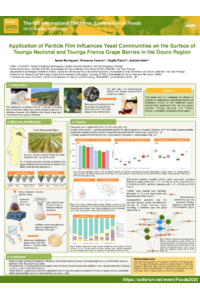
The microbial community present on the surface of grape berries plays a key role in the initial stages of wine fermentation, affecting both the microbiological stability and sensory characteristics of the final product. This study investigated the effects of particle film applications, specifically kaolin and potassium silicate, on the indigenous yeast communities associated with two key grape varieties, “Touriga Nacional” and “Touriga Franca”, cultivated in Portugal’s Douro region. Grape bunches were harvested from a commercial vineyard, where selected rows of “Touriga Nacional” and “Touriga Franca” had been treated at veraison with kaolin (5%) or potassium silicate (at 0.05% or 0.1%). Untreated vines served as controls. To assess the yeast populations, berry samples were washed in isotonic peptone water, and the resulting suspensions were plated on YPD agar. Yeast colonies were isolated, quantified, and identified through molecular analysis of the D1/D2 domain of the 26S rRNA gene. Total yeast count ranged from 10³ to 10⁴ CFU/berry. Overall, the “Touriga Franca” variety presented significantly higher populations of both Saccharomyces and non-Saccharomyces yeasts. However, within this variety, grape samples treated with potassium silicate (at both concentrations) presented the lowest yeast counts. Thirteen yeast species were identified, belonging to the phyla Ascomycota and Basidiomycota. Untreated grapes exhibited significantly higher species richness and diversity compared to treated grapes. Aureobasidium pullulans was the dominant species across all treatments, although its relative frequency varied according to treatment type and grape variety. Multivariate analyses revealed distinct yeast community structures shaped by grape variety, treatment, and their interaction. These findings suggest that particle film applications can change the indigenous yeast community on grape surfaces, potentially affecting fermentation dynamics and wine quality.
Keywords
Aureobasidium pullulans
Kaolin
Non-Saccharomyces yeasts
Potassium silicate
Yeast diversity
Poster
Rodrigues et al., 2025_Foods2025.pdf
EVALUATION OF THE NEUROPROTECTIVE ACTIVITIES IN GABA-PRODUCING POTENTIAL PROBIOTIC STRAINS FROM INDIGENOUS FERMENTED FOODS
Bifidobacterial occurrence and species variability in raw milk