Event submissions
Published
This submission belongs to the session D. Food Microbiology of the event The 6th International Electronic Conference on Foods
Published date
27 Oct, 2025
Academic Editor
'%3e%3cpath%20d='M12.6657%2010.9104C12.4185%2010.325%2012.0599%209.79327%2011.6097%209.34482C11.1609%208.89508%2010.6293%208.5365%2010.0442%208.28888C10.0389%208.28626%2010.0337%208.28495%2010.0285%208.28233C10.8446%207.69279%2011.3752%206.73249%2011.3752%205.64904C11.3752%203.8542%209.92103%202.39999%208.1262%202.39999C6.33136%202.39999%204.87715%203.8542%204.87715%205.64904C4.87715%206.73249%205.40774%207.69279%206.22393%208.28364C6.21869%208.28626%206.21345%208.28757%206.20821%208.29019C5.62129%208.5378%205.09463%208.89284%204.64265%209.34613C4.1929%209.79493%203.83432%2010.3266%203.58671%2010.9117C3.34345%2011.4845%203.21226%2012.0987%203.20023%2012.7209C3.19988%2012.7349%203.20233%2012.7488%203.20744%2012.7619C3.21255%2012.7749%203.22022%2012.7867%203.22998%2012.7968C3.23975%2012.8068%203.25142%2012.8147%203.26431%2012.8202C3.2772%2012.8256%203.29105%2012.8284%203.30504%2012.8284H4.09109C4.14874%2012.8284%204.19459%2012.7825%204.1959%2012.7262C4.2221%2011.7148%204.62823%2010.7676%205.34617%2010.0497C6.08899%209.30683%207.0755%208.89808%208.1262%208.89808C9.17689%208.89808%2010.1634%209.30683%2010.9062%2010.0497C11.6242%2010.7676%2012.0303%2011.7148%2012.0565%2012.7262C12.0578%2012.7838%2012.1037%2012.8284%2012.1613%2012.8284H12.9474C12.9613%2012.8284%2012.9752%2012.8256%2012.9881%2012.8202C13.001%2012.8147%2013.0126%2012.8068%2013.0224%2012.7968C13.0322%2012.7867%2013.0398%2012.7749%2013.0449%2012.7619C13.0501%2012.7488%2013.0525%2012.7349%2013.0522%2012.7209C13.0391%2012.0947%2012.9094%2011.4855%2012.6657%2010.9104ZM8.1262%207.9024C7.52486%207.9024%206.9589%207.6679%206.53312%207.24211C6.10733%206.81633%205.87283%206.25037%205.87283%205.64904C5.87283%205.0477%206.10733%204.48174%206.53312%204.05596C6.9589%203.63018%207.52486%203.39567%208.1262%203.39567C8.72753%203.39567%209.29349%203.63018%209.71927%204.05596C10.1451%204.48174%2010.3796%205.0477%2010.3796%205.64904C10.3796%206.25037%2010.1451%206.81633%209.71927%207.24211C9.29349%207.6679%208.72753%207.9024%208.1262%207.9024Z'%20fill='%235D1EE1'/%3e%3c/g%3e%3c/svg%3e) Efstathios Giaouris
Efstathios GiaourisCitation
Elisana Julek, Artur Silva Ruschel, Vitória Furquim Nascimento, Barbara Kornin Gabardo, Bruno Ariel Furtado Miranda, Milena Gabrielle de Jesus, Lorena Lima Ludovico, Kauã Colaço Schier, Andreia Bueno da Silva, Fabio Sossai Possebon, Tomaz Longhi Santos, Julia Arantes Galvão, Microbiological Evaluation of Stingless Bee Honey from Four Different Species, in Proceedings of The 6th International Electronic Conference on Foods, 28 October–30 October 2025, MDPI: Basel, Switzerland
Share
Email
Facebook
Twitter
LinkedIn
Microbiological Evaluation of Stingless Bee Honey from Four Different Species
'%3e%3cpath%20d='M12.6647%2010.9104C12.4176%2010.325%2012.0589%209.7933%2011.6088%209.34485C11.16%208.89511%2010.6283%208.53653%2010.0432%208.28891C10.038%208.28629%2010.0327%208.28498%2010.0275%208.28236C10.8437%207.69282%2011.3743%206.73252%2011.3743%205.64907C11.3743%203.85423%209.92005%202.40002%208.12522%202.40002C6.33038%202.40002%204.87618%203.85423%204.87618%205.64907C4.87618%206.73252%205.40677%207.69282%206.22296%208.28367C6.21772%208.28629%206.21248%208.2876%206.20724%208.29022C5.62031%208.53783%205.09365%208.89287%204.64167%209.34616C4.19192%209.79496%203.83334%2010.3266%203.58573%2010.9117C3.34247%2011.4846%203.21128%2012.0987%203.19925%2012.721C3.1989%2012.735%203.20135%2012.7489%203.20646%2012.7619C3.21157%2012.7749%203.21924%2012.7868%203.22901%2012.7968C3.23877%2012.8068%203.25045%2012.8148%203.26334%2012.8202C3.27623%2012.8256%203.29007%2012.8284%203.30406%2012.8284H4.09012C4.14776%2012.8284%204.19362%2012.7825%204.19493%2012.7262C4.22113%2011.7148%204.62726%2010.7676%205.34519%2010.0497C6.08802%209.30686%207.07452%208.89811%208.12522%208.89811C9.17592%208.89811%2010.1624%209.30686%2010.9052%2010.0497C11.6232%2010.7676%2012.0293%2011.7148%2012.0555%2012.7262C12.0568%2012.7839%2012.1027%2012.8284%2012.1603%2012.8284H12.9464C12.9604%2012.8284%2012.9742%2012.8256%2012.9871%2012.8202C13%2012.8148%2013.0117%2012.8068%2013.0214%2012.7968C13.0312%2012.7868%2013.0389%2012.7749%2013.044%2012.7619C13.0491%2012.7489%2013.0515%2012.735%2013.0512%2012.721C13.0381%2012.0947%2012.9084%2011.4856%2012.6647%2010.9104ZM8.12522%207.90243C7.52388%207.90243%206.95792%207.66793%206.53214%207.24215C6.10636%206.81636%205.87185%206.2504%205.87185%205.64907C5.87185%205.04773%206.10636%204.48177%206.53214%204.05599C6.95792%203.63021%207.52388%203.3957%208.12522%203.3957C8.72655%203.3957%209.29252%203.63021%209.7183%204.05599C10.1441%204.48177%2010.3786%205.04773%2010.3786%205.64907C10.3786%206.2504%2010.1441%206.81636%209.7183%207.24215C9.29252%207.66793%208.72655%207.90243%208.12522%207.90243Z'%20fill='%235D1EE1'/%3e%3c/g%3e%3c/svg%3e)
Elisana Julek 1,2
Artur Silva Ruschel 2
Vitória Furquim Nascimento 2
Barbara Kornin Gabardo 2
Bruno Ariel Furtado Miranda 1,2
Milena Gabrielle de Jesus 2
Lorena Lima Ludovico 2
Kauã Colaço Schier 2
Andreia Bueno da Silva 2
Fabio Sossai Possebon 3
Tomaz Longhi Santos 4

Julia Arantes Galvão 1,2
1. Post-Graduation Program in Veterinary Sciences - Federal University of Paraná, Curitiba/Paraná, 80035-050, Brazil
2. Quality Control and Food Safety Laboratory - Federal University of Paraná , Curitiba/Paraná, 81531-970, Brazil
3. Instituto de Biotecnologia, Universidade Estadual Paulista Júlio de Mesquita Filho, 01049-010, Saint Paul, Brazil
4. Post-Graduation Program in Environment, the Federal University of Paraná, Curitiba/Paraná, 80035-050, Brazil
Abstract
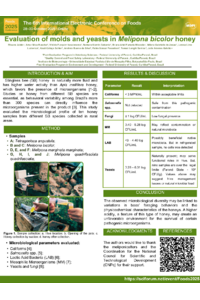
Stingless bee honey (SB) is naturally more fluid and has higher water activity than Apis mellifera honey, which favors the presence of microorganisms. Studies on honey from different SB species are essential, as behavioral variability among Brazil’s more than 300 species can directly influence the microorganisms present in the product. This study evaluated the microbiological profile of ten honey samples from different stingless bee species collected in rural areas: Tetragonisca angustula (A), Melipona bicolor (B and C), Melipona marginata marginata (D, E, and F), and Melipona quadrifasciata quadrifasciata (G, H, I, and J), testing for coliforms, Salmonella spp., lactic acid bacteria (LAB), mesophilic microorganisms (MM), yeasts, and fungi. All samples showed <3 MPN/mL for coliforms, were negative for Salmonella spp., and demonstrated ≤1 log CFU/mL of fungi. MM colony counts ranged from 3.40 to 5.28 log CFU/mL, reflecting contamination or the product’s own microbiota, potentially characterized by LAB (counts from <3 to 4.40). The lowest count (absence of cells) occurred in the only sample refrigerated by the producer. The highest microorganism count corresponded to the lowest yeast concentration, which ranged from 3.28 to 6.31 log CFU/mL. Values above 10⁴ CFU/g, the limit set by Paraná state legislation, may indicate issues in hive management or the natural microbiota accompanying the product. Yeasts can be considered intrinsic to the product, as they are introduced through the bees’ natural foraging behavior and may be used to feed larvae. Accurate identification of these yeasts may be valuable for assessing whether their presence poses real risks to consumers, thus ensuring product safety. The observed microbiological diversity may be linked to variations in bees’ foraging behaviors and the physicochemical characteristics of the honeys. A higher acidity, a feature of this type of honey, may create an unfavorable environment for the survival of certain pathogenic microorganisms.
Keywords
Brazil
Food safety
Yeasts and molds
Poster
elisana_julek.pdf
The Microbiology of Cheeses Produced in the Metropolitan Region of Curitiba
Analysis of the Metabolic Behavior of Torulaspora delbrueckii and Saccharomyces cerevisiae in Synthetic Musts at Different pHs: An Investigation into the Impact of Climate Change on Alcoholic Fermentation and Main Oenological Parameters