Event submissions
Published
This submission belongs to the session D. Food Microbiology of the event The 6th International Electronic Conference on Foods
Published date
27 Oct, 2025
Academic Editor
'%3e%3cpath%20d='M12.6657%2010.9104C12.4185%2010.325%2012.0599%209.79327%2011.6097%209.34482C11.1609%208.89508%2010.6293%208.5365%2010.0442%208.28888C10.0389%208.28626%2010.0337%208.28495%2010.0285%208.28233C10.8446%207.69279%2011.3752%206.73249%2011.3752%205.64904C11.3752%203.8542%209.92103%202.39999%208.1262%202.39999C6.33136%202.39999%204.87715%203.8542%204.87715%205.64904C4.87715%206.73249%205.40774%207.69279%206.22393%208.28364C6.21869%208.28626%206.21345%208.28757%206.20821%208.29019C5.62129%208.5378%205.09463%208.89284%204.64265%209.34613C4.1929%209.79493%203.83432%2010.3266%203.58671%2010.9117C3.34345%2011.4845%203.21226%2012.0987%203.20023%2012.7209C3.19988%2012.7349%203.20233%2012.7488%203.20744%2012.7619C3.21255%2012.7749%203.22022%2012.7867%203.22998%2012.7968C3.23975%2012.8068%203.25142%2012.8147%203.26431%2012.8202C3.2772%2012.8256%203.29105%2012.8284%203.30504%2012.8284H4.09109C4.14874%2012.8284%204.19459%2012.7825%204.1959%2012.7262C4.2221%2011.7148%204.62823%2010.7676%205.34617%2010.0497C6.08899%209.30683%207.0755%208.89808%208.1262%208.89808C9.17689%208.89808%2010.1634%209.30683%2010.9062%2010.0497C11.6242%2010.7676%2012.0303%2011.7148%2012.0565%2012.7262C12.0578%2012.7838%2012.1037%2012.8284%2012.1613%2012.8284H12.9474C12.9613%2012.8284%2012.9752%2012.8256%2012.9881%2012.8202C13.001%2012.8147%2013.0126%2012.8068%2013.0224%2012.7968C13.0322%2012.7867%2013.0398%2012.7749%2013.0449%2012.7619C13.0501%2012.7488%2013.0525%2012.7349%2013.0522%2012.7209C13.0391%2012.0947%2012.9094%2011.4855%2012.6657%2010.9104ZM8.1262%207.9024C7.52486%207.9024%206.9589%207.6679%206.53312%207.24211C6.10733%206.81633%205.87283%206.25037%205.87283%205.64904C5.87283%205.0477%206.10733%204.48174%206.53312%204.05596C6.9589%203.63018%207.52486%203.39567%208.1262%203.39567C8.72753%203.39567%209.29349%203.63018%209.71927%204.05596C10.1451%204.48174%2010.3796%205.0477%2010.3796%205.64904C10.3796%206.25037%2010.1451%206.81633%209.71927%207.24211C9.29349%207.6679%208.72753%207.9024%208.1262%207.9024Z'%20fill='%235D1EE1'/%3e%3c/g%3e%3c/svg%3e) Efstathios Giaouris
Efstathios GiaourisCitation
Mafalda Sofia Duarte Oliveira Silva, Manuela Vida, Cláudia Correia, Ana Cristina Ramos, Fernando Reboredo, Elsa Margarida Gonçalves, Fermentation of Hericium erinaceus Byproducts: A Microbial Stability Assessment, in Proceedings of The 6th International Electronic Conference on Foods, 28 October–30 October 2025, MDPI: Basel, Switzerland
Share
Email
Facebook
Twitter
LinkedIn
Fermentation of Hericium erinaceus Byproducts: A Microbial Stability Assessment
'%3e%3cpath%20d='M12.6647%2010.9104C12.4176%2010.325%2012.0589%209.7933%2011.6088%209.34485C11.16%208.89511%2010.6283%208.53653%2010.0432%208.28891C10.038%208.28629%2010.0327%208.28498%2010.0275%208.28236C10.8437%207.69282%2011.3743%206.73252%2011.3743%205.64907C11.3743%203.85423%209.92005%202.40002%208.12522%202.40002C6.33038%202.40002%204.87618%203.85423%204.87618%205.64907C4.87618%206.73252%205.40677%207.69282%206.22296%208.28367C6.21772%208.28629%206.21248%208.2876%206.20724%208.29022C5.62031%208.53783%205.09365%208.89287%204.64167%209.34616C4.19192%209.79496%203.83334%2010.3266%203.58573%2010.9117C3.34247%2011.4846%203.21128%2012.0987%203.19925%2012.721C3.1989%2012.735%203.20135%2012.7489%203.20646%2012.7619C3.21157%2012.7749%203.21924%2012.7868%203.22901%2012.7968C3.23877%2012.8068%203.25045%2012.8148%203.26334%2012.8202C3.27623%2012.8256%203.29007%2012.8284%203.30406%2012.8284H4.09012C4.14776%2012.8284%204.19362%2012.7825%204.19493%2012.7262C4.22113%2011.7148%204.62726%2010.7676%205.34519%2010.0497C6.08802%209.30686%207.07452%208.89811%208.12522%208.89811C9.17592%208.89811%2010.1624%209.30686%2010.9052%2010.0497C11.6232%2010.7676%2012.0293%2011.7148%2012.0555%2012.7262C12.0568%2012.7839%2012.1027%2012.8284%2012.1603%2012.8284H12.9464C12.9604%2012.8284%2012.9742%2012.8256%2012.9871%2012.8202C13%2012.8148%2013.0117%2012.8068%2013.0214%2012.7968C13.0312%2012.7868%2013.0389%2012.7749%2013.044%2012.7619C13.0491%2012.7489%2013.0515%2012.735%2013.0512%2012.721C13.0381%2012.0947%2012.9084%2011.4856%2012.6647%2010.9104ZM8.12522%207.90243C7.52388%207.90243%206.95792%207.66793%206.53214%207.24215C6.10636%206.81636%205.87185%206.2504%205.87185%205.64907C5.87185%205.04773%206.10636%204.48177%206.53214%204.05599C6.95792%203.63021%207.52388%203.3957%208.12522%203.3957C8.72655%203.3957%209.29252%203.63021%209.7183%204.05599C10.1441%204.48177%2010.3786%205.04773%2010.3786%205.64907C10.3786%206.2504%2010.1441%206.81636%209.7183%207.24215C9.29252%207.66793%208.72655%207.90243%208.12522%207.90243Z'%20fill='%235D1EE1'/%3e%3c/g%3e%3c/svg%3e)
Mafalda Sofia Duarte Oliveira Silva 1
Manuela Vida 1
Cláudia Correia 1
Ana Cristina Ramos 1,2

Fernando Reboredo 2

Elsa Margarida Gonçalves 1,2
1. Instituto Nacional de Investigação Agrária e Veterinária, Unidade de Tecnologia e Inovação (UTI), I.P., Oeiras, 2780-157, Portugal
2. GeoBioTec – Departamento de Ciências da Terra, Faculdade de Ciências e Tecnologia, Universidade NOVA de Lisboa, Caparica, 2829-516, Portugal
Abstract
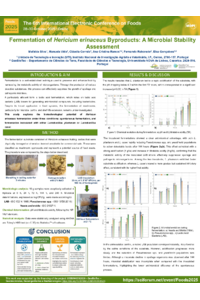
Fermentation is a well-established technique used to preserve and enhance food by harnessing the metabolic activity of microorganisms. Through the production of various bioactive substances, this process can effectively suppress the growth of spoilage and pathogenic microbes. A particularly efficient form is lactic acid fermentation, which relies on lactic acid bacteria (LAB) known for generating antimicrobial compounds, including bacteriocins.
Despite its broad application in food systems, the fermentation of mushrooms, particularly for microbial control and shelf-life extension, remains under-investigated. This study explores the biotechnological potential of Hericium erinaceus fermentation under three conditions: spontaneous fermentation, and fermentation inoculated with either Lactobacillus plantarum or Lactobacillus casei. The fermentation substrate consisted of Hericium erinaceus fruiting bodies that were physically damaged or otherwise deemed unsuitable for commercial sale. These were classified as mushroom byproducts and represent a potential source of food waste. Over a 10-day (240-hour) fermentation period at ambient temperature, microbial counts (LAB, yeasts and molds, Pseudomonas spp.), pH, and titratable acidity were assessed following ISO protocols. Data were statistically analyzed using ANOVA and Tukey’s HSD test (α = 0.05) via Statistica™ v.8 software.
The results revealed that L. plantarum led to a rapid acidification of the substrate, with the pH dropping below 4.0 within the first 72 hours. This corresponded to a substantial reduction in spoilage organisms by 144 hours. While L. casei also exhibited antimicrobial properties, its inhibitory effect emerged later in the process. In contrast, the uninoculated control experienced a continuous rise in Pseudomonas and fungal counts, exceeding 10⁶ CFU/g by the end of fermentation.
This study underscores the potential of lactic acid fermentation as a value-adding approach for mushroom byproducts, offering a sustainable means to improve food safety, extend shelf life, and reduce waste through microbial stabilization.
Keywords
Fermentation
Hericium erinaceus
Lactobacillus plantarum
Lactobacillus casei
Poster
Foods2025_Fermentation of Hericium erinaceus Byproducts EMG20102025_MS.pdf
Evaluation of the antimicrobial activity of Melipona quadrifasciata geopropolis against foodborne pathogens
Biostimulant effects of brown macroalgae and arbuscular mycorrhizal fungi on the yield and quality of a yellow tomato landrace