Event submissions
Published
This submission belongs to the session F. Sustainable Food Security and Food Systems of the event The 6th International Electronic Conference on Foods
Published date
27 Oct, 2025
Academic Editor
'%3e%3cpath%20d='M12.6657%2010.9104C12.4185%2010.325%2012.0599%209.79327%2011.6097%209.34482C11.1609%208.89508%2010.6293%208.5365%2010.0442%208.28888C10.0389%208.28626%2010.0337%208.28495%2010.0285%208.28233C10.8446%207.69279%2011.3752%206.73249%2011.3752%205.64904C11.3752%203.8542%209.92103%202.39999%208.1262%202.39999C6.33136%202.39999%204.87715%203.8542%204.87715%205.64904C4.87715%206.73249%205.40774%207.69279%206.22393%208.28364C6.21869%208.28626%206.21345%208.28757%206.20821%208.29019C5.62129%208.5378%205.09463%208.89284%204.64265%209.34613C4.1929%209.79493%203.83432%2010.3266%203.58671%2010.9117C3.34345%2011.4845%203.21226%2012.0987%203.20023%2012.7209C3.19988%2012.7349%203.20233%2012.7488%203.20744%2012.7619C3.21255%2012.7749%203.22022%2012.7867%203.22998%2012.7968C3.23975%2012.8068%203.25142%2012.8147%203.26431%2012.8202C3.2772%2012.8256%203.29105%2012.8284%203.30504%2012.8284H4.09109C4.14874%2012.8284%204.19459%2012.7825%204.1959%2012.7262C4.2221%2011.7148%204.62823%2010.7676%205.34617%2010.0497C6.08899%209.30683%207.0755%208.89808%208.1262%208.89808C9.17689%208.89808%2010.1634%209.30683%2010.9062%2010.0497C11.6242%2010.7676%2012.0303%2011.7148%2012.0565%2012.7262C12.0578%2012.7838%2012.1037%2012.8284%2012.1613%2012.8284H12.9474C12.9613%2012.8284%2012.9752%2012.8256%2012.9881%2012.8202C13.001%2012.8147%2013.0126%2012.8068%2013.0224%2012.7968C13.0322%2012.7867%2013.0398%2012.7749%2013.0449%2012.7619C13.0501%2012.7488%2013.0525%2012.7349%2013.0522%2012.7209C13.0391%2012.0947%2012.9094%2011.4855%2012.6657%2010.9104ZM8.1262%207.9024C7.52486%207.9024%206.9589%207.6679%206.53312%207.24211C6.10733%206.81633%205.87283%206.25037%205.87283%205.64904C5.87283%205.0477%206.10733%204.48174%206.53312%204.05596C6.9589%203.63018%207.52486%203.39567%208.1262%203.39567C8.72753%203.39567%209.29349%203.63018%209.71927%204.05596C10.1451%204.48174%2010.3796%205.0477%2010.3796%205.64904C10.3796%206.25037%2010.1451%206.81633%209.71927%207.24211C9.29349%207.6679%208.72753%207.9024%208.1262%207.9024Z'%20fill='%235D1EE1'/%3e%3c/g%3e%3c/svg%3e) Theodoros Varzakas
Theodoros VarzakasCitation
Maria Gimena Torres, Silvina Cecilia Andrés, Nadia Florencia Nagai, Gabriel Lorenzo, Germán García Colli, Life Cycle Assessment of Argentinian dry bean flour, in Proceedings of The 6th International Electronic Conference on Foods, 28 October–30 October 2025, MDPI: Basel, Switzerland
Share
Email
Facebook
Twitter
LinkedIn
Life Cycle Assessment of Argentinian dry bean flour
'%3e%3cpath%20d='M12.6647%2010.9104C12.4176%2010.325%2012.0589%209.7933%2011.6088%209.34485C11.16%208.89511%2010.6283%208.53653%2010.0432%208.28891C10.038%208.28629%2010.0327%208.28498%2010.0275%208.28236C10.8437%207.69282%2011.3743%206.73252%2011.3743%205.64907C11.3743%203.85423%209.92005%202.40002%208.12522%202.40002C6.33038%202.40002%204.87618%203.85423%204.87618%205.64907C4.87618%206.73252%205.40677%207.69282%206.22296%208.28367C6.21772%208.28629%206.21248%208.2876%206.20724%208.29022C5.62031%208.53783%205.09365%208.89287%204.64167%209.34616C4.19192%209.79496%203.83334%2010.3266%203.58573%2010.9117C3.34247%2011.4846%203.21128%2012.0987%203.19925%2012.721C3.1989%2012.735%203.20135%2012.7489%203.20646%2012.7619C3.21157%2012.7749%203.21924%2012.7868%203.22901%2012.7968C3.23877%2012.8068%203.25045%2012.8148%203.26334%2012.8202C3.27623%2012.8256%203.29007%2012.8284%203.30406%2012.8284H4.09012C4.14776%2012.8284%204.19362%2012.7825%204.19493%2012.7262C4.22113%2011.7148%204.62726%2010.7676%205.34519%2010.0497C6.08802%209.30686%207.07452%208.89811%208.12522%208.89811C9.17592%208.89811%2010.1624%209.30686%2010.9052%2010.0497C11.6232%2010.7676%2012.0293%2011.7148%2012.0555%2012.7262C12.0568%2012.7839%2012.1027%2012.8284%2012.1603%2012.8284H12.9464C12.9604%2012.8284%2012.9742%2012.8256%2012.9871%2012.8202C13%2012.8148%2013.0117%2012.8068%2013.0214%2012.7968C13.0312%2012.7868%2013.0389%2012.7749%2013.044%2012.7619C13.0491%2012.7489%2013.0515%2012.735%2013.0512%2012.721C13.0381%2012.0947%2012.9084%2011.4856%2012.6647%2010.9104ZM8.12522%207.90243C7.52388%207.90243%206.95792%207.66793%206.53214%207.24215C6.10636%206.81636%205.87185%206.2504%205.87185%205.64907C5.87185%205.04773%206.10636%204.48177%206.53214%204.05599C6.95792%203.63021%207.52388%203.3957%208.12522%203.3957C8.72655%203.3957%209.29252%203.63021%209.7183%204.05599C10.1441%204.48177%2010.3786%205.04773%2010.3786%205.64907C10.3786%206.2504%2010.1441%206.81636%209.7183%207.24215C9.29252%207.66793%208.72655%207.90243%208.12522%207.90243Z'%20fill='%235D1EE1'/%3e%3c/g%3e%3c/svg%3e)
Maria Gimena Torres 1
Silvina Cecilia Andrés 2
Nadia Florencia Nagai 2
Gabriel Lorenzo 1,2
Germán García Colli 1,3
1. Chemical Engineer Department, National University of La Plata (UNLP), Buenos Aires, Argentina.
2. Center for Research and Development in Food Science and Technology (CIDCA), Buenos Aires, Argentina.
3. Development and Investigation Center in Applied Science ‘Dr. J. J. Ronco’ (CINDECA) CONICET – UNLP, Buenos Aires, Argentina
Abstract
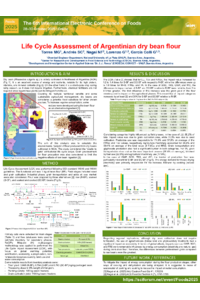
Plant-based sources are being assessed as alternatives to animal-based foods as a strategy to reduce environmental impacts. This study aimed to calculate the environmental footprint of dry bean flour made from Phaseolus vulgaris cultivated in northwest Argentina. Since grain pre-treatment influences the flour’s nutritional properties, three different processing methods were evaluated: raw (R-BF), soaked (S-BF), and soaked and cooked (SC-BF). A comparative Life Cycle Assessment was conducted, evaluating multiple impact categories using the ReCiPe method. The functional unit was 1 kg of flour, and the primary stages assessed were seed and grain production, transportation, processing, and flour production. Inventory data were based on Argentina’s 2023 harvest. All impact categories were higher for S-BF and SC-BF due to several factors. First, flour yield decreased from 0.97 for R-BF to 0.80 and 0.74 for S-BF and SC-BF. Additionally, soaking and drying before milling in S-BF increased electricity and water consumption. SC-BF required further inputs of water and natural gas for cooking. As a result, the most significant differences were observed in global warming, fossil resource scarcity, and water consumption, with values 4, 5, and 8 times higher than R-BF, respectively. Regarding ecotoxicity, pesticide use during seed and grain production had a substantial burden, contributing 82% to freshwater and 64% to terrestrial ecotoxicity. Transport and agricultural machinery accounted for up to 90% of R-BF’s acidification impact; this share decreased by 20% in S-BF and SC-BF due to higher electricity use. Transport remained a major contributor in several categories because of distribution distances. Water consumption for soaking and cooking represented 6% and 15% of total impact for S-BF and SC-BF. This analysis highlights how processing methods affect the environmental footprint of flour.
Keywords
Environmental footprint
plant-based food
legumes
hydrothernal treatment
sustainability
Phaseolus vulgaris
Poster
LCA bean flour_Poster.pdf
A novel Avocado Puree with Encapsulated Tomato By-Products: Impact of Processing Techniques on Bioactive Compound Retention
Nutritional and Metabolomic Profiles of Solanum quitoense Lam. Fruit Fractions: Implications for Functional Food Development