Event submissions
Published
This submission belongs to the session B. Nutritional and Functional Foods of the event The 6th International Electronic Conference on Foods
Published date
27 Oct, 2025
Academic Editor
'%3e%3cpath%20d='M12.6657%2010.9104C12.4185%2010.325%2012.0599%209.79327%2011.6097%209.34482C11.1609%208.89508%2010.6293%208.5365%2010.0442%208.28888C10.0389%208.28626%2010.0337%208.28495%2010.0285%208.28233C10.8446%207.69279%2011.3752%206.73249%2011.3752%205.64904C11.3752%203.8542%209.92103%202.39999%208.1262%202.39999C6.33136%202.39999%204.87715%203.8542%204.87715%205.64904C4.87715%206.73249%205.40774%207.69279%206.22393%208.28364C6.21869%208.28626%206.21345%208.28757%206.20821%208.29019C5.62129%208.5378%205.09463%208.89284%204.64265%209.34613C4.1929%209.79493%203.83432%2010.3266%203.58671%2010.9117C3.34345%2011.4845%203.21226%2012.0987%203.20023%2012.7209C3.19988%2012.7349%203.20233%2012.7488%203.20744%2012.7619C3.21255%2012.7749%203.22022%2012.7867%203.22998%2012.7968C3.23975%2012.8068%203.25142%2012.8147%203.26431%2012.8202C3.2772%2012.8256%203.29105%2012.8284%203.30504%2012.8284H4.09109C4.14874%2012.8284%204.19459%2012.7825%204.1959%2012.7262C4.2221%2011.7148%204.62823%2010.7676%205.34617%2010.0497C6.08899%209.30683%207.0755%208.89808%208.1262%208.89808C9.17689%208.89808%2010.1634%209.30683%2010.9062%2010.0497C11.6242%2010.7676%2012.0303%2011.7148%2012.0565%2012.7262C12.0578%2012.7838%2012.1037%2012.8284%2012.1613%2012.8284H12.9474C12.9613%2012.8284%2012.9752%2012.8256%2012.9881%2012.8202C13.001%2012.8147%2013.0126%2012.8068%2013.0224%2012.7968C13.0322%2012.7867%2013.0398%2012.7749%2013.0449%2012.7619C13.0501%2012.7488%2013.0525%2012.7349%2013.0522%2012.7209C13.0391%2012.0947%2012.9094%2011.4855%2012.6657%2010.9104ZM8.1262%207.9024C7.52486%207.9024%206.9589%207.6679%206.53312%207.24211C6.10733%206.81633%205.87283%206.25037%205.87283%205.64904C5.87283%205.0477%206.10733%204.48174%206.53312%204.05596C6.9589%203.63018%207.52486%203.39567%208.1262%203.39567C8.72753%203.39567%209.29349%203.63018%209.71927%204.05596C10.1451%204.48174%2010.3796%205.0477%2010.3796%205.64904C10.3796%206.25037%2010.1451%206.81633%209.71927%207.24211C9.29349%207.6679%208.72753%207.9024%208.1262%207.9024Z'%20fill='%235D1EE1'/%3e%3c/g%3e%3c/svg%3e) Manuel Viuda-Martos
Manuel Viuda-MartosCitation
Madelín Pérez Armas, Elena Fauste Alonso, Cristina Donis, Paola Otero, Mª Isabel Panadero, Carlos Bocos De Prada, MATERNAL FRUCTOSE INTAKE WORSENS THE DETRIMENTAL EFFECTS OF TAGATOSE CONSUMPTION IN RAT MALE DESCENDANTS, in Proceedings of The 6th International Electronic Conference on Foods, 28 October–30 October 2025, MDPI: Basel, Switzerland
Share
Email
Facebook
Twitter
LinkedIn
MATERNAL FRUCTOSE INTAKE WORSENS THE DETRIMENTAL EFFECTS OF TAGATOSE CONSUMPTION IN RAT MALE DESCENDANTS
'%3e%3cpath%20d='M12.6647%2010.9104C12.4176%2010.325%2012.0589%209.7933%2011.6088%209.34485C11.16%208.89511%2010.6283%208.53653%2010.0432%208.28891C10.038%208.28629%2010.0327%208.28498%2010.0275%208.28236C10.8437%207.69282%2011.3743%206.73252%2011.3743%205.64907C11.3743%203.85423%209.92005%202.40002%208.12522%202.40002C6.33038%202.40002%204.87618%203.85423%204.87618%205.64907C4.87618%206.73252%205.40677%207.69282%206.22296%208.28367C6.21772%208.28629%206.21248%208.2876%206.20724%208.29022C5.62031%208.53783%205.09365%208.89287%204.64167%209.34616C4.19192%209.79496%203.83334%2010.3266%203.58573%2010.9117C3.34247%2011.4846%203.21128%2012.0987%203.19925%2012.721C3.1989%2012.735%203.20135%2012.7489%203.20646%2012.7619C3.21157%2012.7749%203.21924%2012.7868%203.22901%2012.7968C3.23877%2012.8068%203.25045%2012.8148%203.26334%2012.8202C3.27623%2012.8256%203.29007%2012.8284%203.30406%2012.8284H4.09012C4.14776%2012.8284%204.19362%2012.7825%204.19493%2012.7262C4.22113%2011.7148%204.62726%2010.7676%205.34519%2010.0497C6.08802%209.30686%207.07452%208.89811%208.12522%208.89811C9.17592%208.89811%2010.1624%209.30686%2010.9052%2010.0497C11.6232%2010.7676%2012.0293%2011.7148%2012.0555%2012.7262C12.0568%2012.7839%2012.1027%2012.8284%2012.1603%2012.8284H12.9464C12.9604%2012.8284%2012.9742%2012.8256%2012.9871%2012.8202C13%2012.8148%2013.0117%2012.8068%2013.0214%2012.7968C13.0312%2012.7868%2013.0389%2012.7749%2013.044%2012.7619C13.0491%2012.7489%2013.0515%2012.735%2013.0512%2012.721C13.0381%2012.0947%2012.9084%2011.4856%2012.6647%2010.9104ZM8.12522%207.90243C7.52388%207.90243%206.95792%207.66793%206.53214%207.24215C6.10636%206.81636%205.87185%206.2504%205.87185%205.64907C5.87185%205.04773%206.10636%204.48177%206.53214%204.05599C6.95792%203.63021%207.52388%203.3957%208.12522%203.3957C8.72655%203.3957%209.29252%203.63021%209.7183%204.05599C10.1441%204.48177%2010.3786%205.04773%2010.3786%205.64907C10.3786%206.2504%2010.1441%206.81636%209.7183%207.24215C9.29252%207.66793%208.72655%207.90243%208.12522%207.90243Z'%20fill='%235D1EE1'/%3e%3c/g%3e%3c/svg%3e)
Madelín Pérez Armas 1
Elena Fauste Alonso 1
Cristina Donis 1
Paola Otero 1
Mª Isabel Panadero 1
Carlos Bocos De Prada 1
1. Facultad de Farmacia, Universidad San Pablo-CEU, CEU Universities, Montepríncipe, Boadilla del Monte, 28668 Madrid, Spain
Abstract
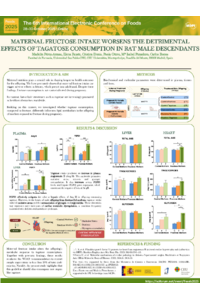
Introduction: We have previously shown that maternal fructose consumption induces harmful effects in foetuses, which remain present in adulthood. However, this sugar is not contraindicated during pregnancy. On the other hand, the use of low-caloric sweeteners such as tagatose is worldwide recommended. Given this background, we have studied whether the consumption of tagatose compared to fructose affects lipid metabolism in the offspring of mothers which were supplemented with fructose during their pregnancy.
Methods: Three-month-old male offspring from control or fructose mothers received liquid 10% fructose or tagatose for 21 days. A control group (without any additive) was also performed. Biochemical and molecular parameters were determined in plasma, tissues and feces.
Results: Both tagatose and fructose consumption caused hypertriglyceridemia in descendants of fructose-fed mothers. Whereas fructose consumption led to a greater hepatic lipogenesis, tagatose supplementation provoked a higher enterohepatic bile acids recirculation, a greater expression in genes involved in intestinal lipid absorption, and lower faecal triglycerides levels. Moreover, GLP1 is a molecule that affects lipid intestinal absorption, being its production dependent on bile acid and sugar concentration. Curiously, although proglucagon gene expression was stimulated by tagatose in fructose-fed mother descendants, plasma GLP1 was unchanged. However, FGF21, a molecule sensitive to GLP1 which regulates lipid metabolism, was augmented in plasma and liver of tagatose supplemented descendants regardless of their maternal diet. Searching for the mechanism explaining this tagatose mediated effect, neither ChREBP nor PPARa signalling seemed to be involved. Interestingly, Angiotensin 2 (Ang2) which is also able to induce FGF21 production to counteract its harmful actions, was increased in plasma of all animals that ingested tagatose. However, the deleterious effects of Ang2 were not effectively reversed by FGF21 in descendants of fructose-fed dams.
Conclusions: Maternal fructose consumption determines the response of the offspring to tagatose intake, causing an increased intestinal lipid absorption, dyslipidaemia and steatosis.
Keywords
Fructose
pregnancy
foetal programming
bile acids
FGF21
Angiotensin 2
tagatose.
Poster
sciforum-133164.pdf
Can lupins be the next generation of plant-based proteins?
A Novel Functional Pasta from Red teff (Eragrostis tef (Zucc.)) and Soybean (Glycine max): Nutritional Enhancement and In Vitro Antioxidant Properties