Event submissions
Published
This submission belongs to the session B. Nutritional and Functional Foods of the event The 6th International Electronic Conference on Foods
Published date
27 Oct, 2025
Academic Editor
'%3e%3cpath%20d='M12.6657%2010.9104C12.4185%2010.325%2012.0599%209.79327%2011.6097%209.34482C11.1609%208.89508%2010.6293%208.5365%2010.0442%208.28888C10.0389%208.28626%2010.0337%208.28495%2010.0285%208.28233C10.8446%207.69279%2011.3752%206.73249%2011.3752%205.64904C11.3752%203.8542%209.92103%202.39999%208.1262%202.39999C6.33136%202.39999%204.87715%203.8542%204.87715%205.64904C4.87715%206.73249%205.40774%207.69279%206.22393%208.28364C6.21869%208.28626%206.21345%208.28757%206.20821%208.29019C5.62129%208.5378%205.09463%208.89284%204.64265%209.34613C4.1929%209.79493%203.83432%2010.3266%203.58671%2010.9117C3.34345%2011.4845%203.21226%2012.0987%203.20023%2012.7209C3.19988%2012.7349%203.20233%2012.7488%203.20744%2012.7619C3.21255%2012.7749%203.22022%2012.7867%203.22998%2012.7968C3.23975%2012.8068%203.25142%2012.8147%203.26431%2012.8202C3.2772%2012.8256%203.29105%2012.8284%203.30504%2012.8284H4.09109C4.14874%2012.8284%204.19459%2012.7825%204.1959%2012.7262C4.2221%2011.7148%204.62823%2010.7676%205.34617%2010.0497C6.08899%209.30683%207.0755%208.89808%208.1262%208.89808C9.17689%208.89808%2010.1634%209.30683%2010.9062%2010.0497C11.6242%2010.7676%2012.0303%2011.7148%2012.0565%2012.7262C12.0578%2012.7838%2012.1037%2012.8284%2012.1613%2012.8284H12.9474C12.9613%2012.8284%2012.9752%2012.8256%2012.9881%2012.8202C13.001%2012.8147%2013.0126%2012.8068%2013.0224%2012.7968C13.0322%2012.7867%2013.0398%2012.7749%2013.0449%2012.7619C13.0501%2012.7488%2013.0525%2012.7349%2013.0522%2012.7209C13.0391%2012.0947%2012.9094%2011.4855%2012.6657%2010.9104ZM8.1262%207.9024C7.52486%207.9024%206.9589%207.6679%206.53312%207.24211C6.10733%206.81633%205.87283%206.25037%205.87283%205.64904C5.87283%205.0477%206.10733%204.48174%206.53312%204.05596C6.9589%203.63018%207.52486%203.39567%208.1262%203.39567C8.72753%203.39567%209.29349%203.63018%209.71927%204.05596C10.1451%204.48174%2010.3796%205.0477%2010.3796%205.64904C10.3796%206.25037%2010.1451%206.81633%209.71927%207.24211C9.29349%207.6679%208.72753%207.9024%208.1262%207.9024Z'%20fill='%235D1EE1'/%3e%3c/g%3e%3c/svg%3e) Manuel Viuda-Martos
Manuel Viuda-MartosCitation
Gonçalo Mendes, Manuela Lageiro, Maria Lídia Palma, Paula Pereira, Marisa Nicolai, Food Applications of Grape Pomace: Nutritional, Antioxidant, and Functional Insights, in Proceedings of The 6th International Electronic Conference on Foods, 28 October–30 October 2025, MDPI: Basel, Switzerland
Share
Email
Facebook
Twitter
LinkedIn
Food Applications of Grape Pomace: Nutritional, Antioxidant, and Functional Insights
'%3e%3cpath%20d='M12.6647%2010.9104C12.4176%2010.325%2012.0589%209.7933%2011.6088%209.34485C11.16%208.89511%2010.6283%208.53653%2010.0432%208.28891C10.038%208.28629%2010.0327%208.28498%2010.0275%208.28236C10.8437%207.69282%2011.3743%206.73252%2011.3743%205.64907C11.3743%203.85423%209.92005%202.40002%208.12522%202.40002C6.33038%202.40002%204.87618%203.85423%204.87618%205.64907C4.87618%206.73252%205.40677%207.69282%206.22296%208.28367C6.21772%208.28629%206.21248%208.2876%206.20724%208.29022C5.62031%208.53783%205.09365%208.89287%204.64167%209.34616C4.19192%209.79496%203.83334%2010.3266%203.58573%2010.9117C3.34247%2011.4846%203.21128%2012.0987%203.19925%2012.721C3.1989%2012.735%203.20135%2012.7489%203.20646%2012.7619C3.21157%2012.7749%203.21924%2012.7868%203.22901%2012.7968C3.23877%2012.8068%203.25045%2012.8148%203.26334%2012.8202C3.27623%2012.8256%203.29007%2012.8284%203.30406%2012.8284H4.09012C4.14776%2012.8284%204.19362%2012.7825%204.19493%2012.7262C4.22113%2011.7148%204.62726%2010.7676%205.34519%2010.0497C6.08802%209.30686%207.07452%208.89811%208.12522%208.89811C9.17592%208.89811%2010.1624%209.30686%2010.9052%2010.0497C11.6232%2010.7676%2012.0293%2011.7148%2012.0555%2012.7262C12.0568%2012.7839%2012.1027%2012.8284%2012.1603%2012.8284H12.9464C12.9604%2012.8284%2012.9742%2012.8256%2012.9871%2012.8202C13%2012.8148%2013.0117%2012.8068%2013.0214%2012.7968C13.0312%2012.7868%2013.0389%2012.7749%2013.044%2012.7619C13.0491%2012.7489%2013.0515%2012.735%2013.0512%2012.721C13.0381%2012.0947%2012.9084%2011.4856%2012.6647%2010.9104ZM8.12522%207.90243C7.52388%207.90243%206.95792%207.66793%206.53214%207.24215C6.10636%206.81636%205.87185%206.2504%205.87185%205.64907C5.87185%205.04773%206.10636%204.48177%206.53214%204.05599C6.95792%203.63021%207.52388%203.3957%208.12522%203.3957C8.72655%203.3957%209.29252%203.63021%209.7183%204.05599C10.1441%204.48177%2010.3786%205.04773%2010.3786%205.64907C10.3786%206.2504%2010.1441%206.81636%209.7183%207.24215C9.29252%207.66793%208.72655%207.90243%208.12522%207.90243Z'%20fill='%235D1EE1'/%3e%3c/g%3e%3c/svg%3e)
Gonçalo Mendes 1

Manuela Lageiro 2,3,4
Maria Lídia Palma 1,5

Paula Pereira 5,6,7

Marisa Nicolai 1,5
1. Universidade Lusófona, Campo Grande 376, 1749-024 Lisboa, Portugal
2. INIAV—Instituto Nacional de Investigação Agrária e Veterinária, Unidade de Tecnologia e Inovação, 2780-157 Oeiras, Portugal
3. FCT-NOVA, Faculdade de Ciências e Tecnologia, Universidade Nova de Lisboa, 2829‐516 Caparica, Portugal
4. GeoBioTech Research Center, FCT-NOVA, Campus da Caparica, 2829-516 Caparica, Portugal
5. CBIOS—Research Center for Biosciences & Health Technologies, Universidade Lusófona, Campo Grande 376, 1749-024 Lisboa, Portugal
6. EPCV, School of Psychology and Life Science, Department of Life Sciences, Universidade Lusófona, Campo Grande 376, 1749-024 Lisboa, Portugal
7. CERENA, Center for Natural Resources and Environment, Instituto Superior Técnico (IST), Universidade de Lisboa, Av. Rovisco Pais, 1049-001 Lisboa, Portugal
Abstract
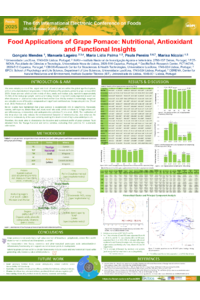
The wine industry, a major player in the global agri-food sector, generates millions of tonnes of grape pomace annually as a by-product. Although rich in polyphenols, fiber, and antioxidants with proven health benefits, most pomace remains underutilized, often being discarded or repurposed as low-value compost or animal feed. This study highlights the untapped potential of grape pomace flour by analyzing its bioactive profile, emphasizing its viability for high-value applications in nutraceuticals, functional foods, and pharmaceuticals.
Six samples from two Portuguese grape varieties (Arinto and Touriga Nacional) were sourced from three wineries (Carmim, Cerrado da Porta, Mingorra) and analyzed. Total phenolic content (114.94–128.31 mg GAE/100 g) and flavonoids (452.74–2,214.27 mg quercetin equivalents/100 g) were quantified spectrophotometrically, demonstrating potent antioxidant activity (FRAP: 110.56–543.00 µmol FeSO₄/100 g; DPPH: 586.93–698.71 µmol Trolox/100 g). Dietary fiber stood out (45.29–64.97%), surpassing many conventional sources, while HPLC analysis confirmed B-vitamins and calculated macronutrient profiles.
The findings reveal grape pomace as a sustainable, nutrient-dense ingredient. In food production, it could enrich baked goods, snacks, or supplements, leveraging its fiber for gut health and its polyphenols for oxidative stress reduction. Cosmetic applications include anti-aging serums, harnessing their free radical-scavenging properties. Pharmaceutical uses extend to anti-inflammatory formulations or controlled-release delivery systems, with emerging research supporting its role in mitigating metabolic syndrome and cognitive decline.
By transforming waste into value-added products, this approach aligns with circular economy principles, reducing environmental impact while creating new revenue streams for wineries. Further research should optimize extraction methods and evaluate bioavailability to maximize commercial adoption.
Keywords
Grape pomace
phenolic compounds
flavonoids
nutritional value
dietetic fiber
sustainability
Poster
Poster_Grape Pomace TN and Ar_Foods 2025.pdf
MINERAL AND VITAMIN CONTENTS OF PRETREATED BAMBARA GROUNDNUT (VIGNA SUBTERRANEAN) CAKE
Fatty Acid Profile and Sensory Characteristics of Canola (Brassica napus) Oil-Based Mayonnaise Sweetened with Date (Phoenix dactylifera) Paste.