Event submissions
Published
This submission belongs to the session B. Nutritional and Functional Foods of the event The 6th International Electronic Conference on Foods
Published date
27 Oct, 2025
Academic Editor
'%3e%3cpath%20d='M12.6657%2010.9104C12.4185%2010.325%2012.0599%209.79327%2011.6097%209.34482C11.1609%208.89508%2010.6293%208.5365%2010.0442%208.28888C10.0389%208.28626%2010.0337%208.28495%2010.0285%208.28233C10.8446%207.69279%2011.3752%206.73249%2011.3752%205.64904C11.3752%203.8542%209.92103%202.39999%208.1262%202.39999C6.33136%202.39999%204.87715%203.8542%204.87715%205.64904C4.87715%206.73249%205.40774%207.69279%206.22393%208.28364C6.21869%208.28626%206.21345%208.28757%206.20821%208.29019C5.62129%208.5378%205.09463%208.89284%204.64265%209.34613C4.1929%209.79493%203.83432%2010.3266%203.58671%2010.9117C3.34345%2011.4845%203.21226%2012.0987%203.20023%2012.7209C3.19988%2012.7349%203.20233%2012.7488%203.20744%2012.7619C3.21255%2012.7749%203.22022%2012.7867%203.22998%2012.7968C3.23975%2012.8068%203.25142%2012.8147%203.26431%2012.8202C3.2772%2012.8256%203.29105%2012.8284%203.30504%2012.8284H4.09109C4.14874%2012.8284%204.19459%2012.7825%204.1959%2012.7262C4.2221%2011.7148%204.62823%2010.7676%205.34617%2010.0497C6.08899%209.30683%207.0755%208.89808%208.1262%208.89808C9.17689%208.89808%2010.1634%209.30683%2010.9062%2010.0497C11.6242%2010.7676%2012.0303%2011.7148%2012.0565%2012.7262C12.0578%2012.7838%2012.1037%2012.8284%2012.1613%2012.8284H12.9474C12.9613%2012.8284%2012.9752%2012.8256%2012.9881%2012.8202C13.001%2012.8147%2013.0126%2012.8068%2013.0224%2012.7968C13.0322%2012.7867%2013.0398%2012.7749%2013.0449%2012.7619C13.0501%2012.7488%2013.0525%2012.7349%2013.0522%2012.7209C13.0391%2012.0947%2012.9094%2011.4855%2012.6657%2010.9104ZM8.1262%207.9024C7.52486%207.9024%206.9589%207.6679%206.53312%207.24211C6.10733%206.81633%205.87283%206.25037%205.87283%205.64904C5.87283%205.0477%206.10733%204.48174%206.53312%204.05596C6.9589%203.63018%207.52486%203.39567%208.1262%203.39567C8.72753%203.39567%209.29349%203.63018%209.71927%204.05596C10.1451%204.48174%2010.3796%205.0477%2010.3796%205.64904C10.3796%206.25037%2010.1451%206.81633%209.71927%207.24211C9.29349%207.6679%208.72753%207.9024%208.1262%207.9024Z'%20fill='%235D1EE1'/%3e%3c/g%3e%3c/svg%3e) Manuel Viuda-Martos
Manuel Viuda-MartosCitation
Linda Oluchi Akajiaku, Justina N. Nwosu, Jane Chigozie Nwakanma, Euphresia N. Odimegwu, Serah Ogechi Alabgaoso, Somtochukwu Emmanuel Ndukwe, Fatty Acid Profile and Sensory Characteristics of Canola (Brassica napus) Oil-Based Mayonnaise Sweetened with Date (Phoenix dactylifera) Paste., in Proceedings of The 6th International Electronic Conference on Foods, 28 October–30 October 2025, MDPI: Basel, Switzerland
Share
Email
Facebook
Twitter
LinkedIn
Fatty Acid Profile and Sensory Characteristics of Canola (Brassica napus) Oil-Based Mayonnaise Sweetened with Date (Phoenix dactylifera) Paste.
'%3e%3cpath%20d='M12.6647%2010.9104C12.4176%2010.325%2012.0589%209.7933%2011.6088%209.34485C11.16%208.89511%2010.6283%208.53653%2010.0432%208.28891C10.038%208.28629%2010.0327%208.28498%2010.0275%208.28236C10.8437%207.69282%2011.3743%206.73252%2011.3743%205.64907C11.3743%203.85423%209.92005%202.40002%208.12522%202.40002C6.33038%202.40002%204.87618%203.85423%204.87618%205.64907C4.87618%206.73252%205.40677%207.69282%206.22296%208.28367C6.21772%208.28629%206.21248%208.2876%206.20724%208.29022C5.62031%208.53783%205.09365%208.89287%204.64167%209.34616C4.19192%209.79496%203.83334%2010.3266%203.58573%2010.9117C3.34247%2011.4846%203.21128%2012.0987%203.19925%2012.721C3.1989%2012.735%203.20135%2012.7489%203.20646%2012.7619C3.21157%2012.7749%203.21924%2012.7868%203.22901%2012.7968C3.23877%2012.8068%203.25045%2012.8148%203.26334%2012.8202C3.27623%2012.8256%203.29007%2012.8284%203.30406%2012.8284H4.09012C4.14776%2012.8284%204.19362%2012.7825%204.19493%2012.7262C4.22113%2011.7148%204.62726%2010.7676%205.34519%2010.0497C6.08802%209.30686%207.07452%208.89811%208.12522%208.89811C9.17592%208.89811%2010.1624%209.30686%2010.9052%2010.0497C11.6232%2010.7676%2012.0293%2011.7148%2012.0555%2012.7262C12.0568%2012.7839%2012.1027%2012.8284%2012.1603%2012.8284H12.9464C12.9604%2012.8284%2012.9742%2012.8256%2012.9871%2012.8202C13%2012.8148%2013.0117%2012.8068%2013.0214%2012.7968C13.0312%2012.7868%2013.0389%2012.7749%2013.044%2012.7619C13.0491%2012.7489%2013.0515%2012.735%2013.0512%2012.721C13.0381%2012.0947%2012.9084%2011.4856%2012.6647%2010.9104ZM8.12522%207.90243C7.52388%207.90243%206.95792%207.66793%206.53214%207.24215C6.10636%206.81636%205.87185%206.2504%205.87185%205.64907C5.87185%205.04773%206.10636%204.48177%206.53214%204.05599C6.95792%203.63021%207.52388%203.3957%208.12522%203.3957C8.72655%203.3957%209.29252%203.63021%209.7183%204.05599C10.1441%204.48177%2010.3786%205.04773%2010.3786%205.64907C10.3786%206.2504%2010.1441%206.81636%209.7183%207.24215C9.29252%207.66793%208.72655%207.90243%208.12522%207.90243Z'%20fill='%235D1EE1'/%3e%3c/g%3e%3c/svg%3e)
Linda Oluchi Akajiaku 1
Justina N. Nwosu 1
Jane Chigozie Nwakanma 2
Euphresia N. Odimegwu 1
Serah Ogechi Alabgaoso 1
Somtochukwu Emmanuel Ndukwe 1
1. Department of Food Science and Technology, Federal University of Technology, P.M.B. 1526, Owerri, Imo State, Nigeria
2. Department of Public Health, Federal University of Technology, P.M.B. 1526, Owerri, Imo State, Nigeria
Abstract
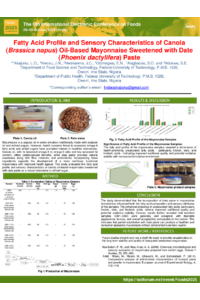
The excessive consumption of refined sugar and unhealthy fats in traditional mayonnaise recipes has raised nutritional concerns and interest in healthier alternatives. This study investigated the effects of replacing conventional soya bean oil and refined sucrose with canola oil and date paste in mayonnaise production, focusing on fatty acid composition and sensory properties. Six samples were developed: a control sample (CM0) with soya bean oil and sucrose and five further samples (CM1–CM5) with canola oil and increasing proportions of date paste (5–25%): 5% (CM1), 10% (CM2), 15% (CM3), 20% (CM4), and 25% (CM5). Standard analytical methods were used to determine the fatty acid composition and conduct sensory evaluation. The fatty acid analysis revealed that canola-based mayonnaise had a healthier lipid profile, with a notable increase in oleic acid (C18:1) from 5.33% in CM0 to 9.26% in CM5, linoleic acid (C18:2) from 40.23% to 43.47%, and α-linolenic acid (C18:3) from 10.04% to 14.59%, indicating an increased content of beneficial monounsaturated and polyunsaturated fatty acids. The saturated fatty acid content remained relatively low, with a moderate increase in lauric acid (from 15.08% to 17.03%) and stearic acid (from 6.99% to 11.62%) in all samples. Sensory evaluation showed that samples CM1 to CM3 were well accepted, with CM2 (10% date paste) receiving the highest ratings for overall acceptability (8.47), flavour (8.53), and texture (8.80), while CM0 received the best ratings for appearance (8.53). Samples CM4 and CM5, which contained a higher proportion of date paste, had significantly lower flavour and acceptability scores (p ≤ 0.05), indicating a threshold above which sweetness negatively affects sensory properties. Replacing conventional ingredients with canola oil and date paste improved the fatty acid profile and maintained the desirable sensory properties up to a level of 15 % date paste. This recipe offers a novel and nutritionally enhanced mayonnaise alternative that meets the demand for heart-healthy, environmentally friendly, and functional foods.
Keywords
Canola oil
Date paste
Fatty acid profile
Functional mayonnaise
Sensory evaluation
Poster
sciforum-131521.pdf
Food Applications of Grape Pomace: Nutritional, Antioxidant, and Functional Insights
GenoPheno4Trait Project—Genomic and phenotypic traits contributing to persistence of Listeria monocytogenes in food processing environment