Event submissions
Published
This submission belongs to the session D. Food Microbiology of the event The 6th International Electronic Conference on Foods
Published date
27 Oct, 2025
Academic Editor
'%3e%3cpath%20d='M12.6657%2010.9104C12.4185%2010.325%2012.0599%209.79327%2011.6097%209.34482C11.1609%208.89508%2010.6293%208.5365%2010.0442%208.28888C10.0389%208.28626%2010.0337%208.28495%2010.0285%208.28233C10.8446%207.69279%2011.3752%206.73249%2011.3752%205.64904C11.3752%203.8542%209.92103%202.39999%208.1262%202.39999C6.33136%202.39999%204.87715%203.8542%204.87715%205.64904C4.87715%206.73249%205.40774%207.69279%206.22393%208.28364C6.21869%208.28626%206.21345%208.28757%206.20821%208.29019C5.62129%208.5378%205.09463%208.89284%204.64265%209.34613C4.1929%209.79493%203.83432%2010.3266%203.58671%2010.9117C3.34345%2011.4845%203.21226%2012.0987%203.20023%2012.7209C3.19988%2012.7349%203.20233%2012.7488%203.20744%2012.7619C3.21255%2012.7749%203.22022%2012.7867%203.22998%2012.7968C3.23975%2012.8068%203.25142%2012.8147%203.26431%2012.8202C3.2772%2012.8256%203.29105%2012.8284%203.30504%2012.8284H4.09109C4.14874%2012.8284%204.19459%2012.7825%204.1959%2012.7262C4.2221%2011.7148%204.62823%2010.7676%205.34617%2010.0497C6.08899%209.30683%207.0755%208.89808%208.1262%208.89808C9.17689%208.89808%2010.1634%209.30683%2010.9062%2010.0497C11.6242%2010.7676%2012.0303%2011.7148%2012.0565%2012.7262C12.0578%2012.7838%2012.1037%2012.8284%2012.1613%2012.8284H12.9474C12.9613%2012.8284%2012.9752%2012.8256%2012.9881%2012.8202C13.001%2012.8147%2013.0126%2012.8068%2013.0224%2012.7968C13.0322%2012.7867%2013.0398%2012.7749%2013.0449%2012.7619C13.0501%2012.7488%2013.0525%2012.7349%2013.0522%2012.7209C13.0391%2012.0947%2012.9094%2011.4855%2012.6657%2010.9104ZM8.1262%207.9024C7.52486%207.9024%206.9589%207.6679%206.53312%207.24211C6.10733%206.81633%205.87283%206.25037%205.87283%205.64904C5.87283%205.0477%206.10733%204.48174%206.53312%204.05596C6.9589%203.63018%207.52486%203.39567%208.1262%203.39567C8.72753%203.39567%209.29349%203.63018%209.71927%204.05596C10.1451%204.48174%2010.3796%205.0477%2010.3796%205.64904C10.3796%206.25037%2010.1451%206.81633%209.71927%207.24211C9.29349%207.6679%208.72753%207.9024%208.1262%207.9024Z'%20fill='%235D1EE1'/%3e%3c/g%3e%3c/svg%3e) Efstathios Giaouris
Efstathios GiaourisCitation
Rui Magalhães, Lucia Noronha, Ana Sousa, Paula Teixeira, GenoPheno4Trait Project—Genomic and phenotypic traits contributing to persistence of Listeria monocytogenes in food processing environment, in Proceedings of The 6th International Electronic Conference on Foods, 28 October–30 October 2025, MDPI: Basel, Switzerland
Share
Email
Facebook
Twitter
LinkedIn
GenoPheno4Trait Project—Genomic and phenotypic traits contributing to persistence of Listeria monocytogenes in food processing environment
'%3e%3cpath%20d='M12.6647%2010.9104C12.4176%2010.325%2012.0589%209.7933%2011.6088%209.34485C11.16%208.89511%2010.6283%208.53653%2010.0432%208.28891C10.038%208.28629%2010.0327%208.28498%2010.0275%208.28236C10.8437%207.69282%2011.3743%206.73252%2011.3743%205.64907C11.3743%203.85423%209.92005%202.40002%208.12522%202.40002C6.33038%202.40002%204.87618%203.85423%204.87618%205.64907C4.87618%206.73252%205.40677%207.69282%206.22296%208.28367C6.21772%208.28629%206.21248%208.2876%206.20724%208.29022C5.62031%208.53783%205.09365%208.89287%204.64167%209.34616C4.19192%209.79496%203.83334%2010.3266%203.58573%2010.9117C3.34247%2011.4846%203.21128%2012.0987%203.19925%2012.721C3.1989%2012.735%203.20135%2012.7489%203.20646%2012.7619C3.21157%2012.7749%203.21924%2012.7868%203.22901%2012.7968C3.23877%2012.8068%203.25045%2012.8148%203.26334%2012.8202C3.27623%2012.8256%203.29007%2012.8284%203.30406%2012.8284H4.09012C4.14776%2012.8284%204.19362%2012.7825%204.19493%2012.7262C4.22113%2011.7148%204.62726%2010.7676%205.34519%2010.0497C6.08802%209.30686%207.07452%208.89811%208.12522%208.89811C9.17592%208.89811%2010.1624%209.30686%2010.9052%2010.0497C11.6232%2010.7676%2012.0293%2011.7148%2012.0555%2012.7262C12.0568%2012.7839%2012.1027%2012.8284%2012.1603%2012.8284H12.9464C12.9604%2012.8284%2012.9742%2012.8256%2012.9871%2012.8202C13%2012.8148%2013.0117%2012.8068%2013.0214%2012.7968C13.0312%2012.7868%2013.0389%2012.7749%2013.044%2012.7619C13.0491%2012.7489%2013.0515%2012.735%2013.0512%2012.721C13.0381%2012.0947%2012.9084%2011.4856%2012.6647%2010.9104ZM8.12522%207.90243C7.52388%207.90243%206.95792%207.66793%206.53214%207.24215C6.10636%206.81636%205.87185%206.2504%205.87185%205.64907C5.87185%205.04773%206.10636%204.48177%206.53214%204.05599C6.95792%203.63021%207.52388%203.3957%208.12522%203.3957C8.72655%203.3957%209.29252%203.63021%209.7183%204.05599C10.1441%204.48177%2010.3786%205.04773%2010.3786%205.64907C10.3786%206.2504%2010.1441%206.81636%209.7183%207.24215C9.29252%207.66793%208.72655%207.90243%208.12522%207.90243Z'%20fill='%235D1EE1'/%3e%3c/g%3e%3c/svg%3e)
Rui Magalhães 1
Lucia Noronha 2
Ana Sousa 2
Paula Teixeira 1
1. Universidade Católica Portuguesa, CBQF - Centro de Biotecnologia e Química Fina– Laboratório Associado, Escola Superior de Biotecnologia, Rua de Diogo Botelho 1327, 4169- 005 Porto, Portugal
2. Associação Colab4Food - Laboratório Colaborativo para Inovação da Indústria Alimentar, Rua dos Lagidos, 4485-655, Vairão, Portugal
Abstract
Listeria monocytogenes is a major foodborne pathogen, responsible for the highest mortality rates due to contaminated food and for frequent product recalls, contributing to significant economic losses and food waste. Persistent Listeria strains, which can survive for extended periods in food processing environments (FPEs), are particularly challenging to control. However, the specific traits that enable this persistence remain poorly understood. The GenoPhenoTraits4Persistence project aims to reduce food contamination with Listeria by identifying the genetic and phenotypic traits associated with persistence. A unique collection of 1000 L. monocytogenes isolates, already sequenced through Whole Genome Sequencing (WGS), will serve as the basis for comparing persistent and sporadic strains. These comparisons will include tolerance to environmental stresses commonly found in FPEs (low temperatures, acidity, salt, disinfectants, phages, and desiccation), as well as the formation of persister cells—a potential mechanism for survival under stress. Importantly, this project introduces metabolomic profiling as a novel strategy to discover biomarkers for persistence, an approach not previously applied in this context. The integration of genomics, stress phenotyping, and metabolomics represents a disruptive and innovative methodology in Listeria research. Led by a multidisciplinary team, this project will significantly advance our understanding of Listeria persistence and support the development of targeted control strategies. The outcomes will contribute to improving food safety and reducing food waste, aligning with national and international priorities in food quality and safety and with the United Nations Sustainable Development Goals.
This project was supported by National Funds from FCT - Fundação para a Ciência e a Tecnologia (PTDC/BAA-AGR/4194/2021).
Keywords
Listeria monocytogenes
persistence
food processing environments
food microbiology
foodborne pathogen
Poster
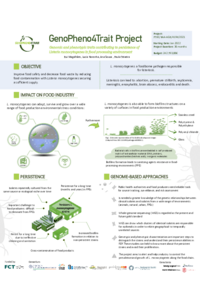
Poster GenoPheno4Trait_foods2025.pdf
Fatty Acid Profile and Sensory Characteristics of Canola (Brassica napus) Oil-Based Mayonnaise Sweetened with Date (Phoenix dactylifera) Paste.
Bioactivity and hydrolysis degree of aqueous extracts from Hermetia illucens larvae obtained with the aid of pineapple juice