Event submissions
Published
This submission belongs to the session C. Food Quality and Safety of the event The 6th International Electronic Conference on Foods
Published date
27 Oct, 2025
Academic Editor
'%3e%3cpath%20d='M12.6657%2010.9104C12.4185%2010.325%2012.0599%209.79327%2011.6097%209.34482C11.1609%208.89508%2010.6293%208.5365%2010.0442%208.28888C10.0389%208.28626%2010.0337%208.28495%2010.0285%208.28233C10.8446%207.69279%2011.3752%206.73249%2011.3752%205.64904C11.3752%203.8542%209.92103%202.39999%208.1262%202.39999C6.33136%202.39999%204.87715%203.8542%204.87715%205.64904C4.87715%206.73249%205.40774%207.69279%206.22393%208.28364C6.21869%208.28626%206.21345%208.28757%206.20821%208.29019C5.62129%208.5378%205.09463%208.89284%204.64265%209.34613C4.1929%209.79493%203.83432%2010.3266%203.58671%2010.9117C3.34345%2011.4845%203.21226%2012.0987%203.20023%2012.7209C3.19988%2012.7349%203.20233%2012.7488%203.20744%2012.7619C3.21255%2012.7749%203.22022%2012.7867%203.22998%2012.7968C3.23975%2012.8068%203.25142%2012.8147%203.26431%2012.8202C3.2772%2012.8256%203.29105%2012.8284%203.30504%2012.8284H4.09109C4.14874%2012.8284%204.19459%2012.7825%204.1959%2012.7262C4.2221%2011.7148%204.62823%2010.7676%205.34617%2010.0497C6.08899%209.30683%207.0755%208.89808%208.1262%208.89808C9.17689%208.89808%2010.1634%209.30683%2010.9062%2010.0497C11.6242%2010.7676%2012.0303%2011.7148%2012.0565%2012.7262C12.0578%2012.7838%2012.1037%2012.8284%2012.1613%2012.8284H12.9474C12.9613%2012.8284%2012.9752%2012.8256%2012.9881%2012.8202C13.001%2012.8147%2013.0126%2012.8068%2013.0224%2012.7968C13.0322%2012.7867%2013.0398%2012.7749%2013.0449%2012.7619C13.0501%2012.7488%2013.0525%2012.7349%2013.0522%2012.7209C13.0391%2012.0947%2012.9094%2011.4855%2012.6657%2010.9104ZM8.1262%207.9024C7.52486%207.9024%206.9589%207.6679%206.53312%207.24211C6.10733%206.81633%205.87283%206.25037%205.87283%205.64904C5.87283%205.0477%206.10733%204.48174%206.53312%204.05596C6.9589%203.63018%207.52486%203.39567%208.1262%203.39567C8.72753%203.39567%209.29349%203.63018%209.71927%204.05596C10.1451%204.48174%2010.3796%205.0477%2010.3796%205.64904C10.3796%206.25037%2010.1451%206.81633%209.71927%207.24211C9.29349%207.6679%208.72753%207.9024%208.1262%207.9024Z'%20fill='%235D1EE1'/%3e%3c/g%3e%3c/svg%3e) Susana Casal
Susana CasalCitation
Miroslava Kuzniarová, Milena Dömötörová, Martina Micháliková, Ensuring Food Safety through Comprehensive Pesticide Residue Monitoring and Regulatory Compliance in Infant Nutrition, in Proceedings of The 6th International Electronic Conference on Foods, 28 October–30 October 2025, MDPI: Basel, Switzerland
Share
Email
Facebook
Twitter
LinkedIn
Ensuring Food Safety through Comprehensive Pesticide Residue Monitoring and Regulatory Compliance in Infant Nutrition
'%3e%3cpath%20d='M12.6647%2010.9104C12.4176%2010.325%2012.0589%209.7933%2011.6088%209.34485C11.16%208.89511%2010.6283%208.53653%2010.0432%208.28891C10.038%208.28629%2010.0327%208.28498%2010.0275%208.28236C10.8437%207.69282%2011.3743%206.73252%2011.3743%205.64907C11.3743%203.85423%209.92005%202.40002%208.12522%202.40002C6.33038%202.40002%204.87618%203.85423%204.87618%205.64907C4.87618%206.73252%205.40677%207.69282%206.22296%208.28367C6.21772%208.28629%206.21248%208.2876%206.20724%208.29022C5.62031%208.53783%205.09365%208.89287%204.64167%209.34616C4.19192%209.79496%203.83334%2010.3266%203.58573%2010.9117C3.34247%2011.4846%203.21128%2012.0987%203.19925%2012.721C3.1989%2012.735%203.20135%2012.7489%203.20646%2012.7619C3.21157%2012.7749%203.21924%2012.7868%203.22901%2012.7968C3.23877%2012.8068%203.25045%2012.8148%203.26334%2012.8202C3.27623%2012.8256%203.29007%2012.8284%203.30406%2012.8284H4.09012C4.14776%2012.8284%204.19362%2012.7825%204.19493%2012.7262C4.22113%2011.7148%204.62726%2010.7676%205.34519%2010.0497C6.08802%209.30686%207.07452%208.89811%208.12522%208.89811C9.17592%208.89811%2010.1624%209.30686%2010.9052%2010.0497C11.6232%2010.7676%2012.0293%2011.7148%2012.0555%2012.7262C12.0568%2012.7839%2012.1027%2012.8284%2012.1603%2012.8284H12.9464C12.9604%2012.8284%2012.9742%2012.8256%2012.9871%2012.8202C13%2012.8148%2013.0117%2012.8068%2013.0214%2012.7968C13.0312%2012.7868%2013.0389%2012.7749%2013.044%2012.7619C13.0491%2012.7489%2013.0515%2012.735%2013.0512%2012.721C13.0381%2012.0947%2012.9084%2011.4856%2012.6647%2010.9104ZM8.12522%207.90243C7.52388%207.90243%206.95792%207.66793%206.53214%207.24215C6.10636%206.81636%205.87185%206.2504%205.87185%205.64907C5.87185%205.04773%206.10636%204.48177%206.53214%204.05599C6.95792%203.63021%207.52388%203.3957%208.12522%203.3957C8.72655%203.3957%209.29252%203.63021%209.7183%204.05599C10.1441%204.48177%2010.3786%205.04773%2010.3786%205.64907C10.3786%206.2504%2010.1441%206.81636%209.7183%207.24215C9.29252%207.66793%208.72655%207.90243%208.12522%207.90243Z'%20fill='%235D1EE1'/%3e%3c/g%3e%3c/svg%3e)
Miroslava Kuzniarová 1,2
Milena Dömötörová 1
Martina Micháliková 1
1. Public Health Authority of the Slovak Republic, National Reference Center for Pesticide Residues, Trnavská cesta 52, 826 45 Bratislava, Slovak Republic
2. Department of Analytical Chemistry, Faculty of Natural Sciences, Comenius University in Bratislava, Ilkovičova 6, 842 15 Bratislava, Slovak Republic
Abstract
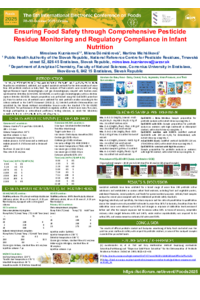
Pesticide residues in baby food are a significant food safety concern due to the heightened vulnerability of infants and young children. The European Union enforces strict regulations, such as Regulation (EC) No. 396/2005 on maximum residue levels (MRLs) and Regulation (EC) No. 178/2002 on general food law. The European Food Safety Authority (EFSA) provides scientific assessments of pesticide toxicity and exposure, supporting risk management decisions.
In Slovakia, the National Reference Center for Pesticide Residues at the Public Health Authority uses validated analytical methods to detect over 200 pesticides in various baby food matrices, including purees, milk formulas, and cereal-based products. Due to infants’ higher food intake relative to body weight, it is essential to monitor pesticide residues and metabolites at trace levels (µg/kg).
Sample preparation is based on the QuEChERS method, suitable for complex food matrices. Analytical detection combines LC-MS/MS for thermolabile and polar compounds and GC-MS/MS for volatile and thermally stable substances.
Method validation follows the SANTE/11312/2021 guidelines, addressing parameters such as selectivity, linearity, recovery, precision, and limits of quantification (LOQs). LOQs range from 0.0003 to 0.01 mg/kg. Recoveries generally fall within the acceptable 70–120% range, with some exceptions for organochlorine pesticides in milk. Reproducibility remains below 20%, with rare cases up to 34%.
Around 40 samples are tested annually. Over the past 15 years, no pesticide residue has exceeded the legal limit in baby food. The methods are accredited by the Slovak National Accreditation Service under STN EN ISO/IEC 17025:2018. Their accuracy is regularly confirmed through international proficiency tests and interlaboratory comparisons, with consistently satisfactory results.
These monitoring activities ensure compliance with EU regulations and help protect infant health by minimizing exposure to harmful pesticide residues in baby food.
Keywords
pesticide residues
baby food
LC-MS/MS
GC-MS/MS
QuEChERS
food safety
multi-residue analysis
Poster
sciforum-134420.pdf
Development and Evaluation of a Multi-Ingredient Functional Spread Incorporating Olea europaea, Nigella sativa, and Sesamum indicum
Bio-Based Nanoemulsions for the Delivery of Algal Lipids: Stability and In Vitro Gastrointestinal Digestibility Assessment