Event submissions
Published
This submission belongs to the session B. Nutritional and Functional Foods of the event The 6th International Electronic Conference on Foods
Published date
27 Oct, 2025
Academic Editor
'%3e%3cpath%20d='M12.6657%2010.9104C12.4185%2010.325%2012.0599%209.79327%2011.6097%209.34482C11.1609%208.89508%2010.6293%208.5365%2010.0442%208.28888C10.0389%208.28626%2010.0337%208.28495%2010.0285%208.28233C10.8446%207.69279%2011.3752%206.73249%2011.3752%205.64904C11.3752%203.8542%209.92103%202.39999%208.1262%202.39999C6.33136%202.39999%204.87715%203.8542%204.87715%205.64904C4.87715%206.73249%205.40774%207.69279%206.22393%208.28364C6.21869%208.28626%206.21345%208.28757%206.20821%208.29019C5.62129%208.5378%205.09463%208.89284%204.64265%209.34613C4.1929%209.79493%203.83432%2010.3266%203.58671%2010.9117C3.34345%2011.4845%203.21226%2012.0987%203.20023%2012.7209C3.19988%2012.7349%203.20233%2012.7488%203.20744%2012.7619C3.21255%2012.7749%203.22022%2012.7867%203.22998%2012.7968C3.23975%2012.8068%203.25142%2012.8147%203.26431%2012.8202C3.2772%2012.8256%203.29105%2012.8284%203.30504%2012.8284H4.09109C4.14874%2012.8284%204.19459%2012.7825%204.1959%2012.7262C4.2221%2011.7148%204.62823%2010.7676%205.34617%2010.0497C6.08899%209.30683%207.0755%208.89808%208.1262%208.89808C9.17689%208.89808%2010.1634%209.30683%2010.9062%2010.0497C11.6242%2010.7676%2012.0303%2011.7148%2012.0565%2012.7262C12.0578%2012.7838%2012.1037%2012.8284%2012.1613%2012.8284H12.9474C12.9613%2012.8284%2012.9752%2012.8256%2012.9881%2012.8202C13.001%2012.8147%2013.0126%2012.8068%2013.0224%2012.7968C13.0322%2012.7867%2013.0398%2012.7749%2013.0449%2012.7619C13.0501%2012.7488%2013.0525%2012.7349%2013.0522%2012.7209C13.0391%2012.0947%2012.9094%2011.4855%2012.6657%2010.9104ZM8.1262%207.9024C7.52486%207.9024%206.9589%207.6679%206.53312%207.24211C6.10733%206.81633%205.87283%206.25037%205.87283%205.64904C5.87283%205.0477%206.10733%204.48174%206.53312%204.05596C6.9589%203.63018%207.52486%203.39567%208.1262%203.39567C8.72753%203.39567%209.29349%203.63018%209.71927%204.05596C10.1451%204.48174%2010.3796%205.0477%2010.3796%205.64904C10.3796%206.25037%2010.1451%206.81633%209.71927%207.24211C9.29349%207.6679%208.72753%207.9024%208.1262%207.9024Z'%20fill='%235D1EE1'/%3e%3c/g%3e%3c/svg%3e) Manuel Viuda-Martos
Manuel Viuda-MartosCitation
Valter Filipe Reis Martins, Ana Isabel Lopes, Manuela Machado, Manuela Pintado, Rui M.S.C. Morais, Alcina M.M.B. Morais, Nannochloropsis sp. Extract as a Potential Functional Ingredient for Food Applications, in Proceedings of The 6th International Electronic Conference on Foods, 28 October–30 October 2025, MDPI: Basel, Switzerland
Share
Email
Facebook
Twitter
LinkedIn
Nannochloropsis sp. Extract as a Potential Functional Ingredient for Food Applications
'%3e%3cpath%20d='M12.6647%2010.9104C12.4176%2010.325%2012.0589%209.7933%2011.6088%209.34485C11.16%208.89511%2010.6283%208.53653%2010.0432%208.28891C10.038%208.28629%2010.0327%208.28498%2010.0275%208.28236C10.8437%207.69282%2011.3743%206.73252%2011.3743%205.64907C11.3743%203.85423%209.92005%202.40002%208.12522%202.40002C6.33038%202.40002%204.87618%203.85423%204.87618%205.64907C4.87618%206.73252%205.40677%207.69282%206.22296%208.28367C6.21772%208.28629%206.21248%208.2876%206.20724%208.29022C5.62031%208.53783%205.09365%208.89287%204.64167%209.34616C4.19192%209.79496%203.83334%2010.3266%203.58573%2010.9117C3.34247%2011.4846%203.21128%2012.0987%203.19925%2012.721C3.1989%2012.735%203.20135%2012.7489%203.20646%2012.7619C3.21157%2012.7749%203.21924%2012.7868%203.22901%2012.7968C3.23877%2012.8068%203.25045%2012.8148%203.26334%2012.8202C3.27623%2012.8256%203.29007%2012.8284%203.30406%2012.8284H4.09012C4.14776%2012.8284%204.19362%2012.7825%204.19493%2012.7262C4.22113%2011.7148%204.62726%2010.7676%205.34519%2010.0497C6.08802%209.30686%207.07452%208.89811%208.12522%208.89811C9.17592%208.89811%2010.1624%209.30686%2010.9052%2010.0497C11.6232%2010.7676%2012.0293%2011.7148%2012.0555%2012.7262C12.0568%2012.7839%2012.1027%2012.8284%2012.1603%2012.8284H12.9464C12.9604%2012.8284%2012.9742%2012.8256%2012.9871%2012.8202C13%2012.8148%2013.0117%2012.8068%2013.0214%2012.7968C13.0312%2012.7868%2013.0389%2012.7749%2013.044%2012.7619C13.0491%2012.7489%2013.0515%2012.735%2013.0512%2012.721C13.0381%2012.0947%2012.9084%2011.4856%2012.6647%2010.9104ZM8.12522%207.90243C7.52388%207.90243%206.95792%207.66793%206.53214%207.24215C6.10636%206.81636%205.87185%206.2504%205.87185%205.64907C5.87185%205.04773%206.10636%204.48177%206.53214%204.05599C6.95792%203.63021%207.52388%203.3957%208.12522%203.3957C8.72655%203.3957%209.29252%203.63021%209.7183%204.05599C10.1441%204.48177%2010.3786%205.04773%2010.3786%205.64907C10.3786%206.2504%2010.1441%206.81636%209.7183%207.24215C9.29252%207.66793%208.72655%207.90243%208.12522%207.90243Z'%20fill='%235D1EE1'/%3e%3c/g%3e%3c/svg%3e)
Valter Filipe Reis Martins 1
Ana Isabel Lopes 1
Manuela Machado 1

Manuela Pintado 1

Rui M.S.C. Morais 1

Alcina M.M.B. Morais 1
1. CBQF-Centro de Biotecnologia e Química Fina—Laboratório Associado, Escola Superior de Biotecnologia, Universidade Católica Portuguesa, Porto, 4169-005, Portugal
Abstract
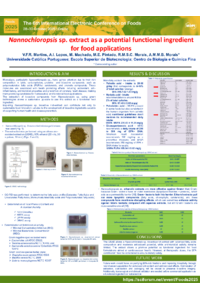
Sustainability is a worldwide concern, and the exploration of natural resources contributes to it. Microalgae biomass can source nutrients. Nannochloropsis sp. is a saltwater microalga, known for its bioactive compounds, such as phenolics, fatty acids (PUFAs including EPA), and carotenoids (e.g. violaxanthin and zeaxanthin). Therapeutic applications can be achieved via these bioactives, like cholesterol reduction with anti-atherosclerotic or anti-cancer properties. Nannochloropsis sp. biomass was supplied by A4F—Algae for Future (Portugal). The nutritional characterization of the biomass was performed via standard methodology (A.O.A.C.). Its bioactive compounds were extracted through maceration (hydroethanolic solution 90%, 50°C, 120 rpm, 2 h, repeated twice). The total phenolic content (TPC), the antioxidant activity (ABTS, DPPH, ORAC), the antimicrobial activity and the lipid profile of the extracts were determined. The results demonstrated that fat (36.6±0.0 g/100 g DW) is the majority macronutrient of the biomass, followed by carbohydrates (31.4±0.0 g/100 g DW) and protein (22.9±0.1 g/100 g DW). The TPC of the extract was 0.57±0.10 mg GAE/100 mg DW, and ABTS, DPPH, and ORAC were 1.35±0.27, 0.25±0.06 and 7.53±0.28 µmol TE/100 mg DW, respectively. The antimicrobial activity assay was performed, determining the minimal inhibitory concentration against bacteria Gram- Echerichia coli (1.25 mg/100 μL), Yersinia enterocolitica (0.63 mg/100 μL), Salmonela enterica serovar Enteridis (1.25 mg/100 μL), Gram+ Staphylococus aureus (1.25 mg/100 μL), Bacillus cereus (5 mg/100 μL), and Listeria monocytogenes (1.25 mg/100 μL). The minimal bactericidal concentration was above 5 mg/100 μL for all bacteria tested. The major fatty acids in the extract were palmitic acid (310.7±21.04 mg/g) and palmitoleic acid (235.0±11.25 mg/g).
Nannochloropsis sp. biomass has a good nutritional profile with healthy benefits, presenting an alternative to other unhealthy fats. The bioactive-rich extract presented antioxidant and antimicrobial activities. This extract has interesting functionality to be used as an ingredient in the food and feed sectors.
Keywords
Microalgae
Nannochloropsis
biochemical composition
bioactives
lipids
total phenolic content
antioxidant activity
antimicrobial activity.
Poster
ciforum-131465.pdf
Unlocking the functional and therapeutic potential of ultrasound-assisted millet protein extract using emerging analytical techniques like IR spectrometry, NMR, FTIR, Circular dichroism, XRD, and microscopic imaging
Combining pectin and sunflower seed protein for the development of biodegradable films with potential application in food packaging