Event submissions
Published
This submission belongs to the session B. Nutritional and Functional Foods of the event The 6th International Electronic Conference on Foods
Published date
27 Oct, 2025
Academic Editor
'%3e%3cpath%20d='M12.6657%2010.9104C12.4185%2010.325%2012.0599%209.79327%2011.6097%209.34482C11.1609%208.89508%2010.6293%208.5365%2010.0442%208.28888C10.0389%208.28626%2010.0337%208.28495%2010.0285%208.28233C10.8446%207.69279%2011.3752%206.73249%2011.3752%205.64904C11.3752%203.8542%209.92103%202.39999%208.1262%202.39999C6.33136%202.39999%204.87715%203.8542%204.87715%205.64904C4.87715%206.73249%205.40774%207.69279%206.22393%208.28364C6.21869%208.28626%206.21345%208.28757%206.20821%208.29019C5.62129%208.5378%205.09463%208.89284%204.64265%209.34613C4.1929%209.79493%203.83432%2010.3266%203.58671%2010.9117C3.34345%2011.4845%203.21226%2012.0987%203.20023%2012.7209C3.19988%2012.7349%203.20233%2012.7488%203.20744%2012.7619C3.21255%2012.7749%203.22022%2012.7867%203.22998%2012.7968C3.23975%2012.8068%203.25142%2012.8147%203.26431%2012.8202C3.2772%2012.8256%203.29105%2012.8284%203.30504%2012.8284H4.09109C4.14874%2012.8284%204.19459%2012.7825%204.1959%2012.7262C4.2221%2011.7148%204.62823%2010.7676%205.34617%2010.0497C6.08899%209.30683%207.0755%208.89808%208.1262%208.89808C9.17689%208.89808%2010.1634%209.30683%2010.9062%2010.0497C11.6242%2010.7676%2012.0303%2011.7148%2012.0565%2012.7262C12.0578%2012.7838%2012.1037%2012.8284%2012.1613%2012.8284H12.9474C12.9613%2012.8284%2012.9752%2012.8256%2012.9881%2012.8202C13.001%2012.8147%2013.0126%2012.8068%2013.0224%2012.7968C13.0322%2012.7867%2013.0398%2012.7749%2013.0449%2012.7619C13.0501%2012.7488%2013.0525%2012.7349%2013.0522%2012.7209C13.0391%2012.0947%2012.9094%2011.4855%2012.6657%2010.9104ZM8.1262%207.9024C7.52486%207.9024%206.9589%207.6679%206.53312%207.24211C6.10733%206.81633%205.87283%206.25037%205.87283%205.64904C5.87283%205.0477%206.10733%204.48174%206.53312%204.05596C6.9589%203.63018%207.52486%203.39567%208.1262%203.39567C8.72753%203.39567%209.29349%203.63018%209.71927%204.05596C10.1451%204.48174%2010.3796%205.0477%2010.3796%205.64904C10.3796%206.25037%2010.1451%206.81633%209.71927%207.24211C9.29349%207.6679%208.72753%207.9024%208.1262%207.9024Z'%20fill='%235D1EE1'/%3e%3c/g%3e%3c/svg%3e) Antonello Santini
Antonello SantiniCitation
Silvia Cañas, María Paz Jiménez-Losilla, Sandra García-Muñoz, Shuai Hu, Miguel Rebollo-Hernanz, Yolanda Aguilera, María A. Martín-Cabrejas, In Vitro Antioxidant Properties of Coffee Pulp and Cocoa Shell Infusions for Sustainable Functional Beverages, in Proceedings of The 6th International Electronic Conference on Foods, 28 October–30 October 2025, MDPI: Basel, Switzerland
Share
Email
Facebook
Twitter
LinkedIn
In Vitro Antioxidant Properties of Coffee Pulp and Cocoa Shell Infusions for Sustainable Functional Beverages

Silvia Cañas 1,2
'%3e%3cpath%20d='M12.6647%2010.9104C12.4176%2010.325%2012.0589%209.7933%2011.6088%209.34485C11.16%208.89511%2010.6283%208.53653%2010.0432%208.28891C10.038%208.28629%2010.0327%208.28498%2010.0275%208.28236C10.8437%207.69282%2011.3743%206.73252%2011.3743%205.64907C11.3743%203.85423%209.92005%202.40002%208.12522%202.40002C6.33038%202.40002%204.87618%203.85423%204.87618%205.64907C4.87618%206.73252%205.40677%207.69282%206.22296%208.28367C6.21772%208.28629%206.21248%208.2876%206.20724%208.29022C5.62031%208.53783%205.09365%208.89287%204.64167%209.34616C4.19192%209.79496%203.83334%2010.3266%203.58573%2010.9117C3.34247%2011.4846%203.21128%2012.0987%203.19925%2012.721C3.1989%2012.735%203.20135%2012.7489%203.20646%2012.7619C3.21157%2012.7749%203.21924%2012.7868%203.22901%2012.7968C3.23877%2012.8068%203.25045%2012.8148%203.26334%2012.8202C3.27623%2012.8256%203.29007%2012.8284%203.30406%2012.8284H4.09012C4.14776%2012.8284%204.19362%2012.7825%204.19493%2012.7262C4.22113%2011.7148%204.62726%2010.7676%205.34519%2010.0497C6.08802%209.30686%207.07452%208.89811%208.12522%208.89811C9.17592%208.89811%2010.1624%209.30686%2010.9052%2010.0497C11.6232%2010.7676%2012.0293%2011.7148%2012.0555%2012.7262C12.0568%2012.7839%2012.1027%2012.8284%2012.1603%2012.8284H12.9464C12.9604%2012.8284%2012.9742%2012.8256%2012.9871%2012.8202C13%2012.8148%2013.0117%2012.8068%2013.0214%2012.7968C13.0312%2012.7868%2013.0389%2012.7749%2013.044%2012.7619C13.0491%2012.7489%2013.0515%2012.735%2013.0512%2012.721C13.0381%2012.0947%2012.9084%2011.4856%2012.6647%2010.9104ZM8.12522%207.90243C7.52388%207.90243%206.95792%207.66793%206.53214%207.24215C6.10636%206.81636%205.87185%206.2504%205.87185%205.64907C5.87185%205.04773%206.10636%204.48177%206.53214%204.05599C6.95792%203.63021%207.52388%203.3957%208.12522%203.3957C8.72655%203.3957%209.29252%203.63021%209.7183%204.05599C10.1441%204.48177%2010.3786%205.04773%2010.3786%205.64907C10.3786%206.2504%2010.1441%206.81636%209.7183%207.24215C9.29252%207.66793%208.72655%207.90243%208.12522%207.90243Z'%20fill='%235D1EE1'/%3e%3c/g%3e%3c/svg%3e)
María Paz Jiménez-Losilla 1
Sandra García-Muñoz 1
Shuai Hu 1,2

Miguel Rebollo-Hernanz 1,2

Yolanda Aguilera 1,2

María A. Martín-Cabrejas 1,2
1. Department of Agricultural Chemistry and Food Science, Universidad Autónoma de Madrid, 28049 Madrid, Spain
2. Institute of Food Science Research, CIAL (UAM-CSIC), 28049 Madrid, Spain
Abstract
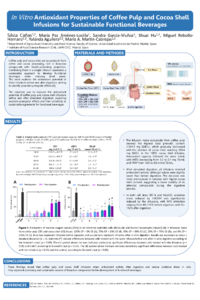
Coffee pulp and cocoa shell are by-products from coffee and cocoa processing rich in bioactive compounds with antioxidant and anti-inflammatory properties. Evaluating the combination of these materials in a single infusion intended for human consumption represents a promising strategy to enhance their functional potential. This study aims to evaluate the antioxidant capacity of the combined infusion before and after simulated in vitro digestion, through in vitro and cell-based assays, to explore synergistic effects and support sustainable functional beverage development. Infusions were prepared using different concentrations of coffee pulp and cocoa shell. A standardized simulated in vitro digestion protocol based on the INFOGEST model was applied to the coffee pulp and cocoa shell infusions to mimic gastrointestinal conditions. The total phenolic content (TPC) was quantified using the Folin-Ciocalteu method. Antioxidant activity was assessed through FRAP and ABTS assays. Additionally, intracellular reactive oxygen species (ROS) levels were measured in IEC-6 (rat intestinal epithelial) and HepG2 (human hepatocellular carcinoma) cell lines after oxidative stress was induced with tert-butyl hydroperoxide (t-BOOH). TPC was significantly higher in the infusion made exclusively from coffee pulp (1341.3 mg GAE/L), decreasing progressively with increasing cocoa shell content, down to 308.4 mg GAE/L in the 100% cocoa shell infusion. Antioxidant capacity (ABTS and FRAP) followed the same trend: ABTS dropped from 3.2 to 0.1 mg TE/mL and FRAP from 14.9 to 0.6 mmol TE/mL. This same trend was observed in infusions after in vitro digestion. Infusions and digested infusions were not toxic to IEC-6 and HepG2 cells, maintaining ≥93% viability. t-BOOH-induced ROS were prevented by the infusions (48-114 %) and the digested infusions (43-112 %) in both intestinal and hepatic cells. In conclusion, coffee pulp and cocoa shell infusions retain antioxidant activity after digestion and reduce cellular oxidative stress, supporting their use as sustainable functional beverages.
Keywords
Coffee pulp
Cocoa shell
Antioxidant activity
In vitro digestion
Oxidative Stress
Functional beverages
Poster
POSTER_foods_2025.pdf
A sustainable approach for recovering high-value bioactive lipids from coffee pulp using ethanol-modified supercritical carbon dioxide
Can bees be considered as proactive microplastic samplers?