Event submissions
Published
This submission belongs to the session B. Nutritional and Functional Foods of the event The 6th International Electronic Conference on Foods
Published date
27 Oct, 2025
Academic Editor
'%3e%3cpath%20d='M12.6657%2010.9104C12.4185%2010.325%2012.0599%209.79327%2011.6097%209.34482C11.1609%208.89508%2010.6293%208.5365%2010.0442%208.28888C10.0389%208.28626%2010.0337%208.28495%2010.0285%208.28233C10.8446%207.69279%2011.3752%206.73249%2011.3752%205.64904C11.3752%203.8542%209.92103%202.39999%208.1262%202.39999C6.33136%202.39999%204.87715%203.8542%204.87715%205.64904C4.87715%206.73249%205.40774%207.69279%206.22393%208.28364C6.21869%208.28626%206.21345%208.28757%206.20821%208.29019C5.62129%208.5378%205.09463%208.89284%204.64265%209.34613C4.1929%209.79493%203.83432%2010.3266%203.58671%2010.9117C3.34345%2011.4845%203.21226%2012.0987%203.20023%2012.7209C3.19988%2012.7349%203.20233%2012.7488%203.20744%2012.7619C3.21255%2012.7749%203.22022%2012.7867%203.22998%2012.7968C3.23975%2012.8068%203.25142%2012.8147%203.26431%2012.8202C3.2772%2012.8256%203.29105%2012.8284%203.30504%2012.8284H4.09109C4.14874%2012.8284%204.19459%2012.7825%204.1959%2012.7262C4.2221%2011.7148%204.62823%2010.7676%205.34617%2010.0497C6.08899%209.30683%207.0755%208.89808%208.1262%208.89808C9.17689%208.89808%2010.1634%209.30683%2010.9062%2010.0497C11.6242%2010.7676%2012.0303%2011.7148%2012.0565%2012.7262C12.0578%2012.7838%2012.1037%2012.8284%2012.1613%2012.8284H12.9474C12.9613%2012.8284%2012.9752%2012.8256%2012.9881%2012.8202C13.001%2012.8147%2013.0126%2012.8068%2013.0224%2012.7968C13.0322%2012.7867%2013.0398%2012.7749%2013.0449%2012.7619C13.0501%2012.7488%2013.0525%2012.7349%2013.0522%2012.7209C13.0391%2012.0947%2012.9094%2011.4855%2012.6657%2010.9104ZM8.1262%207.9024C7.52486%207.9024%206.9589%207.6679%206.53312%207.24211C6.10733%206.81633%205.87283%206.25037%205.87283%205.64904C5.87283%205.0477%206.10733%204.48174%206.53312%204.05596C6.9589%203.63018%207.52486%203.39567%208.1262%203.39567C8.72753%203.39567%209.29349%203.63018%209.71927%204.05596C10.1451%204.48174%2010.3796%205.0477%2010.3796%205.64904C10.3796%206.25037%2010.1451%206.81633%209.71927%207.24211C9.29349%207.6679%208.72753%207.9024%208.1262%207.9024Z'%20fill='%235D1EE1'/%3e%3c/g%3e%3c/svg%3e) Manuel Viuda-Martos
Manuel Viuda-MartosCitation
SATHISH KUMAR MH, Rajani CS, Kaustav Majumder, Prabhashis Bose, Priyanka Singh Rao, Hypoglycemic effect of alphaS1-casein hydrolysates extracted from milk of Gir cows, in Proceedings of The 6th International Electronic Conference on Foods, 28 October–30 October 2025, MDPI: Basel, Switzerland
Share
Email
Facebook
Twitter
LinkedIn
Hypoglycemic effect of alphaS1-casein hydrolysates extracted from milk of Gir cows
'%3e%3cpath%20d='M12.6647%2010.9104C12.4176%2010.325%2012.0589%209.7933%2011.6088%209.34485C11.16%208.89511%2010.6283%208.53653%2010.0432%208.28891C10.038%208.28629%2010.0327%208.28498%2010.0275%208.28236C10.8437%207.69282%2011.3743%206.73252%2011.3743%205.64907C11.3743%203.85423%209.92005%202.40002%208.12522%202.40002C6.33038%202.40002%204.87618%203.85423%204.87618%205.64907C4.87618%206.73252%205.40677%207.69282%206.22296%208.28367C6.21772%208.28629%206.21248%208.2876%206.20724%208.29022C5.62031%208.53783%205.09365%208.89287%204.64167%209.34616C4.19192%209.79496%203.83334%2010.3266%203.58573%2010.9117C3.34247%2011.4846%203.21128%2012.0987%203.19925%2012.721C3.1989%2012.735%203.20135%2012.7489%203.20646%2012.7619C3.21157%2012.7749%203.21924%2012.7868%203.22901%2012.7968C3.23877%2012.8068%203.25045%2012.8148%203.26334%2012.8202C3.27623%2012.8256%203.29007%2012.8284%203.30406%2012.8284H4.09012C4.14776%2012.8284%204.19362%2012.7825%204.19493%2012.7262C4.22113%2011.7148%204.62726%2010.7676%205.34519%2010.0497C6.08802%209.30686%207.07452%208.89811%208.12522%208.89811C9.17592%208.89811%2010.1624%209.30686%2010.9052%2010.0497C11.6232%2010.7676%2012.0293%2011.7148%2012.0555%2012.7262C12.0568%2012.7839%2012.1027%2012.8284%2012.1603%2012.8284H12.9464C12.9604%2012.8284%2012.9742%2012.8256%2012.9871%2012.8202C13%2012.8148%2013.0117%2012.8068%2013.0214%2012.7968C13.0312%2012.7868%2013.0389%2012.7749%2013.044%2012.7619C13.0491%2012.7489%2013.0515%2012.735%2013.0512%2012.721C13.0381%2012.0947%2012.9084%2011.4856%2012.6647%2010.9104ZM8.12522%207.90243C7.52388%207.90243%206.95792%207.66793%206.53214%207.24215C6.10636%206.81636%205.87185%206.2504%205.87185%205.64907C5.87185%205.04773%206.10636%204.48177%206.53214%204.05599C6.95792%203.63021%207.52388%203.3957%208.12522%203.3957C8.72655%203.3957%209.29252%203.63021%209.7183%204.05599C10.1441%204.48177%2010.3786%205.04773%2010.3786%205.64907C10.3786%206.2504%2010.1441%206.81636%209.7183%207.24215C9.29252%207.66793%208.72655%207.90243%208.12522%207.90243Z'%20fill='%235D1EE1'/%3e%3c/g%3e%3c/svg%3e)
SATHISH KUMAR MH 1
Rajani CS 1
Kaustav Majumder 2
Prabhashis Bose 2
Priyanka Singh Rao 1
1. ICAR-National Dairy Research Institute, Karnal, Haryana, 132001, India
2. Department of Food Science & Technology, University of Nebraska–Lincoln, Lincoln, Nebraska, 68588-6205, United States
Abstract
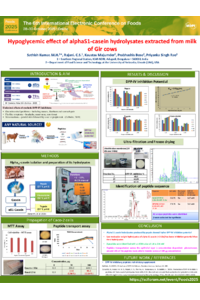
Introduction: Recent research in food and nutrition sciences has explored milk peptides for their nutraceutical and therapeutic benefits. In this study, an attempt was made to assess the hypoglycemic effect of αS1-casein (αS1-CSN) isolated from the milk of Gir through dipeptidyl peptidase – IV (DPP-IV) inhibition.
Methods: The enzymatic hydrolysis of extracted αS1-CSN was carried out using Flavourzyme, pepsin and trypsin individually at 1%, 2% and 4% enzyme–substrate (E-S) ratios for a period of 2 - 12 h. This hydrolysate was ultra-filtered through 10 and 3 kDa cutoff membranes in order to obtain low-molecular-weight peptides. Permeate of 3 kDa was subjected to preparatory RP-HPLC in order to collect time-bound fractions. Later, peptide sequencing was performed through LC-MS/MS. Furthermore, the α-CSN hydrolysate was assessed with a peptide transportation assay using the caco2 cell line model.
Results: The hydrolysate obtained from pepsin treatment after 4 h at a 4% E-S ratio showed maximum DPP-IV inhibition (92.08±1.77%) with an IC50 value of 140.3 µg/mL, and the corresponding degree of hydrolysis was 11.22±1.06%. A total of 45 time-based (collected every 30 s) peaks were recorded and evaluated for % DPP-IV inhibition; among them, fraction 27 showed the highest DPP-IV inhibition (65.31±2.41%), and this fraction was subjected to UHPLC and LC-MS/MS analysis, through which 40 unique peptides were identified. Most of the peptides identified (~85%) belonged to the region of f193-213 and f137 to 154 in αS1-CSN. Among them, two low-molecular-weight peptides were synthesized, viz., IPNPIGSENSE and IQKEDVPSE, and assessed for DPP-IV inhibition; later, one showed the lowest IC50 value of 1.67mM. Cell viability was not affected with up to 100 µg of product per well, and about 10% of the peptides were transported from the apical to the basal chamber in a time of 2 h.
Conclusion: The developed hydrolysate of αS1-CSN could be a potential hypoglycemic product.
Keywords
alpha-casein
diabetes
DPP-IV inhibition
caco2 cells
hypoglycemic peptides
Poster
2025 Sathish Kumar_Poster_Sci-form- 131235.pdf
How the Processing of Sardines and Sprats Affects the Adhesion of Lactobacillus spp. in an Intestinal Cell Model
Preparation and characterisation of galactooligosaccharide-rich spray-dried paneer whey powder