Event submissions
Published
This submission belongs to the session B. Nutritional and Functional Foods of the event The 6th International Electronic Conference on Foods
Published date
27 Oct, 2025
Academic Editor
'%3e%3cpath%20d='M12.6657%2010.9104C12.4185%2010.325%2012.0599%209.79327%2011.6097%209.34482C11.1609%208.89508%2010.6293%208.5365%2010.0442%208.28888C10.0389%208.28626%2010.0337%208.28495%2010.0285%208.28233C10.8446%207.69279%2011.3752%206.73249%2011.3752%205.64904C11.3752%203.8542%209.92103%202.39999%208.1262%202.39999C6.33136%202.39999%204.87715%203.8542%204.87715%205.64904C4.87715%206.73249%205.40774%207.69279%206.22393%208.28364C6.21869%208.28626%206.21345%208.28757%206.20821%208.29019C5.62129%208.5378%205.09463%208.89284%204.64265%209.34613C4.1929%209.79493%203.83432%2010.3266%203.58671%2010.9117C3.34345%2011.4845%203.21226%2012.0987%203.20023%2012.7209C3.19988%2012.7349%203.20233%2012.7488%203.20744%2012.7619C3.21255%2012.7749%203.22022%2012.7867%203.22998%2012.7968C3.23975%2012.8068%203.25142%2012.8147%203.26431%2012.8202C3.2772%2012.8256%203.29105%2012.8284%203.30504%2012.8284H4.09109C4.14874%2012.8284%204.19459%2012.7825%204.1959%2012.7262C4.2221%2011.7148%204.62823%2010.7676%205.34617%2010.0497C6.08899%209.30683%207.0755%208.89808%208.1262%208.89808C9.17689%208.89808%2010.1634%209.30683%2010.9062%2010.0497C11.6242%2010.7676%2012.0303%2011.7148%2012.0565%2012.7262C12.0578%2012.7838%2012.1037%2012.8284%2012.1613%2012.8284H12.9474C12.9613%2012.8284%2012.9752%2012.8256%2012.9881%2012.8202C13.001%2012.8147%2013.0126%2012.8068%2013.0224%2012.7968C13.0322%2012.7867%2013.0398%2012.7749%2013.0449%2012.7619C13.0501%2012.7488%2013.0525%2012.7349%2013.0522%2012.7209C13.0391%2012.0947%2012.9094%2011.4855%2012.6657%2010.9104ZM8.1262%207.9024C7.52486%207.9024%206.9589%207.6679%206.53312%207.24211C6.10733%206.81633%205.87283%206.25037%205.87283%205.64904C5.87283%205.0477%206.10733%204.48174%206.53312%204.05596C6.9589%203.63018%207.52486%203.39567%208.1262%203.39567C8.72753%203.39567%209.29349%203.63018%209.71927%204.05596C10.1451%204.48174%2010.3796%205.0477%2010.3796%205.64904C10.3796%206.25037%2010.1451%206.81633%209.71927%207.24211C9.29349%207.6679%208.72753%207.9024%208.1262%207.9024Z'%20fill='%235D1EE1'/%3e%3c/g%3e%3c/svg%3e) Manuel Viuda-Martos
Manuel Viuda-MartosCitation
Kumkum Cr, Katherine M Livingstone, Kathryn Aston-Mourney, Bryony A. McNeill, Leni Rivera, Anthocyanin-Based Dietary Supplements in the Australian Online Market: Their Composition, Formulation, and Health Claims., in Proceedings of The 6th International Electronic Conference on Foods, 28 October–30 October 2025, MDPI: Basel, Switzerland
Share
Email
Facebook
Twitter
LinkedIn
Anthocyanin-Based Dietary Supplements in the Australian Online Market: Their Composition, Formulation, and Health Claims.
'%3e%3cpath%20d='M12.6647%2010.9104C12.4176%2010.325%2012.0589%209.7933%2011.6088%209.34485C11.16%208.89511%2010.6283%208.53653%2010.0432%208.28891C10.038%208.28629%2010.0327%208.28498%2010.0275%208.28236C10.8437%207.69282%2011.3743%206.73252%2011.3743%205.64907C11.3743%203.85423%209.92005%202.40002%208.12522%202.40002C6.33038%202.40002%204.87618%203.85423%204.87618%205.64907C4.87618%206.73252%205.40677%207.69282%206.22296%208.28367C6.21772%208.28629%206.21248%208.2876%206.20724%208.29022C5.62031%208.53783%205.09365%208.89287%204.64167%209.34616C4.19192%209.79496%203.83334%2010.3266%203.58573%2010.9117C3.34247%2011.4846%203.21128%2012.0987%203.19925%2012.721C3.1989%2012.735%203.20135%2012.7489%203.20646%2012.7619C3.21157%2012.7749%203.21924%2012.7868%203.22901%2012.7968C3.23877%2012.8068%203.25045%2012.8148%203.26334%2012.8202C3.27623%2012.8256%203.29007%2012.8284%203.30406%2012.8284H4.09012C4.14776%2012.8284%204.19362%2012.7825%204.19493%2012.7262C4.22113%2011.7148%204.62726%2010.7676%205.34519%2010.0497C6.08802%209.30686%207.07452%208.89811%208.12522%208.89811C9.17592%208.89811%2010.1624%209.30686%2010.9052%2010.0497C11.6232%2010.7676%2012.0293%2011.7148%2012.0555%2012.7262C12.0568%2012.7839%2012.1027%2012.8284%2012.1603%2012.8284H12.9464C12.9604%2012.8284%2012.9742%2012.8256%2012.9871%2012.8202C13%2012.8148%2013.0117%2012.8068%2013.0214%2012.7968C13.0312%2012.7868%2013.0389%2012.7749%2013.044%2012.7619C13.0491%2012.7489%2013.0515%2012.735%2013.0512%2012.721C13.0381%2012.0947%2012.9084%2011.4856%2012.6647%2010.9104ZM8.12522%207.90243C7.52388%207.90243%206.95792%207.66793%206.53214%207.24215C6.10636%206.81636%205.87185%206.2504%205.87185%205.64907C5.87185%205.04773%206.10636%204.48177%206.53214%204.05599C6.95792%203.63021%207.52388%203.3957%208.12522%203.3957C8.72655%203.3957%209.29252%203.63021%209.7183%204.05599C10.1441%204.48177%2010.3786%205.04773%2010.3786%205.64907C10.3786%206.2504%2010.1441%206.81636%209.7183%207.24215C9.29252%207.66793%208.72655%207.90243%208.12522%207.90243Z'%20fill='%235D1EE1'/%3e%3c/g%3e%3c/svg%3e)
Kumkum Cr 1
Katherine M Livingstone 1
Kathryn Aston-Mourney 1
Bryony A. McNeill 1
Leni Rivera 1
1. School of Medicine, Deakin University, Geelong, VIC 3216, Australia
Abstract
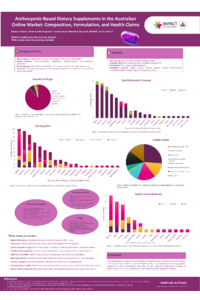
Amidst growing consumer interest in anthocyanins’ health benefits, the market for anthocyanin-based supplements has expanded rapidly. However, data on the composition, formulation, and health positioning of these products in the Australian online market remains limited. This study addresses this gap through a comprehensive analysis of anthocyanin-based dietary supplements available online in Australia (in July–August 2024), focusing on key product characteristics, including their origin, sources, formulation, concentration, content, claims, dosage, and pricing. Among 121 analysed products, bilberry, elderberry, and tart cherry were the most common sources, representing 47% of the market. Capsules were the dominant delivery format (86%), and the extract concentrations varied widely, where lower concentrations (1–10:1) were the most prevalent, indicating that the extracts were less than 10 times concentrated from fresh fruits. Only 12% of the products disclosed their anthocyanin levels (0.1%–39%), with bilberry-based products dominating this category. Health claims appeared for 69% of the products, often linking bilberry to vision health, elderberry to immune support, tart cherry to joint and muscle recovery, and cranberry to urinary tract health. However, most claims did not reference clinical evidence or use approved wording under the Food Standards Australia New Zealand (FSANZ) or Therapeutic Goods Administration (TGA) regulations, and regulatory disclaimers were inconsistently provided. This suggests limited regulatory compliance across product labelling. The amount of the extract per serving varied significantly, ranging from 10 mg to 1,000 mg. Pricing analysis revealed a large cost range (AUD 0.02–7.40/g; average of AUD 0.78/g), with bilberry being the most expensive and tart cherry the cheapest. This analysis provides valuable insights for consumers seeking to make informed decisions, health professionals offering evidence-based guidance, researchers optimising delivery formats, and manufacturers improving their product offerings. Moreover, the findings highlight the need for greater transparency in product labelling and underscore the necessity for FSANZ to enhance the scrutiny of online products, particularly those sourced internationally, to ensure adherence to labelling and health claim standards under Australian regulations.
Keywords
anthocyanins
anthocyanin supplements
berries
health claims
food regulations
Poster
sciforum-131180.pdf
Life Cycle Assessment as a Decision-Making Tool for the Sustainable Valorization of Agro-Industrial Byproducts in Paraguay: A Case Study of Acrocomia aculeata Endocarp.
Digested or Extracted? Edible Insect Effects on Human Cells and Probiotics