Event submissions
Published
This submission belongs to the session B. Nutritional and Functional Foods of the event The 6th International Electronic Conference on Foods
Published date
27 Oct, 2025
Academic Editor
'%3e%3cpath%20d='M12.6657%2010.9104C12.4185%2010.325%2012.0599%209.79327%2011.6097%209.34482C11.1609%208.89508%2010.6293%208.5365%2010.0442%208.28888C10.0389%208.28626%2010.0337%208.28495%2010.0285%208.28233C10.8446%207.69279%2011.3752%206.73249%2011.3752%205.64904C11.3752%203.8542%209.92103%202.39999%208.1262%202.39999C6.33136%202.39999%204.87715%203.8542%204.87715%205.64904C4.87715%206.73249%205.40774%207.69279%206.22393%208.28364C6.21869%208.28626%206.21345%208.28757%206.20821%208.29019C5.62129%208.5378%205.09463%208.89284%204.64265%209.34613C4.1929%209.79493%203.83432%2010.3266%203.58671%2010.9117C3.34345%2011.4845%203.21226%2012.0987%203.20023%2012.7209C3.19988%2012.7349%203.20233%2012.7488%203.20744%2012.7619C3.21255%2012.7749%203.22022%2012.7867%203.22998%2012.7968C3.23975%2012.8068%203.25142%2012.8147%203.26431%2012.8202C3.2772%2012.8256%203.29105%2012.8284%203.30504%2012.8284H4.09109C4.14874%2012.8284%204.19459%2012.7825%204.1959%2012.7262C4.2221%2011.7148%204.62823%2010.7676%205.34617%2010.0497C6.08899%209.30683%207.0755%208.89808%208.1262%208.89808C9.17689%208.89808%2010.1634%209.30683%2010.9062%2010.0497C11.6242%2010.7676%2012.0303%2011.7148%2012.0565%2012.7262C12.0578%2012.7838%2012.1037%2012.8284%2012.1613%2012.8284H12.9474C12.9613%2012.8284%2012.9752%2012.8256%2012.9881%2012.8202C13.001%2012.8147%2013.0126%2012.8068%2013.0224%2012.7968C13.0322%2012.7867%2013.0398%2012.7749%2013.0449%2012.7619C13.0501%2012.7488%2013.0525%2012.7349%2013.0522%2012.7209C13.0391%2012.0947%2012.9094%2011.4855%2012.6657%2010.9104ZM8.1262%207.9024C7.52486%207.9024%206.9589%207.6679%206.53312%207.24211C6.10733%206.81633%205.87283%206.25037%205.87283%205.64904C5.87283%205.0477%206.10733%204.48174%206.53312%204.05596C6.9589%203.63018%207.52486%203.39567%208.1262%203.39567C8.72753%203.39567%209.29349%203.63018%209.71927%204.05596C10.1451%204.48174%2010.3796%205.0477%2010.3796%205.64904C10.3796%206.25037%2010.1451%206.81633%209.71927%207.24211C9.29349%207.6679%208.72753%207.9024%208.1262%207.9024Z'%20fill='%235D1EE1'/%3e%3c/g%3e%3c/svg%3e) Manuel Viuda-Martos
Manuel Viuda-MartosCitation
João Ferreira, Marcos Trigo, Carlos Martins-Gomes, Santiago P. Aubourg, Ricardo Prego, Luís M. M. Ferreira, Mário Pacheco, Amélia M. Silva, Isabel Gaivão, Filling the gap in Grateloupia turuturu and Porphyra umbilicalis nutritional and functional profiling: red seaweeds as sustainable alternatives to terrestrial crops, in Proceedings of The 6th International Electronic Conference on Foods, 28 October–30 October 2025, MDPI: Basel, Switzerland
Share
Email
Facebook
Twitter
LinkedIn
Filling the gap in Grateloupia turuturu and Porphyra umbilicalis nutritional and functional profiling: red seaweeds as sustainable alternatives to terrestrial crops
'%3e%3cpath%20d='M12.6647%2010.9104C12.4176%2010.325%2012.0589%209.7933%2011.6088%209.34485C11.16%208.89511%2010.6283%208.53653%2010.0432%208.28891C10.038%208.28629%2010.0327%208.28498%2010.0275%208.28236C10.8437%207.69282%2011.3743%206.73252%2011.3743%205.64907C11.3743%203.85423%209.92005%202.40002%208.12522%202.40002C6.33038%202.40002%204.87618%203.85423%204.87618%205.64907C4.87618%206.73252%205.40677%207.69282%206.22296%208.28367C6.21772%208.28629%206.21248%208.2876%206.20724%208.29022C5.62031%208.53783%205.09365%208.89287%204.64167%209.34616C4.19192%209.79496%203.83334%2010.3266%203.58573%2010.9117C3.34247%2011.4846%203.21128%2012.0987%203.19925%2012.721C3.1989%2012.735%203.20135%2012.7489%203.20646%2012.7619C3.21157%2012.7749%203.21924%2012.7868%203.22901%2012.7968C3.23877%2012.8068%203.25045%2012.8148%203.26334%2012.8202C3.27623%2012.8256%203.29007%2012.8284%203.30406%2012.8284H4.09012C4.14776%2012.8284%204.19362%2012.7825%204.19493%2012.7262C4.22113%2011.7148%204.62726%2010.7676%205.34519%2010.0497C6.08802%209.30686%207.07452%208.89811%208.12522%208.89811C9.17592%208.89811%2010.1624%209.30686%2010.9052%2010.0497C11.6232%2010.7676%2012.0293%2011.7148%2012.0555%2012.7262C12.0568%2012.7839%2012.1027%2012.8284%2012.1603%2012.8284H12.9464C12.9604%2012.8284%2012.9742%2012.8256%2012.9871%2012.8202C13%2012.8148%2013.0117%2012.8068%2013.0214%2012.7968C13.0312%2012.7868%2013.0389%2012.7749%2013.044%2012.7619C13.0491%2012.7489%2013.0515%2012.735%2013.0512%2012.721C13.0381%2012.0947%2012.9084%2011.4856%2012.6647%2010.9104ZM8.12522%207.90243C7.52388%207.90243%206.95792%207.66793%206.53214%207.24215C6.10636%206.81636%205.87185%206.2504%205.87185%205.64907C5.87185%205.04773%206.10636%204.48177%206.53214%204.05599C6.95792%203.63021%207.52388%203.3957%208.12522%203.3957C8.72655%203.3957%209.29252%203.63021%209.7183%204.05599C10.1441%204.48177%2010.3786%205.04773%2010.3786%205.64907C10.3786%206.2504%2010.1441%206.81636%209.7183%207.24215C9.29252%207.66793%208.72655%207.90243%208.12522%207.90243Z'%20fill='%235D1EE1'/%3e%3c/g%3e%3c/svg%3e)
João Ferreira 1,2
Marcos Trigo 3
Carlos Martins-Gomes 1
Santiago P. Aubourg 3
Ricardo Prego 4

Luís M. M. Ferreira 1,2

Mário Pacheco 5
Amélia M. Silva 1

Isabel Gaivão 2
1. Centre for Research and Technology of Agro-Environmental and Biological Sciences (CITAB), University of Trás-os-Montes and Alto Douro (UTAD), Quinta de Prados, 5000-801 Vila Real, Portugal.
2. Animal and Veterinary Research Centre (CECAV), UTAD, Quinta de Prados, 5000-801 Vila Real, Portugal.
3. Department of Food Technology, Marine Research Institute (CSIC), c/ Eduardo Cabello 6, 36208 Vigo, Spain.
4. Department of Oceanography, Marine Research Institute (CSIC), c/ Eduardo Cabello 6, 36208 Vigo, Spain.
5. Centre for Environmental and Marine Studies (CESAM) and Department of Biology, University of Aveiro, Campus Universitário de Santiago, 3810-193 Aveiro, Portugal.
Abstract
Seaweed farming and wild harvesting offer environmentally sustainable alternatives to conventional crop cultivation. Among red seaweeds, Grateloupia turuturu and Porphyra umbilicalis have gained attention due to their rich nutritional profiles and the presence of valuable bioactive compounds. Traditionally consumed in East Asia as vegetables, seasonings and sushi wrappings, their full potential remains underexplored, particularly regarding their detailed nutritional composition and functional bioactivities. In this study, proximate composition analyses were conducted following AOAC protocols, while mineral profiling was carried out using ICP-OES/ICP-MS. Hydroethanolic and aqueous seaweed extracts were prepared to assess acetylcholinesterase (AChE) inhibitory activity using Ellman’s assay. Additionally, the immunostimulatory effect of seaweed extracts was evaluated in RAW 264.7 macrophages through the colorimetric measurement of •NO production. Dietary fibre stood out as the predominant nutritional component (50% dw of P. umbilicalis). G. turuturu exhibited greater ash content (30.98% dw) than P. umbilicalis (21.61% dw), but a lower protein level (20.16% vs. 22.32% dw, respectively). Both seaweeds showed residual lipid levels (1.52 % dw). Sodium, zinc, iron, and iodine were identified as the most relevant minerals in both species. All extracts inhibited AChE activity by more than 20%, with the decoction of P. umbilicalis reaching nearly 50% inhibition. For immunostimulation, the decoction of G. turuturu at 0.20 mg/mL produced the highest increase in •NO levels, 153.17%. Through a literature-anchored review, when benchmarked against commonly consumed terrestrial plants with a high environmental footprint—namely wheat, white rice and tomatoes—G. turuturu and P. umbilicalis showed higher levels of protein, fibre, and minerals. Unlike conventional agricultural crops, these seaweeds can grow without the need for land, freshwater or chemicals, and display great bioactive potential. These results reinforce the potential of G. turuturu and P. umbilicalis as promising functional foods, highlighting their relevance as sustainable, nutrient-rich resources with promising neuroprotective and immunomodulatory properties.
Keywords
Rhodophyta
proximate composition
minerals
acetylcholinesterase inhibition
immunomodulation
agri-food comparison
functional food
Poster
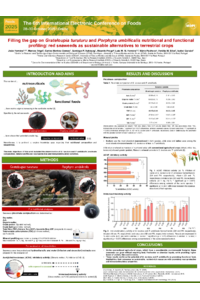
poster sciforum-131171.pdf
Postharvest Mycotoxin Contamination in Maize: Microbiological Insights from Ghana
Innovative valorization of bovine bones from the meat industry in Paraguay: mineral matrices for soil sustainability