Event submissions
Published
This submission belongs to the session F. Sustainable Food Security and Food Systems of the event The 6th International Electronic Conference on Foods
Published date
27 Oct, 2025
Academic Editor
'%3e%3cpath%20d='M12.6657%2010.9104C12.4185%2010.325%2012.0599%209.79327%2011.6097%209.34482C11.1609%208.89508%2010.6293%208.5365%2010.0442%208.28888C10.0389%208.28626%2010.0337%208.28495%2010.0285%208.28233C10.8446%207.69279%2011.3752%206.73249%2011.3752%205.64904C11.3752%203.8542%209.92103%202.39999%208.1262%202.39999C6.33136%202.39999%204.87715%203.8542%204.87715%205.64904C4.87715%206.73249%205.40774%207.69279%206.22393%208.28364C6.21869%208.28626%206.21345%208.28757%206.20821%208.29019C5.62129%208.5378%205.09463%208.89284%204.64265%209.34613C4.1929%209.79493%203.83432%2010.3266%203.58671%2010.9117C3.34345%2011.4845%203.21226%2012.0987%203.20023%2012.7209C3.19988%2012.7349%203.20233%2012.7488%203.20744%2012.7619C3.21255%2012.7749%203.22022%2012.7867%203.22998%2012.7968C3.23975%2012.8068%203.25142%2012.8147%203.26431%2012.8202C3.2772%2012.8256%203.29105%2012.8284%203.30504%2012.8284H4.09109C4.14874%2012.8284%204.19459%2012.7825%204.1959%2012.7262C4.2221%2011.7148%204.62823%2010.7676%205.34617%2010.0497C6.08899%209.30683%207.0755%208.89808%208.1262%208.89808C9.17689%208.89808%2010.1634%209.30683%2010.9062%2010.0497C11.6242%2010.7676%2012.0303%2011.7148%2012.0565%2012.7262C12.0578%2012.7838%2012.1037%2012.8284%2012.1613%2012.8284H12.9474C12.9613%2012.8284%2012.9752%2012.8256%2012.9881%2012.8202C13.001%2012.8147%2013.0126%2012.8068%2013.0224%2012.7968C13.0322%2012.7867%2013.0398%2012.7749%2013.0449%2012.7619C13.0501%2012.7488%2013.0525%2012.7349%2013.0522%2012.7209C13.0391%2012.0947%2012.9094%2011.4855%2012.6657%2010.9104ZM8.1262%207.9024C7.52486%207.9024%206.9589%207.6679%206.53312%207.24211C6.10733%206.81633%205.87283%206.25037%205.87283%205.64904C5.87283%205.0477%206.10733%204.48174%206.53312%204.05596C6.9589%203.63018%207.52486%203.39567%208.1262%203.39567C8.72753%203.39567%209.29349%203.63018%209.71927%204.05596C10.1451%204.48174%2010.3796%205.0477%2010.3796%205.64904C10.3796%206.25037%2010.1451%206.81633%209.71927%207.24211C9.29349%207.6679%208.72753%207.9024%208.1262%207.9024Z'%20fill='%235D1EE1'/%3e%3c/g%3e%3c/svg%3e) Theodoros Varzakas
Theodoros VarzakasCitation
Claudia Gómez-Leguizamón, Laura León-Ovelar, Mercedes Jiménez-Rosado, Alberto Romero, Innovative valorization of bovine bones from the meat industry in Paraguay: mineral matrices for soil sustainability, in Proceedings of The 6th International Electronic Conference on Foods, 28 October–30 October 2025, MDPI: Basel, Switzerland
Share
Email
Facebook
Twitter
LinkedIn
Innovative valorization of bovine bones from the meat industry in Paraguay: mineral matrices for soil sustainability
'%3e%3cpath%20d='M12.6647%2010.9104C12.4176%2010.325%2012.0589%209.7933%2011.6088%209.34485C11.16%208.89511%2010.6283%208.53653%2010.0432%208.28891C10.038%208.28629%2010.0327%208.28498%2010.0275%208.28236C10.8437%207.69282%2011.3743%206.73252%2011.3743%205.64907C11.3743%203.85423%209.92005%202.40002%208.12522%202.40002C6.33038%202.40002%204.87618%203.85423%204.87618%205.64907C4.87618%206.73252%205.40677%207.69282%206.22296%208.28367C6.21772%208.28629%206.21248%208.2876%206.20724%208.29022C5.62031%208.53783%205.09365%208.89287%204.64167%209.34616C4.19192%209.79496%203.83334%2010.3266%203.58573%2010.9117C3.34247%2011.4846%203.21128%2012.0987%203.19925%2012.721C3.1989%2012.735%203.20135%2012.7489%203.20646%2012.7619C3.21157%2012.7749%203.21924%2012.7868%203.22901%2012.7968C3.23877%2012.8068%203.25045%2012.8148%203.26334%2012.8202C3.27623%2012.8256%203.29007%2012.8284%203.30406%2012.8284H4.09012C4.14776%2012.8284%204.19362%2012.7825%204.19493%2012.7262C4.22113%2011.7148%204.62726%2010.7676%205.34519%2010.0497C6.08802%209.30686%207.07452%208.89811%208.12522%208.89811C9.17592%208.89811%2010.1624%209.30686%2010.9052%2010.0497C11.6232%2010.7676%2012.0293%2011.7148%2012.0555%2012.7262C12.0568%2012.7839%2012.1027%2012.8284%2012.1603%2012.8284H12.9464C12.9604%2012.8284%2012.9742%2012.8256%2012.9871%2012.8202C13%2012.8148%2013.0117%2012.8068%2013.0214%2012.7968C13.0312%2012.7868%2013.0389%2012.7749%2013.044%2012.7619C13.0491%2012.7489%2013.0515%2012.735%2013.0512%2012.721C13.0381%2012.0947%2012.9084%2011.4856%2012.6647%2010.9104ZM8.12522%207.90243C7.52388%207.90243%206.95792%207.66793%206.53214%207.24215C6.10636%206.81636%205.87185%206.2504%205.87185%205.64907C5.87185%205.04773%206.10636%204.48177%206.53214%204.05599C6.95792%203.63021%207.52388%203.3957%208.12522%203.3957C8.72655%203.3957%209.29252%203.63021%209.7183%204.05599C10.1441%204.48177%2010.3786%205.04773%2010.3786%205.64907C10.3786%206.2504%2010.1441%206.81636%209.7183%207.24215C9.29252%207.66793%208.72655%207.90243%208.12522%207.90243Z'%20fill='%235D1EE1'/%3e%3c/g%3e%3c/svg%3e)
Claudia Gómez-Leguizamón 1,2
Laura León-Ovelar 1
Mercedes Jiménez-Rosado 2,3

Alberto Romero 2
1. Faculty of Engineering, National University of Asunción, San Lorenzo, 2160, Paraguay
2. Department of Chemical Engineering, Faculty of Chemistry, University of Seville, 41012, Seville, Spain
3. Chemical, Environmental and Bioprocess Engineering Group, I4 Institute, University of León, 24071 León, Spain
Abstract
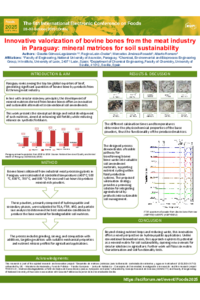
Paraguay ranks among the top ten global exporters of beef, generating significant quantities of bovine bone by-products from its thriving meat industry. These by-products are often underutilized, representing a lost opportunity within the food production chain. In line with circular economy principles, the development of mineral matrices derived from bovine bones offers an innovative and sustainable alternative to conventional soil amendments. This work presents the conceptual design and initial development of such matrices, aimed at enhancing soil fertility while reducing reliance on synthetic fertilizers. Bovine bones obtained from industrial meat processing plants in Paraguay were calcinated at controlled temperatures (400°C, 500 °C, 600°C, 700 °C, and 800 °C) for one and two hours to produce mineral-rich powders. Observations revealed variations in color and texture, indicative of phase transitions and composition changes. These powders, primarily composed of hydroxyapatite and secondary phases, were subjected to TGA, FTIR, XRD, and particle size analysis to determine the best calcination conditions to produce the base material for biodegradable soil matrices. The process includes grinding, sieving, and compaction with additives, targeting matrices with suitable mechanical properties and nutrient release profiles for agricultural applications. The different calcination times and temperatures determine the physicochemical properties of the base powders, thus the functionality of the produced matrices. The designed process demonstrates a feasible pathway for transforming bovine bone waste into valuable soil amendment materials, supporting nutrient cycling within food production systems. The proposed valorization strategy provides a promising solution for integrating agro-industrial by-products into sustainable soil management. Beyond closing nutrient loops and reducing waste, this innovation offers a novel perspective on hydroxyapatite applications. Unlike conventional biomedical uses, this approach explores its potential as a mineral matrix for soil sustainability, opening new avenues for circular solutions in agriculture. Further work will focus on matrix characterization and soil functionality tests.
Keywords
Bovine bone valorisation
circular economy
hydroxyapatite
soil amendment
agro-industrial by-products
Poster
sciforum-130958.pdf
Filling the gap in Grateloupia turuturu and Porphyra umbilicalis nutritional and functional profiling: red seaweeds as sustainable alternatives to terrestrial crops
Towards a Grass-Fed Certification System: The FILIERBA Project and the Future of Quality Livestock in Italy