Event submissions
Published
This submission belongs to the session F. Sustainable Food Security and Food Systems of the event The 6th International Electronic Conference on Foods
Published date
27 Oct, 2025
Academic Editor
'%3e%3cpath%20d='M12.6657%2010.9104C12.4185%2010.325%2012.0599%209.79327%2011.6097%209.34482C11.1609%208.89508%2010.6293%208.5365%2010.0442%208.28888C10.0389%208.28626%2010.0337%208.28495%2010.0285%208.28233C10.8446%207.69279%2011.3752%206.73249%2011.3752%205.64904C11.3752%203.8542%209.92103%202.39999%208.1262%202.39999C6.33136%202.39999%204.87715%203.8542%204.87715%205.64904C4.87715%206.73249%205.40774%207.69279%206.22393%208.28364C6.21869%208.28626%206.21345%208.28757%206.20821%208.29019C5.62129%208.5378%205.09463%208.89284%204.64265%209.34613C4.1929%209.79493%203.83432%2010.3266%203.58671%2010.9117C3.34345%2011.4845%203.21226%2012.0987%203.20023%2012.7209C3.19988%2012.7349%203.20233%2012.7488%203.20744%2012.7619C3.21255%2012.7749%203.22022%2012.7867%203.22998%2012.7968C3.23975%2012.8068%203.25142%2012.8147%203.26431%2012.8202C3.2772%2012.8256%203.29105%2012.8284%203.30504%2012.8284H4.09109C4.14874%2012.8284%204.19459%2012.7825%204.1959%2012.7262C4.2221%2011.7148%204.62823%2010.7676%205.34617%2010.0497C6.08899%209.30683%207.0755%208.89808%208.1262%208.89808C9.17689%208.89808%2010.1634%209.30683%2010.9062%2010.0497C11.6242%2010.7676%2012.0303%2011.7148%2012.0565%2012.7262C12.0578%2012.7838%2012.1037%2012.8284%2012.1613%2012.8284H12.9474C12.9613%2012.8284%2012.9752%2012.8256%2012.9881%2012.8202C13.001%2012.8147%2013.0126%2012.8068%2013.0224%2012.7968C13.0322%2012.7867%2013.0398%2012.7749%2013.0449%2012.7619C13.0501%2012.7488%2013.0525%2012.7349%2013.0522%2012.7209C13.0391%2012.0947%2012.9094%2011.4855%2012.6657%2010.9104ZM8.1262%207.9024C7.52486%207.9024%206.9589%207.6679%206.53312%207.24211C6.10733%206.81633%205.87283%206.25037%205.87283%205.64904C5.87283%205.0477%206.10733%204.48174%206.53312%204.05596C6.9589%203.63018%207.52486%203.39567%208.1262%203.39567C8.72753%203.39567%209.29349%203.63018%209.71927%204.05596C10.1451%204.48174%2010.3796%205.0477%2010.3796%205.64904C10.3796%206.25037%2010.1451%206.81633%209.71927%207.24211C9.29349%207.6679%208.72753%207.9024%208.1262%207.9024Z'%20fill='%235D1EE1'/%3e%3c/g%3e%3c/svg%3e) Theodoros Varzakas
Theodoros VarzakasCitation
Ángel Radhamés Pimentel Pujols, Fernando Borrás, Juana Fernández López, José Miguel García, Bell Pepper (Capsicum annuum) Production in Protected Environments in the Dominican Republic: Optimization of Fertigation and Substrate, in Proceedings of The 6th International Electronic Conference on Foods, 28 October–30 October 2025, MDPI: Basel, Switzerland
Share
Email
Facebook
Twitter
LinkedIn
Bell Pepper (Capsicum annuum) Production in Protected Environments in the Dominican Republic: Optimization of Fertigation and Substrate
'%3e%3cpath%20d='M12.6647%2010.9104C12.4176%2010.325%2012.0589%209.7933%2011.6088%209.34485C11.16%208.89511%2010.6283%208.53653%2010.0432%208.28891C10.038%208.28629%2010.0327%208.28498%2010.0275%208.28236C10.8437%207.69282%2011.3743%206.73252%2011.3743%205.64907C11.3743%203.85423%209.92005%202.40002%208.12522%202.40002C6.33038%202.40002%204.87618%203.85423%204.87618%205.64907C4.87618%206.73252%205.40677%207.69282%206.22296%208.28367C6.21772%208.28629%206.21248%208.2876%206.20724%208.29022C5.62031%208.53783%205.09365%208.89287%204.64167%209.34616C4.19192%209.79496%203.83334%2010.3266%203.58573%2010.9117C3.34247%2011.4846%203.21128%2012.0987%203.19925%2012.721C3.1989%2012.735%203.20135%2012.7489%203.20646%2012.7619C3.21157%2012.7749%203.21924%2012.7868%203.22901%2012.7968C3.23877%2012.8068%203.25045%2012.8148%203.26334%2012.8202C3.27623%2012.8256%203.29007%2012.8284%203.30406%2012.8284H4.09012C4.14776%2012.8284%204.19362%2012.7825%204.19493%2012.7262C4.22113%2011.7148%204.62726%2010.7676%205.34519%2010.0497C6.08802%209.30686%207.07452%208.89811%208.12522%208.89811C9.17592%208.89811%2010.1624%209.30686%2010.9052%2010.0497C11.6232%2010.7676%2012.0293%2011.7148%2012.0555%2012.7262C12.0568%2012.7839%2012.1027%2012.8284%2012.1603%2012.8284H12.9464C12.9604%2012.8284%2012.9742%2012.8256%2012.9871%2012.8202C13%2012.8148%2013.0117%2012.8068%2013.0214%2012.7968C13.0312%2012.7868%2013.0389%2012.7749%2013.044%2012.7619C13.0491%2012.7489%2013.0515%2012.735%2013.0512%2012.721C13.0381%2012.0947%2012.9084%2011.4856%2012.6647%2010.9104ZM8.12522%207.90243C7.52388%207.90243%206.95792%207.66793%206.53214%207.24215C6.10636%206.81636%205.87185%206.2504%205.87185%205.64907C5.87185%205.04773%206.10636%204.48177%206.53214%204.05599C6.95792%203.63021%207.52388%203.3957%208.12522%203.3957C8.72655%203.3957%209.29252%203.63021%209.7183%204.05599C10.1441%204.48177%2010.3786%205.04773%2010.3786%205.64907C10.3786%206.2504%2010.1441%206.81636%209.7183%207.24215C9.29252%207.66793%208.72655%207.90243%208.12522%207.90243Z'%20fill='%235D1EE1'/%3e%3c/g%3e%3c/svg%3e)
Ángel Radhamés Pimentel Pujols 1

Fernando Borrás 2

Juana Fernández López 3
José Miguel García 4
1. Faculty of Agronomic and Veterinary Sciences, School of Agronomic Engineering, Universidad Autónoma de Santo Domingo, Santo Domingo, 11005s, Dominican Republic
2. Department of Statistics and Operational Research, Miguel Hernández University of Elche, 03202-Elche, Alicante, Spain
3. Institute of Agri-Food and Agro-Environmental Research and Innovation, Miguel Hernández University of Elche (CIAGRO-UMH), 03312-Orihuela, Alicante, Spain
4. Dominican Institute of Agricultural and Forestry Research (IDIAF), Dominican Republic
Abstract
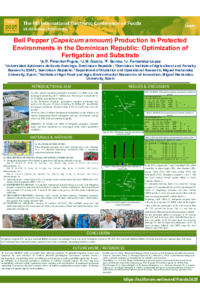
In 2022, global vegetable production exceeded 1.2 billion tons, with bell pepper accounting for 37 million tons. This crop is essential due to its versatility and nutritional value. In the Dominican Republic, greenhouse vegetable production has grown over the past 23 years, exceeding 10 million m². Specifically, bell pepper production increased from 9,122 to 32,000 tons over two decades. However, there is limited documented information on the influence of various management factors (fertigation and type of substrate, among others) on fruit yield and nutritional quality.
This study evaluated the effects of three fertigation programs (EC in the ranges of 1.2 to 1.9, 1.2 to 2, and 1.4 to 2.2 dS/m, respectively) and substrate types (rice husk biochar, coconut fiber, and a 50/50 mix of both) on bell pepper productivity and quality under protected conditions. The experiment followed a split-plot design with four replications. Evaluated variables included plant height, first internode diameter, canopy width, chlorophyll and nitrogen levels, leaf temperature, fruit size, yield, and Brix degree.
The rice charcoal substrate and its mixture with coconut fiber significantly outperformed coconut fiber alone in terms of fruit weight, diameter, and length. No significant interaction effects were observed (p > 0.05). Brix values ranged from 5.20 to 7.9, averaging 6.50. Fruit size in the rice charcoal substrate increased by 28% compared to coconut fiber; program three significantly outperformed program one by 27% in yields. The biochar substrate, combined with the highest nutrient dose, produced the best results.
In conclusion, bell pepper responds significantly to high nutrient doses and shows better adaptation to rice husk biochar as a substrate. The optimization of pepper crop management in a protected environment through the control of fertigation and substrate would increase the productivity of this crop in the Dominican Republic and improve the quality of the fruit obtained.
Keywords
Fertigation
nutrient solution
protected environment
Capsicum annuum
Poster
sciforum-131024.pdf
AQUEOUS EXTRACTION OF CHICKPEA (Cicer arietinum) PROTEIN ASSISTED BY PAPAIN: IMPACTS ON BIOACTIVITY
Sustainable Recovery of Antioxidant Amphiphilic and Lipophilic Bioactives from Avocado By-Products via Green Extraction for Food and Cosmetic Applications