Event submissions
Published
This submission belongs to the session B. Nutritional and Functional Foods of the event The 6th International Electronic Conference on Foods
Published date
27 Oct, 2025
Academic Editor
'%3e%3cpath%20d='M12.6657%2010.9104C12.4185%2010.325%2012.0599%209.79327%2011.6097%209.34482C11.1609%208.89508%2010.6293%208.5365%2010.0442%208.28888C10.0389%208.28626%2010.0337%208.28495%2010.0285%208.28233C10.8446%207.69279%2011.3752%206.73249%2011.3752%205.64904C11.3752%203.8542%209.92103%202.39999%208.1262%202.39999C6.33136%202.39999%204.87715%203.8542%204.87715%205.64904C4.87715%206.73249%205.40774%207.69279%206.22393%208.28364C6.21869%208.28626%206.21345%208.28757%206.20821%208.29019C5.62129%208.5378%205.09463%208.89284%204.64265%209.34613C4.1929%209.79493%203.83432%2010.3266%203.58671%2010.9117C3.34345%2011.4845%203.21226%2012.0987%203.20023%2012.7209C3.19988%2012.7349%203.20233%2012.7488%203.20744%2012.7619C3.21255%2012.7749%203.22022%2012.7867%203.22998%2012.7968C3.23975%2012.8068%203.25142%2012.8147%203.26431%2012.8202C3.2772%2012.8256%203.29105%2012.8284%203.30504%2012.8284H4.09109C4.14874%2012.8284%204.19459%2012.7825%204.1959%2012.7262C4.2221%2011.7148%204.62823%2010.7676%205.34617%2010.0497C6.08899%209.30683%207.0755%208.89808%208.1262%208.89808C9.17689%208.89808%2010.1634%209.30683%2010.9062%2010.0497C11.6242%2010.7676%2012.0303%2011.7148%2012.0565%2012.7262C12.0578%2012.7838%2012.1037%2012.8284%2012.1613%2012.8284H12.9474C12.9613%2012.8284%2012.9752%2012.8256%2012.9881%2012.8202C13.001%2012.8147%2013.0126%2012.8068%2013.0224%2012.7968C13.0322%2012.7867%2013.0398%2012.7749%2013.0449%2012.7619C13.0501%2012.7488%2013.0525%2012.7349%2013.0522%2012.7209C13.0391%2012.0947%2012.9094%2011.4855%2012.6657%2010.9104ZM8.1262%207.9024C7.52486%207.9024%206.9589%207.6679%206.53312%207.24211C6.10733%206.81633%205.87283%206.25037%205.87283%205.64904C5.87283%205.0477%206.10733%204.48174%206.53312%204.05596C6.9589%203.63018%207.52486%203.39567%208.1262%203.39567C8.72753%203.39567%209.29349%203.63018%209.71927%204.05596C10.1451%204.48174%2010.3796%205.0477%2010.3796%205.64904C10.3796%206.25037%2010.1451%206.81633%209.71927%207.24211C9.29349%207.6679%208.72753%207.9024%208.1262%207.9024Z'%20fill='%235D1EE1'/%3e%3c/g%3e%3c/svg%3e) Manuel Viuda-Martos
Manuel Viuda-MartosCitation
Vasileios Manousakis, Stefanos Michailidis, Eirini Palamida, Christos Plakidis, Anna Ofrydopoulou, Alexandros Tsoupras, Sustainable Recovery of Antioxidant Amphiphilic and Lipophilic Bioactives from Avocado By-Products via Green Extraction for Food and Cosmetic Applications, in Proceedings of The 6th International Electronic Conference on Foods, 28 October–30 October 2025, MDPI: Basel, Switzerland
Share
Email
Facebook
Twitter
LinkedIn
Sustainable Recovery of Antioxidant Amphiphilic and Lipophilic Bioactives from Avocado By-Products via Green Extraction for Food and Cosmetic Applications
'%3e%3cpath%20d='M12.6647%2010.9104C12.4176%2010.325%2012.0589%209.7933%2011.6088%209.34485C11.16%208.89511%2010.6283%208.53653%2010.0432%208.28891C10.038%208.28629%2010.0327%208.28498%2010.0275%208.28236C10.8437%207.69282%2011.3743%206.73252%2011.3743%205.64907C11.3743%203.85423%209.92005%202.40002%208.12522%202.40002C6.33038%202.40002%204.87618%203.85423%204.87618%205.64907C4.87618%206.73252%205.40677%207.69282%206.22296%208.28367C6.21772%208.28629%206.21248%208.2876%206.20724%208.29022C5.62031%208.53783%205.09365%208.89287%204.64167%209.34616C4.19192%209.79496%203.83334%2010.3266%203.58573%2010.9117C3.34247%2011.4846%203.21128%2012.0987%203.19925%2012.721C3.1989%2012.735%203.20135%2012.7489%203.20646%2012.7619C3.21157%2012.7749%203.21924%2012.7868%203.22901%2012.7968C3.23877%2012.8068%203.25045%2012.8148%203.26334%2012.8202C3.27623%2012.8256%203.29007%2012.8284%203.30406%2012.8284H4.09012C4.14776%2012.8284%204.19362%2012.7825%204.19493%2012.7262C4.22113%2011.7148%204.62726%2010.7676%205.34519%2010.0497C6.08802%209.30686%207.07452%208.89811%208.12522%208.89811C9.17592%208.89811%2010.1624%209.30686%2010.9052%2010.0497C11.6232%2010.7676%2012.0293%2011.7148%2012.0555%2012.7262C12.0568%2012.7839%2012.1027%2012.8284%2012.1603%2012.8284H12.9464C12.9604%2012.8284%2012.9742%2012.8256%2012.9871%2012.8202C13%2012.8148%2013.0117%2012.8068%2013.0214%2012.7968C13.0312%2012.7868%2013.0389%2012.7749%2013.044%2012.7619C13.0491%2012.7489%2013.0515%2012.735%2013.0512%2012.721C13.0381%2012.0947%2012.9084%2011.4856%2012.6647%2010.9104ZM8.12522%207.90243C7.52388%207.90243%206.95792%207.66793%206.53214%207.24215C6.10636%206.81636%205.87185%206.2504%205.87185%205.64907C5.87185%205.04773%206.10636%204.48177%206.53214%204.05599C6.95792%203.63021%207.52388%203.3957%208.12522%203.3957C8.72655%203.3957%209.29252%203.63021%209.7183%204.05599C10.1441%204.48177%2010.3786%205.04773%2010.3786%205.64907C10.3786%206.2504%2010.1441%206.81636%209.7183%207.24215C9.29252%207.66793%208.72655%207.90243%208.12522%207.90243Z'%20fill='%235D1EE1'/%3e%3c/g%3e%3c/svg%3e)
Vasileios Manousakis 1

Stefanos Michailidis 1
Eirini Palamida 1
Christos Plakidis 1

Anna Ofrydopoulou 1

Alexandros Tsoupras 1
1. Department of Chemistry, Democritus University of Thrace (DUTh), Kavala, 65404, Greece
Abstract
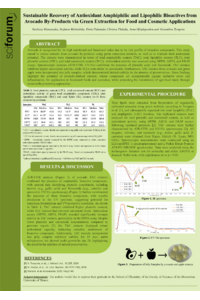
The global avocado industry generates substantial by-product waste, yet these residues remain an underexploited source of health-promoting bioactives. This study explores the sustainable extraction, quantification, and functional evaluation of antioxidant amphiphilic (TAC) and lipophilic (TLC) compounds from avocado (Persea americana) by-products using green, solvent-efficient extraction. The overarching goal is to valorize agri-food waste streams into high-value ingredients for food supplements and cosmetics.
Organically grown domestic (Greek) avocado peels and seeds were subjected to a green extraction and fractionation process to separately obtain the avocado by-products’ extracted TLC and TAC, according to EU regulations. Quantitative analyses of total phenolic content (TPC) and total carotenoid content (TCC), as well as antioxidant activity (DPPH, ABTS, and FRAP), were performed using UV–Vis spectroscopy. ATR–FTIR spectroscopy was used to structurally characterize TAC bioactives, identifying functional groups associated with phenolics, flavonoids, polar lipids, and carotenoids. TAC extracts exhibited higher TPC and superior antioxidant capacity across all assays in comparison to the TLC. Despite relatively modest absolute phenolic and carotenoid concentrations compared to the literature, the extracts retained potent bioactivity, indicating selective enrichment of functional compounds. UV–Vis spectral peaks (240 nm, 310 nm) confirmed the presence of conjugated systems, suggesting potential for anti-UV photo-protective cosmetic applications. ATR–FTIR analysis further identified key amphiphilic constituents, including simple phenolics, flavonoids, polyphenols, carotenoids, and polar lipids.
TAC extracts were successfully integrated into plant-based jelly prototypes as functional food supplements. Antioxidant stability was retained for 15 days under refrigeration, though shelf-life limitations due to moisture and microbial growth highlight the need for preservative strategies.
This work demonstrates a circular bioeconomy approach to food waste valorization, with significant implications for sustainable innovation in functional foods and clean-label cosmetics.
Keywords
Avocado by-products
Green extraction
Antioxidants
Amphiphilic bioactives
Food waste valorization
UV–Vis spectroscopy
ATR–FTIR
Functional foods
Sustainable ingredients
Circular economy.
Poster
Poster - SciForum.pdf
Bell Pepper (Capsicum annuum) Production in Protected Environments in the Dominican Republic: Optimization of Fertigation and Substrate
Selenium biofortification of Swiss chard microgreens under indoor vertical farming conditions