Event submissions
Published
This submission belongs to the session F. Sustainable Food Security and Food Systems of the event The 6th International Electronic Conference on Foods
Published date
27 Oct, 2025
Academic Editor
'%3e%3cpath%20d='M12.6657%2010.9104C12.4185%2010.325%2012.0599%209.79327%2011.6097%209.34482C11.1609%208.89508%2010.6293%208.5365%2010.0442%208.28888C10.0389%208.28626%2010.0337%208.28495%2010.0285%208.28233C10.8446%207.69279%2011.3752%206.73249%2011.3752%205.64904C11.3752%203.8542%209.92103%202.39999%208.1262%202.39999C6.33136%202.39999%204.87715%203.8542%204.87715%205.64904C4.87715%206.73249%205.40774%207.69279%206.22393%208.28364C6.21869%208.28626%206.21345%208.28757%206.20821%208.29019C5.62129%208.5378%205.09463%208.89284%204.64265%209.34613C4.1929%209.79493%203.83432%2010.3266%203.58671%2010.9117C3.34345%2011.4845%203.21226%2012.0987%203.20023%2012.7209C3.19988%2012.7349%203.20233%2012.7488%203.20744%2012.7619C3.21255%2012.7749%203.22022%2012.7867%203.22998%2012.7968C3.23975%2012.8068%203.25142%2012.8147%203.26431%2012.8202C3.2772%2012.8256%203.29105%2012.8284%203.30504%2012.8284H4.09109C4.14874%2012.8284%204.19459%2012.7825%204.1959%2012.7262C4.2221%2011.7148%204.62823%2010.7676%205.34617%2010.0497C6.08899%209.30683%207.0755%208.89808%208.1262%208.89808C9.17689%208.89808%2010.1634%209.30683%2010.9062%2010.0497C11.6242%2010.7676%2012.0303%2011.7148%2012.0565%2012.7262C12.0578%2012.7838%2012.1037%2012.8284%2012.1613%2012.8284H12.9474C12.9613%2012.8284%2012.9752%2012.8256%2012.9881%2012.8202C13.001%2012.8147%2013.0126%2012.8068%2013.0224%2012.7968C13.0322%2012.7867%2013.0398%2012.7749%2013.0449%2012.7619C13.0501%2012.7488%2013.0525%2012.7349%2013.0522%2012.7209C13.0391%2012.0947%2012.9094%2011.4855%2012.6657%2010.9104ZM8.1262%207.9024C7.52486%207.9024%206.9589%207.6679%206.53312%207.24211C6.10733%206.81633%205.87283%206.25037%205.87283%205.64904C5.87283%205.0477%206.10733%204.48174%206.53312%204.05596C6.9589%203.63018%207.52486%203.39567%208.1262%203.39567C8.72753%203.39567%209.29349%203.63018%209.71927%204.05596C10.1451%204.48174%2010.3796%205.0477%2010.3796%205.64904C10.3796%206.25037%2010.1451%206.81633%209.71927%207.24211C9.29349%207.6679%208.72753%207.9024%208.1262%207.9024Z'%20fill='%235D1EE1'/%3e%3c/g%3e%3c/svg%3e) Theodoros Varzakas
Theodoros VarzakasCitation
Alexandre Donovan Goertzen, Donna Ryland, Shiva Shariati-Ievari, April McElrea, Michel Aliani, Origin and Processing Conditions Influence Nutritional and Sensory Properties of North American Wild Rice, in Proceedings of The 6th International Electronic Conference on Foods, 28 October–30 October 2025, MDPI: Basel, Switzerland
Share
Email
Facebook
Twitter
LinkedIn
Origin and Processing Conditions Influence Nutritional and Sensory Properties of North American Wild Rice
'%3e%3cpath%20d='M12.6647%2010.9104C12.4176%2010.325%2012.0589%209.7933%2011.6088%209.34485C11.16%208.89511%2010.6283%208.53653%2010.0432%208.28891C10.038%208.28629%2010.0327%208.28498%2010.0275%208.28236C10.8437%207.69282%2011.3743%206.73252%2011.3743%205.64907C11.3743%203.85423%209.92005%202.40002%208.12522%202.40002C6.33038%202.40002%204.87618%203.85423%204.87618%205.64907C4.87618%206.73252%205.40677%207.69282%206.22296%208.28367C6.21772%208.28629%206.21248%208.2876%206.20724%208.29022C5.62031%208.53783%205.09365%208.89287%204.64167%209.34616C4.19192%209.79496%203.83334%2010.3266%203.58573%2010.9117C3.34247%2011.4846%203.21128%2012.0987%203.19925%2012.721C3.1989%2012.735%203.20135%2012.7489%203.20646%2012.7619C3.21157%2012.7749%203.21924%2012.7868%203.22901%2012.7968C3.23877%2012.8068%203.25045%2012.8148%203.26334%2012.8202C3.27623%2012.8256%203.29007%2012.8284%203.30406%2012.8284H4.09012C4.14776%2012.8284%204.19362%2012.7825%204.19493%2012.7262C4.22113%2011.7148%204.62726%2010.7676%205.34519%2010.0497C6.08802%209.30686%207.07452%208.89811%208.12522%208.89811C9.17592%208.89811%2010.1624%209.30686%2010.9052%2010.0497C11.6232%2010.7676%2012.0293%2011.7148%2012.0555%2012.7262C12.0568%2012.7839%2012.1027%2012.8284%2012.1603%2012.8284H12.9464C12.9604%2012.8284%2012.9742%2012.8256%2012.9871%2012.8202C13%2012.8148%2013.0117%2012.8068%2013.0214%2012.7968C13.0312%2012.7868%2013.0389%2012.7749%2013.044%2012.7619C13.0491%2012.7489%2013.0515%2012.735%2013.0512%2012.721C13.0381%2012.0947%2012.9084%2011.4856%2012.6647%2010.9104ZM8.12522%207.90243C7.52388%207.90243%206.95792%207.66793%206.53214%207.24215C6.10636%206.81636%205.87185%206.2504%205.87185%205.64907C5.87185%205.04773%206.10636%204.48177%206.53214%204.05599C6.95792%203.63021%207.52388%203.3957%208.12522%203.3957C8.72655%203.3957%209.29252%203.63021%209.7183%204.05599C10.1441%204.48177%2010.3786%205.04773%2010.3786%205.64907C10.3786%206.2504%2010.1441%206.81636%209.7183%207.24215C9.29252%207.66793%208.72655%207.90243%208.12522%207.90243Z'%20fill='%235D1EE1'/%3e%3c/g%3e%3c/svg%3e)
Alexandre Donovan Goertzen 1,2
Donna Ryland 1
Shiva Shariati-Ievari 2
April McElrea 2

Michel Aliani 1,2
1. Department of Food and Human Nutritional Sciences, University of Manitoba, Winnipeg, MB R3T 2N2, Canada
2. Division of Neurodegenerative and Neurodevelopmental Disorders, St. Boniface Albrechtsen Research Centre, Winnipeg, MB R2H 2A6, Canada
Abstract
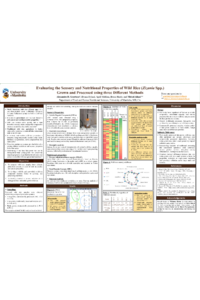
Introduction: A culturally significant, semi-domesticated cereal crop, North American wild rice (Zizania spp.) is valued for its strong protein and amino acid profile and its ability to grow on marginal land with minimal agricultural inputs. However, the wild rice industry is constrained by limited understanding of how growing and processing conditions influence product quality. This study evaluated 11 wild rice sources for differences in nutritional and sensory characteristics.
Methods: Samples were sourced from a diverse range of commercial growers and processors, including American paddy-grown, traditionally processed Indigenous, lake-specific Canadian, and pooled Canadian and American lake-grown wild rice. Analyses included grain size, antioxidant capacity (ORAC), total phenolics, specific phenolic compounds (via NMR), and eNose responses. Five samples underwent additional profiling for volatile organic compounds (VOCs), fatty acids, and descriptive sensory attributes.
Results: Grain size was largest in lake-specific samples and smaller in pooled, American, and Indigenous rice. Traditional Indigenous processing resulted in increased antioxidant activity and total phenolics compared to paddy-grown and commercially processed samples, though the specific contributing compounds remain unclear. eNose data showed modest differentiation, while SIMCA modeling classified samples into three distinct groups with 90.2% accuracy. VOC analysis identified 52 compounds, with traditionally processed rice displaying the richest profile followed by paddy-grown rice. Paddy-grown rice had a higher omega-6/omega-3 ratio (1.5) than other samples (~1.0). Sensory analysis found traditionally processed samples to be most distinct, with subtler differences among lake-specific and American rice.
Conclusion: This study demonstrated that wild rice quality is influenced by both growing conditions and processing methods used, while also suggesting that wild rice grown in specific lakes may also exhibit unique properties. The elevated antioxidant activity observed in traditionally processed samples suggests that incorporating aspects of these methods into commercial practices may improve nutritional quality, though changes to sensory attributes should be considered.
Keywords
Wild Rice
Volatile Organic Compounds
Electronic Nose
Flavoromics
Poster
AlexPoster_2025_36x24_Final (1).pdf
Development of a Functional Plant-Based Energy Drink Produced from Baru Almonds: Innovation Using the Biodiversity of the Brazilian Cerrado
From waste to worth: Valorization of second-grade fig (Ficus carica L.) fruits as a sustainable source of valuable compounds