Event submissions
Published
This submission belongs to the session B. Nutritional and Functional Foods of the event The 6th International Electronic Conference on Foods
Published date
27 Oct, 2025
Academic Editor
'%3e%3cpath%20d='M12.6657%2010.9104C12.4185%2010.325%2012.0599%209.79327%2011.6097%209.34482C11.1609%208.89508%2010.6293%208.5365%2010.0442%208.28888C10.0389%208.28626%2010.0337%208.28495%2010.0285%208.28233C10.8446%207.69279%2011.3752%206.73249%2011.3752%205.64904C11.3752%203.8542%209.92103%202.39999%208.1262%202.39999C6.33136%202.39999%204.87715%203.8542%204.87715%205.64904C4.87715%206.73249%205.40774%207.69279%206.22393%208.28364C6.21869%208.28626%206.21345%208.28757%206.20821%208.29019C5.62129%208.5378%205.09463%208.89284%204.64265%209.34613C4.1929%209.79493%203.83432%2010.3266%203.58671%2010.9117C3.34345%2011.4845%203.21226%2012.0987%203.20023%2012.7209C3.19988%2012.7349%203.20233%2012.7488%203.20744%2012.7619C3.21255%2012.7749%203.22022%2012.7867%203.22998%2012.7968C3.23975%2012.8068%203.25142%2012.8147%203.26431%2012.8202C3.2772%2012.8256%203.29105%2012.8284%203.30504%2012.8284H4.09109C4.14874%2012.8284%204.19459%2012.7825%204.1959%2012.7262C4.2221%2011.7148%204.62823%2010.7676%205.34617%2010.0497C6.08899%209.30683%207.0755%208.89808%208.1262%208.89808C9.17689%208.89808%2010.1634%209.30683%2010.9062%2010.0497C11.6242%2010.7676%2012.0303%2011.7148%2012.0565%2012.7262C12.0578%2012.7838%2012.1037%2012.8284%2012.1613%2012.8284H12.9474C12.9613%2012.8284%2012.9752%2012.8256%2012.9881%2012.8202C13.001%2012.8147%2013.0126%2012.8068%2013.0224%2012.7968C13.0322%2012.7867%2013.0398%2012.7749%2013.0449%2012.7619C13.0501%2012.7488%2013.0525%2012.7349%2013.0522%2012.7209C13.0391%2012.0947%2012.9094%2011.4855%2012.6657%2010.9104ZM8.1262%207.9024C7.52486%207.9024%206.9589%207.6679%206.53312%207.24211C6.10733%206.81633%205.87283%206.25037%205.87283%205.64904C5.87283%205.0477%206.10733%204.48174%206.53312%204.05596C6.9589%203.63018%207.52486%203.39567%208.1262%203.39567C8.72753%203.39567%209.29349%203.63018%209.71927%204.05596C10.1451%204.48174%2010.3796%205.0477%2010.3796%205.64904C10.3796%206.25037%2010.1451%206.81633%209.71927%207.24211C9.29349%207.6679%208.72753%207.9024%208.1262%207.9024Z'%20fill='%235D1EE1'/%3e%3c/g%3e%3c/svg%3e) Manuel Viuda-Martos
Manuel Viuda-MartosCitation
Roxana Elizabeth Gonzalez, Verónica Carolina Soto Vargas, Postharvest quality of fresh-cut baby leaf lettuce as affected by packaging type and LED light treatment, in Proceedings of The 6th International Electronic Conference on Foods, 28 October–30 October 2025, MDPI: Basel, Switzerland
Share
Email
Facebook
Twitter
LinkedIn
Postharvest quality of fresh-cut baby leaf lettuce as affected by packaging type and LED light treatment
'%3e%3cpath%20d='M12.6647%2010.9104C12.4176%2010.325%2012.0589%209.7933%2011.6088%209.34485C11.16%208.89511%2010.6283%208.53653%2010.0432%208.28891C10.038%208.28629%2010.0327%208.28498%2010.0275%208.28236C10.8437%207.69282%2011.3743%206.73252%2011.3743%205.64907C11.3743%203.85423%209.92005%202.40002%208.12522%202.40002C6.33038%202.40002%204.87618%203.85423%204.87618%205.64907C4.87618%206.73252%205.40677%207.69282%206.22296%208.28367C6.21772%208.28629%206.21248%208.2876%206.20724%208.29022C5.62031%208.53783%205.09365%208.89287%204.64167%209.34616C4.19192%209.79496%203.83334%2010.3266%203.58573%2010.9117C3.34247%2011.4846%203.21128%2012.0987%203.19925%2012.721C3.1989%2012.735%203.20135%2012.7489%203.20646%2012.7619C3.21157%2012.7749%203.21924%2012.7868%203.22901%2012.7968C3.23877%2012.8068%203.25045%2012.8148%203.26334%2012.8202C3.27623%2012.8256%203.29007%2012.8284%203.30406%2012.8284H4.09012C4.14776%2012.8284%204.19362%2012.7825%204.19493%2012.7262C4.22113%2011.7148%204.62726%2010.7676%205.34519%2010.0497C6.08802%209.30686%207.07452%208.89811%208.12522%208.89811C9.17592%208.89811%2010.1624%209.30686%2010.9052%2010.0497C11.6232%2010.7676%2012.0293%2011.7148%2012.0555%2012.7262C12.0568%2012.7839%2012.1027%2012.8284%2012.1603%2012.8284H12.9464C12.9604%2012.8284%2012.9742%2012.8256%2012.9871%2012.8202C13%2012.8148%2013.0117%2012.8068%2013.0214%2012.7968C13.0312%2012.7868%2013.0389%2012.7749%2013.044%2012.7619C13.0491%2012.7489%2013.0515%2012.735%2013.0512%2012.721C13.0381%2012.0947%2012.9084%2011.4856%2012.6647%2010.9104ZM8.12522%207.90243C7.52388%207.90243%206.95792%207.66793%206.53214%207.24215C6.10636%206.81636%205.87185%206.2504%205.87185%205.64907C5.87185%205.04773%206.10636%204.48177%206.53214%204.05599C6.95792%203.63021%207.52388%203.3957%208.12522%203.3957C8.72655%203.3957%209.29252%203.63021%209.7183%204.05599C10.1441%204.48177%2010.3786%205.04773%2010.3786%205.64907C10.3786%206.2504%2010.1441%206.81636%209.7183%207.24215C9.29252%207.66793%208.72655%207.90243%208.12522%207.90243Z'%20fill='%235D1EE1'/%3e%3c/g%3e%3c/svg%3e)
Roxana Elizabeth Gonzalez 1,2
Verónica Carolina Soto Vargas 3
1. Estación Experimental La Consulta (EEA La Consulta), Instituto Nacional de Tecnología Agropecuaria (INTA), Centro Regional Mendoza-San Juan (CR Mza-SJ), Mendoza, 5560, Argentina
2. Facultad de Ciencias Exactas y Naturales, Universidad Nacional de Cuyo (UNCUYO). Padre J. Contreras 1300, 5500 Mendoza, Argentina
3. Instituto de Biología Agrícola de Mendoza (IBAM), CONICET, Facultad de Ciencias Agrarias, Mendoza 5507, Argentina
Abstract
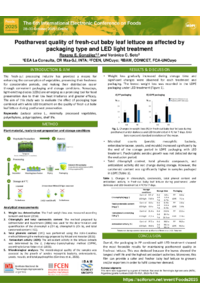
The fresh-cut processing industry has provided a means for enhancing the consumption of vegetables, preserving their freshness for considerable periods, and making their distribution easier through convenient packaging and storage conditions. Nowadays, light-emitting diodes (LEDs) are emerging as a promising tool for food preservation due to their low heat irradiance and greater efficacy. The aim of this study was to evaluate the effect of packaging type combined with white LED treatment on the quality of fresh-cut baby leaf lettuce during postharvest preservation. The lettuce cultivar (Tango) was grown at a density of 800 plants/m² in raised beds. When the leaves reached the optimal size of baby leaf lettuce (5–9 cm), they were harvested, followed by processing. Low-density polyethylene (LDPE) and polypropylene (PP) were tested as polymeric film packaging. The samples were stored at 4 °C under two conditions: (1) continuous darkness throughout the storage period and (2) under short treatments (2 d) with intermittent light (2 h on/2 h off), followed by storage in darkness. The quality of fresh-cut baby leaf lettuce was determined by measuring weight loss, chlorophyll, carotenoids, phenols, antioxidant activity, and microbial quality. Weight loss gradually increased during storage time and significant changes were observed for each treatment and packaging. The lowest weight loss was recorded in the LDPE packaging under LED treatment. Microbial counts (aerobic mesophilic bacteria, enterobacteriaceae, yeasts, and moulds) increased significantly by the end of the storage period in LDPE packaging with LED treatment. Psychrophilic aerobic growth was not detected during the evaluation period. Total chlorophyll content, total phenolic compounds, and antioxidant activity did not change during storage. However, the carotenoid content was significantly higher in samples packaged in LDPE. Overall, the packaging in PP combined with LED treatment showed the most favorable results for maintaining postharvest quality in fresh-cut lettuce.
Keywords
Lactuca sativa L.
minimally processed vegetables
polyethylene
polypropylene
shelf life
Poster
González and Soto.pdf
Effect of potassium polyaspartate on calcium stability in wine
Consumers’ evaluation and perception of the threatened with abandonment Orino of Epirus (OE) sheep of Greece