Event submissions
Published

This submission belongs to the session a. General Organic Synthesis of the event The 18th International Electronic Conference on Synthetic Organic Chemistry
Published date
31 Oct, 2014
Citation
Wolfgang Stadlbauer, Michaela Fischer, Nathalie Lackner, Syntheses and Reactions of Amino- and Azidophenalenones, in Proceedings of The 18th International Electronic Conference on Synthetic Organic Chemistry, 1 November–30 November 2014, MDPI: Basel, Switzerland, doi: 10.3390/ecsoc-18-a014
Share
Email
Facebook
Twitter
LinkedIn
Syntheses and Reactions of Amino- and Azidophenalenones
'%3e%3cpath%20d='M12.6647%2010.9104C12.4176%2010.325%2012.0589%209.7933%2011.6088%209.34485C11.16%208.89511%2010.6283%208.53653%2010.0432%208.28891C10.038%208.28629%2010.0327%208.28498%2010.0275%208.28236C10.8437%207.69282%2011.3743%206.73252%2011.3743%205.64907C11.3743%203.85423%209.92005%202.40002%208.12522%202.40002C6.33038%202.40002%204.87618%203.85423%204.87618%205.64907C4.87618%206.73252%205.40677%207.69282%206.22296%208.28367C6.21772%208.28629%206.21248%208.2876%206.20724%208.29022C5.62031%208.53783%205.09365%208.89287%204.64167%209.34616C4.19192%209.79496%203.83334%2010.3266%203.58573%2010.9117C3.34247%2011.4846%203.21128%2012.0987%203.19925%2012.721C3.1989%2012.735%203.20135%2012.7489%203.20646%2012.7619C3.21157%2012.7749%203.21924%2012.7868%203.22901%2012.7968C3.23877%2012.8068%203.25045%2012.8148%203.26334%2012.8202C3.27623%2012.8256%203.29007%2012.8284%203.30406%2012.8284H4.09012C4.14776%2012.8284%204.19362%2012.7825%204.19493%2012.7262C4.22113%2011.7148%204.62726%2010.7676%205.34519%2010.0497C6.08802%209.30686%207.07452%208.89811%208.12522%208.89811C9.17592%208.89811%2010.1624%209.30686%2010.9052%2010.0497C11.6232%2010.7676%2012.0293%2011.7148%2012.0555%2012.7262C12.0568%2012.7839%2012.1027%2012.8284%2012.1603%2012.8284H12.9464C12.9604%2012.8284%2012.9742%2012.8256%2012.9871%2012.8202C13%2012.8148%2013.0117%2012.8068%2013.0214%2012.7968C13.0312%2012.7868%2013.0389%2012.7749%2013.044%2012.7619C13.0491%2012.7489%2013.0515%2012.735%2013.0512%2012.721C13.0381%2012.0947%2012.9084%2011.4856%2012.6647%2010.9104ZM8.12522%207.90243C7.52388%207.90243%206.95792%207.66793%206.53214%207.24215C6.10636%206.81636%205.87185%206.2504%205.87185%205.64907C5.87185%205.04773%206.10636%204.48177%206.53214%204.05599C6.95792%203.63021%207.52388%203.3957%208.12522%203.3957C8.72655%203.3957%209.29252%203.63021%209.7183%204.05599C10.1441%204.48177%2010.3786%205.04773%2010.3786%205.64907C10.3786%206.2504%2010.1441%206.81636%209.7183%207.24215C9.29252%207.66793%208.72655%207.90243%208.12522%207.90243Z'%20fill='%235D1EE1'/%3e%3c/g%3e%3c/svg%3e)
Wolfgang Stadlbauer 1
Michaela Fischer 1
Nathalie Lackner 2
1. Department of Chemistry, University of Graz, Austria
2. Dep. of Chemistry, University of Graz, Austria
Abstract
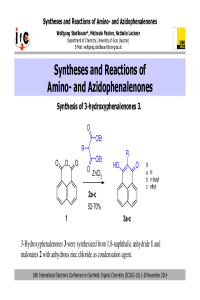
3-Hydroxyphenalenones 3, react by electrophilic halogenation to 2-chlorophenalenediones 4 or 2-iodophenalenone 5. The chloro group of 4 was exchanged against azide by reaction with sodium azide to give 2-azidophenalenediones 6. Nucleophilic chlorination of 3 furnishes 3-chlorophenalenones 7, which were converted to 3-azidophenalenones 8. Staudinger reaction of 8 with triphenylphosphane gave phosphazenes 9 which hydrolyzed to 3-aminophenalenones 10. Amines 10 can also be obtained directly from 3-hydroxyphenalenones 3 and ammonium acetate, or by catalytic hydrogenolysis of azides 8. Nitration of 3-hydroxyphenalenone 3 with nitric acid forms 2-nitrophenalenone 11, which was converted to 3-chloro-2-nitrophenalenone 12. Azidation, however, formed 2,3-diazidophenalenone 13. 2-Amino-3-hydroxyphenalenone 14 or 3-azidophenalenone 8 cyclize with carboxylic acid derivatives to oxazolo-phenalenones 15. 2-Acetylphenalenone 21 leads via the intermediate oxime 22 to an isomer mixture of isoxazolophenalenone 23 as main product and oxazolophenalenone 15 as by-product.
Keywords
3-Hydroxyphenalenones
2/3-halogenation
2/3-azidation
2/3-amination
hydrogenation
cyclization
phenaleno[2,1-d]oxazol-7-one
Manuscript
ecsoc18-phenalen_stadlbauer_manuscript.pdf
Poster
ecsoc18_phenalen_stadlbauer_presentation.pdf
Pyridinium Complexes Supported on a Polymeric Biomaterial: Synthesis of NLO-Phores at Molecular Level
Silica-Supported Alginic Acid-L-Glutamic Acid: An Efficient Heterogeneous Catalyst for Solvent-free Synthesis of 1,8-Dioxohexahydroacridine and Polyhydroquinoline Derivatives