Event submissions
Published
This submission belongs to the session B. Nutritional and Functional Foods of the event The 6th International Electronic Conference on Foods
Published date
27 Oct, 2025
Academic Editor
'%3e%3cpath%20d='M12.6657%2010.9104C12.4185%2010.325%2012.0599%209.79327%2011.6097%209.34482C11.1609%208.89508%2010.6293%208.5365%2010.0442%208.28888C10.0389%208.28626%2010.0337%208.28495%2010.0285%208.28233C10.8446%207.69279%2011.3752%206.73249%2011.3752%205.64904C11.3752%203.8542%209.92103%202.39999%208.1262%202.39999C6.33136%202.39999%204.87715%203.8542%204.87715%205.64904C4.87715%206.73249%205.40774%207.69279%206.22393%208.28364C6.21869%208.28626%206.21345%208.28757%206.20821%208.29019C5.62129%208.5378%205.09463%208.89284%204.64265%209.34613C4.1929%209.79493%203.83432%2010.3266%203.58671%2010.9117C3.34345%2011.4845%203.21226%2012.0987%203.20023%2012.7209C3.19988%2012.7349%203.20233%2012.7488%203.20744%2012.7619C3.21255%2012.7749%203.22022%2012.7867%203.22998%2012.7968C3.23975%2012.8068%203.25142%2012.8147%203.26431%2012.8202C3.2772%2012.8256%203.29105%2012.8284%203.30504%2012.8284H4.09109C4.14874%2012.8284%204.19459%2012.7825%204.1959%2012.7262C4.2221%2011.7148%204.62823%2010.7676%205.34617%2010.0497C6.08899%209.30683%207.0755%208.89808%208.1262%208.89808C9.17689%208.89808%2010.1634%209.30683%2010.9062%2010.0497C11.6242%2010.7676%2012.0303%2011.7148%2012.0565%2012.7262C12.0578%2012.7838%2012.1037%2012.8284%2012.1613%2012.8284H12.9474C12.9613%2012.8284%2012.9752%2012.8256%2012.9881%2012.8202C13.001%2012.8147%2013.0126%2012.8068%2013.0224%2012.7968C13.0322%2012.7867%2013.0398%2012.7749%2013.0449%2012.7619C13.0501%2012.7488%2013.0525%2012.7349%2013.0522%2012.7209C13.0391%2012.0947%2012.9094%2011.4855%2012.6657%2010.9104ZM8.1262%207.9024C7.52486%207.9024%206.9589%207.6679%206.53312%207.24211C6.10733%206.81633%205.87283%206.25037%205.87283%205.64904C5.87283%205.0477%206.10733%204.48174%206.53312%204.05596C6.9589%203.63018%207.52486%203.39567%208.1262%203.39567C8.72753%203.39567%209.29349%203.63018%209.71927%204.05596C10.1451%204.48174%2010.3796%205.0477%2010.3796%205.64904C10.3796%206.25037%2010.1451%206.81633%209.71927%207.24211C9.29349%207.6679%208.72753%207.9024%208.1262%207.9024Z'%20fill='%235D1EE1'/%3e%3c/g%3e%3c/svg%3e) Manuel Viuda-Martos
Manuel Viuda-MartosCitation
Agata Wojciechowicz-Budzisz, Ewa Pejcz, Agata Milcarz, Oliwia Paroń, Patryk Słota, Rafał Wiśniewski, Alona Tiupova, Joanna Harasym, Nutritional and Quality Evaluation of Wheat Bread Enriched with Amaranth Sourdough, in Proceedings of The 6th International Electronic Conference on Foods, 28 October–30 October 2025, MDPI: Basel, Switzerland
Share
Email
Facebook
Twitter
LinkedIn
Nutritional and Quality Evaluation of Wheat Bread Enriched with Amaranth Sourdough

Agata Wojciechowicz-Budzisz 1
'%3e%3cpath%20d='M12.6647%2010.9104C12.4176%2010.325%2012.0589%209.7933%2011.6088%209.34485C11.16%208.89511%2010.6283%208.53653%2010.0432%208.28891C10.038%208.28629%2010.0327%208.28498%2010.0275%208.28236C10.8437%207.69282%2011.3743%206.73252%2011.3743%205.64907C11.3743%203.85423%209.92005%202.40002%208.12522%202.40002C6.33038%202.40002%204.87618%203.85423%204.87618%205.64907C4.87618%206.73252%205.40677%207.69282%206.22296%208.28367C6.21772%208.28629%206.21248%208.2876%206.20724%208.29022C5.62031%208.53783%205.09365%208.89287%204.64167%209.34616C4.19192%209.79496%203.83334%2010.3266%203.58573%2010.9117C3.34247%2011.4846%203.21128%2012.0987%203.19925%2012.721C3.1989%2012.735%203.20135%2012.7489%203.20646%2012.7619C3.21157%2012.7749%203.21924%2012.7868%203.22901%2012.7968C3.23877%2012.8068%203.25045%2012.8148%203.26334%2012.8202C3.27623%2012.8256%203.29007%2012.8284%203.30406%2012.8284H4.09012C4.14776%2012.8284%204.19362%2012.7825%204.19493%2012.7262C4.22113%2011.7148%204.62726%2010.7676%205.34519%2010.0497C6.08802%209.30686%207.07452%208.89811%208.12522%208.89811C9.17592%208.89811%2010.1624%209.30686%2010.9052%2010.0497C11.6232%2010.7676%2012.0293%2011.7148%2012.0555%2012.7262C12.0568%2012.7839%2012.1027%2012.8284%2012.1603%2012.8284H12.9464C12.9604%2012.8284%2012.9742%2012.8256%2012.9871%2012.8202C13%2012.8148%2013.0117%2012.8068%2013.0214%2012.7968C13.0312%2012.7868%2013.0389%2012.7749%2013.044%2012.7619C13.0491%2012.7489%2013.0515%2012.735%2013.0512%2012.721C13.0381%2012.0947%2012.9084%2011.4856%2012.6647%2010.9104ZM8.12522%207.90243C7.52388%207.90243%206.95792%207.66793%206.53214%207.24215C6.10636%206.81636%205.87185%206.2504%205.87185%205.64907C5.87185%205.04773%206.10636%204.48177%206.53214%204.05599C6.95792%203.63021%207.52388%203.3957%208.12522%203.3957C8.72655%203.3957%209.29252%203.63021%209.7183%204.05599C10.1441%204.48177%2010.3786%205.04773%2010.3786%205.64907C10.3786%206.2504%2010.1441%206.81636%209.7183%207.24215C9.29252%207.66793%208.72655%207.90243%208.12522%207.90243Z'%20fill='%235D1EE1'/%3e%3c/g%3e%3c/svg%3e)
Ewa Pejcz 1
Agata Milcarz 1
Oliwia Paroń 1
Patryk Słota 1
Rafał Wiśniewski 1
Alona Tiupova 1

Joanna Harasym 1
1. Department of Biotechnology and Food Analysis, Wroclaw University of Economics and Business, Wrocław, 53-345, Komandorska 118 Street, Poland
Abstract
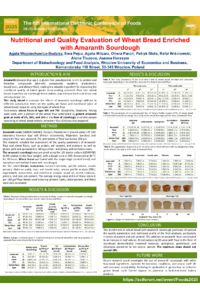
Amaranth (Amaranthus spp.), a gluten-free pseudocereal, is rich in protein and bioactive compounds (phenolic compounds, squalene, phytosterols, tocopherols, and dietary fiber), making it a valuable ingredient for improving the nutritional quality of baked goods. Incorporating amaranth flour into wheat bread, especially via sourdough fermentation, may enhance both nutritional and sensory properties. This study investigates the impact of adding amaranth sourdough at various levels on the quality characteristics and nutritional value of wheat bread. Commercial wheat flours of type 405 and 750 were used, with a portion of the wheat flour substituted by ground amaranth grain at levels of 5%, 10%, and 15% in the form of sourdough. A control sample consisting of wheat bread without amaranth flour (0%) was also prepared.
The research included the assessment of the quality parameters of amaranth grain flour and wheat flours, such as protein, ash content, and moisture, as well as gluten yield and spreadability, falling number, and Zeleny sedimentation index. For the baked breads, evaluations included overbake, specific volume, crumb porosity (Dallman scale), crust and crumb color, texture profile analysis (TPA), organoleptic assessment, and nutritional analysis based on crumb moisture, protein, and total ash content. The average energy value and nutritional content per 100 g of flour blends used in baking (protein, lipids, carbohydrates, and fiber) were also calculated.
The enrichment of wheat bread with amaranth sourdough positively influenced the quality parameters and nutritional profile of the final products, particularly in terms of protein and ash content. The addition of amaranth flour contributed to an increase in loaf volume. Bread containing 5% amaranth flour in the form of sourdough demonstrated improved hardness, springiness, gumminess, and chewiness compared to the control sample. The maximum share should not exceed 10%.
Keywords
amaranth
sourdough
wheat bread
nutritional quality
bread texture
Poster
Amaranth.pdf
Consumers’ evaluation and perception of the threatened with abandonment Orino of Epirus (OE) sheep of Greece
Optimizing Resource Use in Sustainable Food Systems: Life Cycle Assessment of a Multi-Crop Aquaponic System in Italy.