Event submissions
Published
This submission belongs to the session B. Nutritional and Functional Foods of the event The 6th International Electronic Conference on Foods
Published date
27 Oct, 2025
Academic Editor
'%3e%3cpath%20d='M12.6657%2010.9104C12.4185%2010.325%2012.0599%209.79327%2011.6097%209.34482C11.1609%208.89508%2010.6293%208.5365%2010.0442%208.28888C10.0389%208.28626%2010.0337%208.28495%2010.0285%208.28233C10.8446%207.69279%2011.3752%206.73249%2011.3752%205.64904C11.3752%203.8542%209.92103%202.39999%208.1262%202.39999C6.33136%202.39999%204.87715%203.8542%204.87715%205.64904C4.87715%206.73249%205.40774%207.69279%206.22393%208.28364C6.21869%208.28626%206.21345%208.28757%206.20821%208.29019C5.62129%208.5378%205.09463%208.89284%204.64265%209.34613C4.1929%209.79493%203.83432%2010.3266%203.58671%2010.9117C3.34345%2011.4845%203.21226%2012.0987%203.20023%2012.7209C3.19988%2012.7349%203.20233%2012.7488%203.20744%2012.7619C3.21255%2012.7749%203.22022%2012.7867%203.22998%2012.7968C3.23975%2012.8068%203.25142%2012.8147%203.26431%2012.8202C3.2772%2012.8256%203.29105%2012.8284%203.30504%2012.8284H4.09109C4.14874%2012.8284%204.19459%2012.7825%204.1959%2012.7262C4.2221%2011.7148%204.62823%2010.7676%205.34617%2010.0497C6.08899%209.30683%207.0755%208.89808%208.1262%208.89808C9.17689%208.89808%2010.1634%209.30683%2010.9062%2010.0497C11.6242%2010.7676%2012.0303%2011.7148%2012.0565%2012.7262C12.0578%2012.7838%2012.1037%2012.8284%2012.1613%2012.8284H12.9474C12.9613%2012.8284%2012.9752%2012.8256%2012.9881%2012.8202C13.001%2012.8147%2013.0126%2012.8068%2013.0224%2012.7968C13.0322%2012.7867%2013.0398%2012.7749%2013.0449%2012.7619C13.0501%2012.7488%2013.0525%2012.7349%2013.0522%2012.7209C13.0391%2012.0947%2012.9094%2011.4855%2012.6657%2010.9104ZM8.1262%207.9024C7.52486%207.9024%206.9589%207.6679%206.53312%207.24211C6.10733%206.81633%205.87283%206.25037%205.87283%205.64904C5.87283%205.0477%206.10733%204.48174%206.53312%204.05596C6.9589%203.63018%207.52486%203.39567%208.1262%203.39567C8.72753%203.39567%209.29349%203.63018%209.71927%204.05596C10.1451%204.48174%2010.3796%205.0477%2010.3796%205.64904C10.3796%206.25037%2010.1451%206.81633%209.71927%207.24211C9.29349%207.6679%208.72753%207.9024%208.1262%207.9024Z'%20fill='%235D1EE1'/%3e%3c/g%3e%3c/svg%3e) Manuel Viuda-Martos
Manuel Viuda-MartosCitation
Ana Sofia Rodrigues, Cátia Morgado, Mafalda Alexandra Silva, Gilberto Costa, Carlos Brandão, Helena Soares Costa, Tânia Gonçalves Albuquerque, Microbiological evaluation of seaweed-enriched meatballs as a strategy to enhance iodine intake, in Proceedings of The 6th International Electronic Conference on Foods, 28 October–30 October 2025, MDPI: Basel, Switzerland
Share
Email
Facebook
Twitter
LinkedIn
Microbiological evaluation of seaweed-enriched meatballs as a strategy to enhance iodine intake
'%3e%3cpath%20d='M12.6647%2010.9104C12.4176%2010.325%2012.0589%209.7933%2011.6088%209.34485C11.16%208.89511%2010.6283%208.53653%2010.0432%208.28891C10.038%208.28629%2010.0327%208.28498%2010.0275%208.28236C10.8437%207.69282%2011.3743%206.73252%2011.3743%205.64907C11.3743%203.85423%209.92005%202.40002%208.12522%202.40002C6.33038%202.40002%204.87618%203.85423%204.87618%205.64907C4.87618%206.73252%205.40677%207.69282%206.22296%208.28367C6.21772%208.28629%206.21248%208.2876%206.20724%208.29022C5.62031%208.53783%205.09365%208.89287%204.64167%209.34616C4.19192%209.79496%203.83334%2010.3266%203.58573%2010.9117C3.34247%2011.4846%203.21128%2012.0987%203.19925%2012.721C3.1989%2012.735%203.20135%2012.7489%203.20646%2012.7619C3.21157%2012.7749%203.21924%2012.7868%203.22901%2012.7968C3.23877%2012.8068%203.25045%2012.8148%203.26334%2012.8202C3.27623%2012.8256%203.29007%2012.8284%203.30406%2012.8284H4.09012C4.14776%2012.8284%204.19362%2012.7825%204.19493%2012.7262C4.22113%2011.7148%204.62726%2010.7676%205.34519%2010.0497C6.08802%209.30686%207.07452%208.89811%208.12522%208.89811C9.17592%208.89811%2010.1624%209.30686%2010.9052%2010.0497C11.6232%2010.7676%2012.0293%2011.7148%2012.0555%2012.7262C12.0568%2012.7839%2012.1027%2012.8284%2012.1603%2012.8284H12.9464C12.9604%2012.8284%2012.9742%2012.8256%2012.9871%2012.8202C13%2012.8148%2013.0117%2012.8068%2013.0214%2012.7968C13.0312%2012.7868%2013.0389%2012.7749%2013.044%2012.7619C13.0491%2012.7489%2013.0515%2012.735%2013.0512%2012.721C13.0381%2012.0947%2012.9084%2011.4856%2012.6647%2010.9104ZM8.12522%207.90243C7.52388%207.90243%206.95792%207.66793%206.53214%207.24215C6.10636%206.81636%205.87185%206.2504%205.87185%205.64907C5.87185%205.04773%206.10636%204.48177%206.53214%204.05599C6.95792%203.63021%207.52388%203.3957%208.12522%203.3957C8.72655%203.3957%209.29252%203.63021%209.7183%204.05599C10.1441%204.48177%2010.3786%205.04773%2010.3786%205.64907C10.3786%206.2504%2010.1441%206.81636%209.7183%207.24215C9.29252%207.66793%208.72655%207.90243%208.12522%207.90243Z'%20fill='%235D1EE1'/%3e%3c/g%3e%3c/svg%3e)
Ana Sofia Rodrigues 1
Cátia Morgado 1,2
Mafalda Alexandra Silva 3,4
Gilberto Costa 1,2
Carlos Brandão 1,2

Helena Soares Costa 3,4

Tânia Gonçalves Albuquerque 1,3,4
1. Estoril Higher Institute for Tourism and Hotel Studies, Estoril, 2769-510 Estoril, Portugal
2. Centre for Tourism Research, Development and Innovation (CiTUR) Estoril, Estoril, 2769-510 Estoril, Portugal
3. Department of Food and Nutrition, National Institute of Health Dr. Ricardo Jorge, Lisbon, 1649-016 Lisbon, Portugal
4. REQUIMTE-LAQV/Faculty of Pharmacy, University of Porto, Porto, 4050-313 Porto, Portugal
Abstract
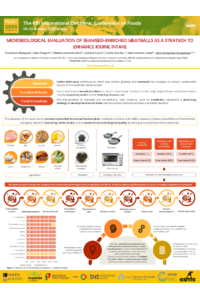
Introduction: Iodine deficiency continues to affect populations globally, and seaweeds have emerged as natural, sustainable sources of this essential micronutrient. Their incorporation into conventional food products, such as meatballs, represents a promising strategy to develop functional foods with enhanced nutritional profiles.
Objectives: To develop a functional food product, meatballs were enriched with edible seaweeds (Undaria pinnatifida and Himanthalia elongata), aimed at improving iodine intake and to assess their microbiological quality according to current food safety standards.
Methodology: Six meatball samples were prepared: two control samples without seaweed (sautéed and oven-baked) and four seaweed-enriched samples using both preparation methods. Microbiological analysis was conducted following the guidelines from the Portuguese National Institute of Health (INSA, 2019) and Regulation (EC) No 2073/2005. The parameters evaluated included Listeria spp., Listeria monocytogenes, Pseudomonas spp., Staphylococcus aureus, Bacillus cereus, moulds, yeasts, Enterobacteriaceae, total viable counts, Escherichia coli, and Clostridium perfringens.
Results: Most samples were microbiologically satisfactory. However, all tested samples showed unsatisfactory results for Listeria monocytogenes, which may indicate environmental or cross-contamination, inadequate surface sanitation, or handling deficiencies. Additionally, the sautéed Himanthalia elongata sample presented an unsatisfactory total viable count (8.9×10⁴ cfu/g), potentially due to poor raw material quality, thermal processing failure, or cold chain disruption.
Conclusion: Although seaweed incorporation can enhance the nutritional profile of meat-based products, these findings highlight the need for strict hygienic measures during formulation and processing. Corrective actions are essential to mitigate microbial risks and ensure product safety without compromising functional benefits.
Keywords
Seaweed
Meatballs
Iodine
Food security
Poster
132849Poster1_Microbiological evaluation of seaweed.pdf
Relationships Between Physicochemical Properties and Image Texture Features of Yellow Sweet Bell Pepper after Selected Periods of Spontaneous Lacto-fermentation
Evaluation of Bulk Flours: Storage Conditions of Bulk-Sold Flours in the City of Macaé-RJ