Event submissions
Published
This submission belongs to the session D. Food Microbiology of the event The 6th International Electronic Conference on Foods
Published date
27 Oct, 2025
Academic Editor
'%3e%3cpath%20d='M12.6657%2010.9104C12.4185%2010.325%2012.0599%209.79327%2011.6097%209.34482C11.1609%208.89508%2010.6293%208.5365%2010.0442%208.28888C10.0389%208.28626%2010.0337%208.28495%2010.0285%208.28233C10.8446%207.69279%2011.3752%206.73249%2011.3752%205.64904C11.3752%203.8542%209.92103%202.39999%208.1262%202.39999C6.33136%202.39999%204.87715%203.8542%204.87715%205.64904C4.87715%206.73249%205.40774%207.69279%206.22393%208.28364C6.21869%208.28626%206.21345%208.28757%206.20821%208.29019C5.62129%208.5378%205.09463%208.89284%204.64265%209.34613C4.1929%209.79493%203.83432%2010.3266%203.58671%2010.9117C3.34345%2011.4845%203.21226%2012.0987%203.20023%2012.7209C3.19988%2012.7349%203.20233%2012.7488%203.20744%2012.7619C3.21255%2012.7749%203.22022%2012.7867%203.22998%2012.7968C3.23975%2012.8068%203.25142%2012.8147%203.26431%2012.8202C3.2772%2012.8256%203.29105%2012.8284%203.30504%2012.8284H4.09109C4.14874%2012.8284%204.19459%2012.7825%204.1959%2012.7262C4.2221%2011.7148%204.62823%2010.7676%205.34617%2010.0497C6.08899%209.30683%207.0755%208.89808%208.1262%208.89808C9.17689%208.89808%2010.1634%209.30683%2010.9062%2010.0497C11.6242%2010.7676%2012.0303%2011.7148%2012.0565%2012.7262C12.0578%2012.7838%2012.1037%2012.8284%2012.1613%2012.8284H12.9474C12.9613%2012.8284%2012.9752%2012.8256%2012.9881%2012.8202C13.001%2012.8147%2013.0126%2012.8068%2013.0224%2012.7968C13.0322%2012.7867%2013.0398%2012.7749%2013.0449%2012.7619C13.0501%2012.7488%2013.0525%2012.7349%2013.0522%2012.7209C13.0391%2012.0947%2012.9094%2011.4855%2012.6657%2010.9104ZM8.1262%207.9024C7.52486%207.9024%206.9589%207.6679%206.53312%207.24211C6.10733%206.81633%205.87283%206.25037%205.87283%205.64904C5.87283%205.0477%206.10733%204.48174%206.53312%204.05596C6.9589%203.63018%207.52486%203.39567%208.1262%203.39567C8.72753%203.39567%209.29349%203.63018%209.71927%204.05596C10.1451%204.48174%2010.3796%205.0477%2010.3796%205.64904C10.3796%206.25037%2010.1451%206.81633%209.71927%207.24211C9.29349%207.6679%208.72753%207.9024%208.1262%207.9024Z'%20fill='%235D1EE1'/%3e%3c/g%3e%3c/svg%3e) Efstathios Giaouris
Efstathios GiaourisCitation
Müge Kayapınar, Recep Çıbık, Potential Emerging Zoonotic Foodborne Pathogen Streptococcus gallolyticus subsp. gallolyticus: Growth and Biocontrol in Dairy Matrices—A Preliminary Assessment, in Proceedings of The 6th International Electronic Conference on Foods, 28 October–30 October 2025, MDPI: Basel, Switzerland
Share
Email
Facebook
Twitter
LinkedIn
Potential Emerging Zoonotic Foodborne Pathogen Streptococcus gallolyticus subsp. gallolyticus: Growth and Biocontrol in Dairy Matrices—A Preliminary Assessment

Müge Kayapınar 1
'%3e%3cpath%20d='M12.6647%2010.9104C12.4176%2010.325%2012.0589%209.7933%2011.6088%209.34485C11.16%208.89511%2010.6283%208.53653%2010.0432%208.28891C10.038%208.28629%2010.0327%208.28498%2010.0275%208.28236C10.8437%207.69282%2011.3743%206.73252%2011.3743%205.64907C11.3743%203.85423%209.92005%202.40002%208.12522%202.40002C6.33038%202.40002%204.87618%203.85423%204.87618%205.64907C4.87618%206.73252%205.40677%207.69282%206.22296%208.28367C6.21772%208.28629%206.21248%208.2876%206.20724%208.29022C5.62031%208.53783%205.09365%208.89287%204.64167%209.34616C4.19192%209.79496%203.83334%2010.3266%203.58573%2010.9117C3.34247%2011.4846%203.21128%2012.0987%203.19925%2012.721C3.1989%2012.735%203.20135%2012.7489%203.20646%2012.7619C3.21157%2012.7749%203.21924%2012.7868%203.22901%2012.7968C3.23877%2012.8068%203.25045%2012.8148%203.26334%2012.8202C3.27623%2012.8256%203.29007%2012.8284%203.30406%2012.8284H4.09012C4.14776%2012.8284%204.19362%2012.7825%204.19493%2012.7262C4.22113%2011.7148%204.62726%2010.7676%205.34519%2010.0497C6.08802%209.30686%207.07452%208.89811%208.12522%208.89811C9.17592%208.89811%2010.1624%209.30686%2010.9052%2010.0497C11.6232%2010.7676%2012.0293%2011.7148%2012.0555%2012.7262C12.0568%2012.7839%2012.1027%2012.8284%2012.1603%2012.8284H12.9464C12.9604%2012.8284%2012.9742%2012.8256%2012.9871%2012.8202C13%2012.8148%2013.0117%2012.8068%2013.0214%2012.7968C13.0312%2012.7868%2013.0389%2012.7749%2013.044%2012.7619C13.0491%2012.7489%2013.0515%2012.735%2013.0512%2012.721C13.0381%2012.0947%2012.9084%2011.4856%2012.6647%2010.9104ZM8.12522%207.90243C7.52388%207.90243%206.95792%207.66793%206.53214%207.24215C6.10636%206.81636%205.87185%206.2504%205.87185%205.64907C5.87185%205.04773%206.10636%204.48177%206.53214%204.05599C6.95792%203.63021%207.52388%203.3957%208.12522%203.3957C8.72655%203.3957%209.29252%203.63021%209.7183%204.05599C10.1441%204.48177%2010.3786%205.04773%2010.3786%205.64907C10.3786%206.2504%2010.1441%206.81636%209.7183%207.24215C9.29252%207.66793%208.72655%207.90243%208.12522%207.90243Z'%20fill='%235D1EE1'/%3e%3c/g%3e%3c/svg%3e)
Recep Çıbık 1
1. Department of Food Hygiene and Technology, Faculty of Veterinary Medicine, Bursa Uludağ University, Bursa, Turkey
Abstract
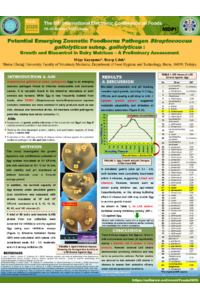
Streptococcus gallolyticus subsp. gallolyticus (Sgg) is an emerging zoonotic pathogen linked to infective endocarditis and colorectal cancer. It is naturally found in the intestinal microbiota of both animals and humans. While Sgg is less frequently isolated from foods, other Streptococcus bovis/Streptococcus equinus complex (SBSEC) members are more common in dairy products such as raw milk cheeses and fermented drinks. All members exhibit pathogenic potential, raising food safety concerns.
This study evaluated the growth dynamics and acid production/resistance of two human-derived Sgg isolates in sterile milk. Strains were inoculated at 10⁵ CFU/mL and incubated for 72 hours. Microbial enumeration and pH tracking revealed rapid growth, reaching 11.2 log₁₀ CFU/mL and causing a pH drop to 5.09. A biphasic growth pattern suggested metabolic adaptability and utilization of secondary substrates. In simulated gastric juice (pH 2.1–2.5), both isolates were completely inactivated within 5 minutes, suggesting limited acid tolerance. However, factors such as proton pump inhibitor (PPI) use, age-related hypochlorhydria, or buffering by cheese and milk may allow Sgg to survive gastric transit.
To explore biocontrol strategies, over 80 lactic acid bacteria (LAB) strains from our collection were screened using spot inhibition assays. Effective Inhibition Ratios (EIRs) were calculated. Thirty-eight LAB strains including Lacticaseibacillus casei, L. delbrueckii, and L. rhamnosus exhibited strong inhibitory activity (EIR > 1.5) against Sgg.
These findings suggest that Sgg can thrive in milk environments and lower pH significantly, posing a potential risk if present in dairy products. However, selected LAB strains demonstrated promising inhibition and may serve as protective cultures. Further studies are planned to test selected LAB strains in cheeses to assess their protective efficacy under realistic production conditions.
Keywords
Streptococcus gallolyticus
zoonotic foodborne pathogens
food safety
dairy products
protective cultures
Poster
Kayapınar M. Foods 2025 Poster.pdf
Mealworm (Tenebrio molitor) Acceptance Test of Grass and Feather Feed
Determining Environmental Sustainability of Polyphenol and Cellulose Recovery from Olive Leaves via Life Cycle Assessment