Event submissions
Published
This submission belongs to the session C. Food Quality and Safety of the event The 6th International Electronic Conference on Foods
Published date
27 Oct, 2025
Academic Editor
'%3e%3cpath%20d='M12.6657%2010.9104C12.4185%2010.325%2012.0599%209.79327%2011.6097%209.34482C11.1609%208.89508%2010.6293%208.5365%2010.0442%208.28888C10.0389%208.28626%2010.0337%208.28495%2010.0285%208.28233C10.8446%207.69279%2011.3752%206.73249%2011.3752%205.64904C11.3752%203.8542%209.92103%202.39999%208.1262%202.39999C6.33136%202.39999%204.87715%203.8542%204.87715%205.64904C4.87715%206.73249%205.40774%207.69279%206.22393%208.28364C6.21869%208.28626%206.21345%208.28757%206.20821%208.29019C5.62129%208.5378%205.09463%208.89284%204.64265%209.34613C4.1929%209.79493%203.83432%2010.3266%203.58671%2010.9117C3.34345%2011.4845%203.21226%2012.0987%203.20023%2012.7209C3.19988%2012.7349%203.20233%2012.7488%203.20744%2012.7619C3.21255%2012.7749%203.22022%2012.7867%203.22998%2012.7968C3.23975%2012.8068%203.25142%2012.8147%203.26431%2012.8202C3.2772%2012.8256%203.29105%2012.8284%203.30504%2012.8284H4.09109C4.14874%2012.8284%204.19459%2012.7825%204.1959%2012.7262C4.2221%2011.7148%204.62823%2010.7676%205.34617%2010.0497C6.08899%209.30683%207.0755%208.89808%208.1262%208.89808C9.17689%208.89808%2010.1634%209.30683%2010.9062%2010.0497C11.6242%2010.7676%2012.0303%2011.7148%2012.0565%2012.7262C12.0578%2012.7838%2012.1037%2012.8284%2012.1613%2012.8284H12.9474C12.9613%2012.8284%2012.9752%2012.8256%2012.9881%2012.8202C13.001%2012.8147%2013.0126%2012.8068%2013.0224%2012.7968C13.0322%2012.7867%2013.0398%2012.7749%2013.0449%2012.7619C13.0501%2012.7488%2013.0525%2012.7349%2013.0522%2012.7209C13.0391%2012.0947%2012.9094%2011.4855%2012.6657%2010.9104ZM8.1262%207.9024C7.52486%207.9024%206.9589%207.6679%206.53312%207.24211C6.10733%206.81633%205.87283%206.25037%205.87283%205.64904C5.87283%205.0477%206.10733%204.48174%206.53312%204.05596C6.9589%203.63018%207.52486%203.39567%208.1262%203.39567C8.72753%203.39567%209.29349%203.63018%209.71927%204.05596C10.1451%204.48174%2010.3796%205.0477%2010.3796%205.64904C10.3796%206.25037%2010.1451%206.81633%209.71927%207.24211C9.29349%207.6679%208.72753%207.9024%208.1262%207.9024Z'%20fill='%235D1EE1'/%3e%3c/g%3e%3c/svg%3e) Susana Casal
Susana CasalCitation
Alessandro Bianchi, Chiara Sanmartin, Isabella Taglieri, Alessandro Tonacci, Francesco Sansone, Francesca Venturi, “CANTINA 5.0”—Industry 5.0 Enters Winemaking Industry in Italy, in Proceedings of The 6th International Electronic Conference on Foods, 28 October–30 October 2025, MDPI: Basel, Switzerland
Share
Email
Facebook
Twitter
LinkedIn
“CANTINA 5.0”—Industry 5.0 Enters Winemaking Industry in Italy

Alessandro Bianchi 1

Chiara Sanmartin 2
'%3e%3cpath%20d='M12.6647%2010.9104C12.4176%2010.325%2012.0589%209.7933%2011.6088%209.34485C11.16%208.89511%2010.6283%208.53653%2010.0432%208.28891C10.038%208.28629%2010.0327%208.28498%2010.0275%208.28236C10.8437%207.69282%2011.3743%206.73252%2011.3743%205.64907C11.3743%203.85423%209.92005%202.40002%208.12522%202.40002C6.33038%202.40002%204.87618%203.85423%204.87618%205.64907C4.87618%206.73252%205.40677%207.69282%206.22296%208.28367C6.21772%208.28629%206.21248%208.2876%206.20724%208.29022C5.62031%208.53783%205.09365%208.89287%204.64167%209.34616C4.19192%209.79496%203.83334%2010.3266%203.58573%2010.9117C3.34247%2011.4846%203.21128%2012.0987%203.19925%2012.721C3.1989%2012.735%203.20135%2012.7489%203.20646%2012.7619C3.21157%2012.7749%203.21924%2012.7868%203.22901%2012.7968C3.23877%2012.8068%203.25045%2012.8148%203.26334%2012.8202C3.27623%2012.8256%203.29007%2012.8284%203.30406%2012.8284H4.09012C4.14776%2012.8284%204.19362%2012.7825%204.19493%2012.7262C4.22113%2011.7148%204.62726%2010.7676%205.34519%2010.0497C6.08802%209.30686%207.07452%208.89811%208.12522%208.89811C9.17592%208.89811%2010.1624%209.30686%2010.9052%2010.0497C11.6232%2010.7676%2012.0293%2011.7148%2012.0555%2012.7262C12.0568%2012.7839%2012.1027%2012.8284%2012.1603%2012.8284H12.9464C12.9604%2012.8284%2012.9742%2012.8256%2012.9871%2012.8202C13%2012.8148%2013.0117%2012.8068%2013.0214%2012.7968C13.0312%2012.7868%2013.0389%2012.7749%2013.044%2012.7619C13.0491%2012.7489%2013.0515%2012.735%2013.0512%2012.721C13.0381%2012.0947%2012.9084%2011.4856%2012.6647%2010.9104ZM8.12522%207.90243C7.52388%207.90243%206.95792%207.66793%206.53214%207.24215C6.10636%206.81636%205.87185%206.2504%205.87185%205.64907C5.87185%205.04773%206.10636%204.48177%206.53214%204.05599C6.95792%203.63021%207.52388%203.3957%208.12522%203.3957C8.72655%203.3957%209.29252%203.63021%209.7183%204.05599C10.1441%204.48177%2010.3786%205.04773%2010.3786%205.64907C10.3786%206.2504%2010.1441%206.81636%209.7183%207.24215C9.29252%207.66793%208.72655%207.90243%208.12522%207.90243Z'%20fill='%235D1EE1'/%3e%3c/g%3e%3c/svg%3e)
Isabella Taglieri 2

Alessandro Tonacci 3
Francesco Sansone 3

Francesca Venturi 2
1. Department of Agriculture, Food and Environment, University of Pisa, Via del Borghetto 80, 56124 Pisa, Italy
2. Department of Agriculture, Food and Environment, University of Pisa, via del Borghetto 80, Pisa, 56124, Italy
3. Institute of Clinical Physiology, National Research Council of Italy (IFC-CNR), via Giuseppe Moruzzi 1, Pisa, 56124, Italy
Abstract
Industry 5.0, as proposed by the European Commission, marks a paradigm shift from profit-oriented production towards a model that prioritizes human well-being and environmental sustainability. In contrast to Industry 4.0, which emphasized automation and efficiency, Industry 5.0 integrates advanced technologies with a human-centric and eco-conscious approach. The agrifood sector—particularly the winemaking industry—is a strategic application area, given its socio-economic relevance and environmental impact, especially in countries such as Italy. In response, we developed CANTINA 5.0, a research initiative aimed to operationalize Industry 5.0 principles in Italian wineries through a multidimensional approach centered on sustainability, human factors, and product quality. The research structure is based on four interconnected pillars: (i) quality of life monitoring via wearable sensors and structured questionnaires assessing workers’ physical and psychological conditions; (ii) environmental monitoring of pollutants within wine cellars using both IoT-based devices and conventional GC-MS analysis; (iii) sustainability assessment through standardized questionnaires addressing environmental practices and social responsibility indicators, with a focus on workforce well-being; and (iv) wine quality evaluation, combining chemical profiling, expert sensory panels, and emotional response tracking of consumers using wearable devices. To date, 20 wineries (12 in Friuli-Venezia Giulia, 8 in Tuscany) have participated. All completed sustainability and well-being surveys; selected facilities underwent environmental monitoring, and workers in some wineries wore smartwatches during harvest and non-harvest periods. Wine samples were analyzed chemically and sensorially, while emotional responses to wine tasting—alone and paired with music—were collected during five public events. Preliminary results show high stakeholder engagement and public interest. Future work will extend data collection and develop targeted dissemination strategies to foster the adoption of Industry 5.0 in national and European R&D frameworks.
Keywords
sensory analysis
emotional response
IoT-based devices
environmental monitoring
Industry 5.0
wine quality evaluation
Poster
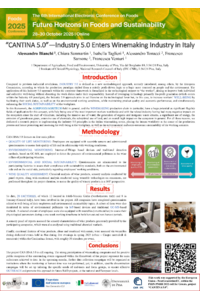
Poster Foods conference 2025-Bianchi-Cantina 5.0.pdf
Integrated metabolic profiling uncovers the stress adaptation network of Saccharomyces boulardii under gastrointestinal stress
Machine Learning-Based Prediction of Polycyclic Aromatic Hydrocarbon (PAH) Levels in Smoked Fish Using WEKA: Evaluation of Smoking Parameters and Model Performance