Event submissions
Published
This submission belongs to the session B. Nutritional and Functional Foods of the event The 6th International Electronic Conference on Foods
Published date
27 Oct, 2025
Academic Editor
'%3e%3cpath%20d='M12.6657%2010.9104C12.4185%2010.325%2012.0599%209.79327%2011.6097%209.34482C11.1609%208.89508%2010.6293%208.5365%2010.0442%208.28888C10.0389%208.28626%2010.0337%208.28495%2010.0285%208.28233C10.8446%207.69279%2011.3752%206.73249%2011.3752%205.64904C11.3752%203.8542%209.92103%202.39999%208.1262%202.39999C6.33136%202.39999%204.87715%203.8542%204.87715%205.64904C4.87715%206.73249%205.40774%207.69279%206.22393%208.28364C6.21869%208.28626%206.21345%208.28757%206.20821%208.29019C5.62129%208.5378%205.09463%208.89284%204.64265%209.34613C4.1929%209.79493%203.83432%2010.3266%203.58671%2010.9117C3.34345%2011.4845%203.21226%2012.0987%203.20023%2012.7209C3.19988%2012.7349%203.20233%2012.7488%203.20744%2012.7619C3.21255%2012.7749%203.22022%2012.7867%203.22998%2012.7968C3.23975%2012.8068%203.25142%2012.8147%203.26431%2012.8202C3.2772%2012.8256%203.29105%2012.8284%203.30504%2012.8284H4.09109C4.14874%2012.8284%204.19459%2012.7825%204.1959%2012.7262C4.2221%2011.7148%204.62823%2010.7676%205.34617%2010.0497C6.08899%209.30683%207.0755%208.89808%208.1262%208.89808C9.17689%208.89808%2010.1634%209.30683%2010.9062%2010.0497C11.6242%2010.7676%2012.0303%2011.7148%2012.0565%2012.7262C12.0578%2012.7838%2012.1037%2012.8284%2012.1613%2012.8284H12.9474C12.9613%2012.8284%2012.9752%2012.8256%2012.9881%2012.8202C13.001%2012.8147%2013.0126%2012.8068%2013.0224%2012.7968C13.0322%2012.7867%2013.0398%2012.7749%2013.0449%2012.7619C13.0501%2012.7488%2013.0525%2012.7349%2013.0522%2012.7209C13.0391%2012.0947%2012.9094%2011.4855%2012.6657%2010.9104ZM8.1262%207.9024C7.52486%207.9024%206.9589%207.6679%206.53312%207.24211C6.10733%206.81633%205.87283%206.25037%205.87283%205.64904C5.87283%205.0477%206.10733%204.48174%206.53312%204.05596C6.9589%203.63018%207.52486%203.39567%208.1262%203.39567C8.72753%203.39567%209.29349%203.63018%209.71927%204.05596C10.1451%204.48174%2010.3796%205.0477%2010.3796%205.64904C10.3796%206.25037%2010.1451%206.81633%209.71927%207.24211C9.29349%207.6679%208.72753%207.9024%208.1262%207.9024Z'%20fill='%235D1EE1'/%3e%3c/g%3e%3c/svg%3e) Manuel Viuda-Martos
Manuel Viuda-MartosCitation
Maria Eugenia Sabatino, Mariana Soledad Lingia, Maria Verónica Baroni, Effect of in vitro gastrointestinal and colonic digestion on the bioactive properties of yogurt enriched with microencapsuled red grape pomace extracts, in Proceedings of The 6th International Electronic Conference on Foods, 28 October–30 October 2025, MDPI: Basel, Switzerland
Share
Email
Facebook
Twitter
LinkedIn
Effect of in vitro gastrointestinal and colonic digestion on the bioactive properties of yogurt enriched with microencapsuled red grape pomace extracts
'%3e%3cpath%20d='M12.6647%2010.9104C12.4176%2010.325%2012.0589%209.7933%2011.6088%209.34485C11.16%208.89511%2010.6283%208.53653%2010.0432%208.28891C10.038%208.28629%2010.0327%208.28498%2010.0275%208.28236C10.8437%207.69282%2011.3743%206.73252%2011.3743%205.64907C11.3743%203.85423%209.92005%202.40002%208.12522%202.40002C6.33038%202.40002%204.87618%203.85423%204.87618%205.64907C4.87618%206.73252%205.40677%207.69282%206.22296%208.28367C6.21772%208.28629%206.21248%208.2876%206.20724%208.29022C5.62031%208.53783%205.09365%208.89287%204.64167%209.34616C4.19192%209.79496%203.83334%2010.3266%203.58573%2010.9117C3.34247%2011.4846%203.21128%2012.0987%203.19925%2012.721C3.1989%2012.735%203.20135%2012.7489%203.20646%2012.7619C3.21157%2012.7749%203.21924%2012.7868%203.22901%2012.7968C3.23877%2012.8068%203.25045%2012.8148%203.26334%2012.8202C3.27623%2012.8256%203.29007%2012.8284%203.30406%2012.8284H4.09012C4.14776%2012.8284%204.19362%2012.7825%204.19493%2012.7262C4.22113%2011.7148%204.62726%2010.7676%205.34519%2010.0497C6.08802%209.30686%207.07452%208.89811%208.12522%208.89811C9.17592%208.89811%2010.1624%209.30686%2010.9052%2010.0497C11.6232%2010.7676%2012.0293%2011.7148%2012.0555%2012.7262C12.0568%2012.7839%2012.1027%2012.8284%2012.1603%2012.8284H12.9464C12.9604%2012.8284%2012.9742%2012.8256%2012.9871%2012.8202C13%2012.8148%2013.0117%2012.8068%2013.0214%2012.7968C13.0312%2012.7868%2013.0389%2012.7749%2013.044%2012.7619C13.0491%2012.7489%2013.0515%2012.735%2013.0512%2012.721C13.0381%2012.0947%2012.9084%2011.4856%2012.6647%2010.9104ZM8.12522%207.90243C7.52388%207.90243%206.95792%207.66793%206.53214%207.24215C6.10636%206.81636%205.87185%206.2504%205.87185%205.64907C5.87185%205.04773%206.10636%204.48177%206.53214%204.05599C6.95792%203.63021%207.52388%203.3957%208.12522%203.3957C8.72655%203.3957%209.29252%203.63021%209.7183%204.05599C10.1441%204.48177%2010.3786%205.04773%2010.3786%205.64907C10.3786%206.2504%2010.1441%206.81636%209.7183%207.24215C9.29252%207.66793%208.72655%207.90243%208.12522%207.90243Z'%20fill='%235D1EE1'/%3e%3c/g%3e%3c/svg%3e)
Maria Eugenia Sabatino 1
Mariana Soledad Lingia 2
Maria Verónica Baroni 1
1. Instituto de Ciencia y Tecnología de Alimentos Córdoba (ICYTAC- CONICET), Córdoba, X5000HUA, Argentina
2. Instituto Nacional de Tecnología Agropecuaria, Estación Experimental Rafaela (INTA Rafaela), Santa Fe, Rafaela, S2300, Argentina
Abstract
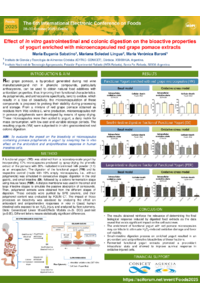
Red grape pomace, a by-product generated during red wine manufactureingand rich in phenolic compounds, particularly anthocyanins, can be used to obtain natural food additives with antioxidant properties, thus improving their functional characteristics. As polyphenols, and anthocyanins specifically, tend to oxidize, which results in a loss of bioactivity, the microencapsulation of these compounds is proposed to prolong their stability during processing and storage. From a mixture of red grape pomace obtained as residues from Vitis vinifera L. wine production, microencapsules (maltodextrin, whey proteins, and chitosan) rich in pomace polyphenols were developed by means of spray drying. These microcapsules were then added to yogurt (skim, natural, and sweetened with Stevia), a dairy matrix for mass consumption, with low cost and variable storage periods. The resulting yogurts (YM) were subjected to in vitro gastrointestinal and colonic digestion. Then, polyphenol extracts were obtained from the different stages of digestion. These extracts were purified using SPE columns, and their polyphenol content was evaluated via FOLIN CT. The impact of these processes on bioactivity was assessed by analyzing the effect on antioxidant and antiproliferative responses in vitro in human intestinal cells via flow cytometry. The results obtained contribute to our understanding of how the modifications that occurred during the digestion process impact the final biological response achieved.
Keywords
Wine by-products
Dairy
Digestion
Oxidative stress
Functional foods
Cell culture
Poster
sciforum-129431.pdf
BIOECONOMY IN THE DAIRY INDUSTRY: APPLICATION OF BUTTERMILK IN KEFIR PRODUCTION
Application of Powder X-Ray Diffraction (p-XRD) and Chemometrics for the Classification of Cheese Varieties.