Event submissions
Published
This submission belongs to the session F. Sustainable Food Security and Food Systems of the event The 6th International Electronic Conference on Foods
Published date
27 Oct, 2025
Academic Editor
'%3e%3cpath%20d='M12.6657%2010.9104C12.4185%2010.325%2012.0599%209.79327%2011.6097%209.34482C11.1609%208.89508%2010.6293%208.5365%2010.0442%208.28888C10.0389%208.28626%2010.0337%208.28495%2010.0285%208.28233C10.8446%207.69279%2011.3752%206.73249%2011.3752%205.64904C11.3752%203.8542%209.92103%202.39999%208.1262%202.39999C6.33136%202.39999%204.87715%203.8542%204.87715%205.64904C4.87715%206.73249%205.40774%207.69279%206.22393%208.28364C6.21869%208.28626%206.21345%208.28757%206.20821%208.29019C5.62129%208.5378%205.09463%208.89284%204.64265%209.34613C4.1929%209.79493%203.83432%2010.3266%203.58671%2010.9117C3.34345%2011.4845%203.21226%2012.0987%203.20023%2012.7209C3.19988%2012.7349%203.20233%2012.7488%203.20744%2012.7619C3.21255%2012.7749%203.22022%2012.7867%203.22998%2012.7968C3.23975%2012.8068%203.25142%2012.8147%203.26431%2012.8202C3.2772%2012.8256%203.29105%2012.8284%203.30504%2012.8284H4.09109C4.14874%2012.8284%204.19459%2012.7825%204.1959%2012.7262C4.2221%2011.7148%204.62823%2010.7676%205.34617%2010.0497C6.08899%209.30683%207.0755%208.89808%208.1262%208.89808C9.17689%208.89808%2010.1634%209.30683%2010.9062%2010.0497C11.6242%2010.7676%2012.0303%2011.7148%2012.0565%2012.7262C12.0578%2012.7838%2012.1037%2012.8284%2012.1613%2012.8284H12.9474C12.9613%2012.8284%2012.9752%2012.8256%2012.9881%2012.8202C13.001%2012.8147%2013.0126%2012.8068%2013.0224%2012.7968C13.0322%2012.7867%2013.0398%2012.7749%2013.0449%2012.7619C13.0501%2012.7488%2013.0525%2012.7349%2013.0522%2012.7209C13.0391%2012.0947%2012.9094%2011.4855%2012.6657%2010.9104ZM8.1262%207.9024C7.52486%207.9024%206.9589%207.6679%206.53312%207.24211C6.10733%206.81633%205.87283%206.25037%205.87283%205.64904C5.87283%205.0477%206.10733%204.48174%206.53312%204.05596C6.9589%203.63018%207.52486%203.39567%208.1262%203.39567C8.72753%203.39567%209.29349%203.63018%209.71927%204.05596C10.1451%204.48174%2010.3796%205.0477%2010.3796%205.64904C10.3796%206.25037%2010.1451%206.81633%209.71927%207.24211C9.29349%207.6679%208.72753%207.9024%208.1262%207.9024Z'%20fill='%235D1EE1'/%3e%3c/g%3e%3c/svg%3e) Theodoros Varzakas
Theodoros VarzakasCitation
Antonia Charalampos Mataragka, Alternative Proteins in Pet Food: A Sustainable, Nutritious Future or Just a Trend?, in Proceedings of The 6th International Electronic Conference on Foods, 28 October–30 October 2025, MDPI: Basel, Switzerland
Share
Email
Facebook
Twitter
LinkedIn
Alternative Proteins in Pet Food: A Sustainable, Nutritious Future or Just a Trend?

Antonia Charalampos Mataragka 1
1. Laboratory of Anatomy and Physiology of Farm Animals, Department of Animal Science, School of Animal Biosciences, Agricultural University of Athens, 11855 Athens, Greece
Abstract
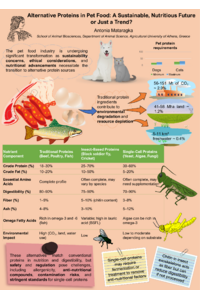
The pet food industry is undergoing significant transformation as sustainability concerns, ethical considerations, and nutritional advancements necessitate the transition to alternative protein sources. Traditional protein ingredients such as beef, poultry, and fish contribute to environmental degradation and resource depletion, necessitating the exploration of novel, eco-friendly alternatives. The potential of alternative protein sources in pet nutrition as a response to the dual challenge of meeting high dietary protein requirements and reducing the environmental impact of traditional pet feeds seems promising. Protein is a critical component in pet diets, with requirements ranging from 18% to 22% for dogs and 26% to 30% for cats on a dry basis. However, conventional dry pet food production contributes 56–151 Mt of CO₂-equivalent emissions annually, utilizes 41–58 Mha of agricultural land, and consumes 5–11 km³ of freshwater, accounting for up to 2.9%, 1.2%, and 0.4% of global agricultural resource use, respectively.
Insect-based proteins offer high protein (25–70%) and lipid (10–50%) contents with a lower water, land, and carbon footprint. Single-cell proteins derived from yeast, fungi, or algae can be cultivated using a variety of substrates, including agricultural waste and industrial by-products. The potential of these alternative protein sources is promising in terms of resource-efficient solutions. While these alternatives offer comparable nutritional value and digestibility to conventional protein sources, safety and regulatory challenges remain, particularly concerning allergenicity and anti-nutritional factors, potential contaminants, and strict standards imposed on single-cell proteins. Future research should focus on mitigating potential risks while establishing robust regulatory frameworks to facilitate widespread adoption of sustainable protein alternatives in pet nutrition.
Keywords
pet food
sustainability
alternative proteins
pet nutrition
environmental footprint
Poster
Poster - Alternative Proteins in Pet Food A Sustainable, Nutritious Future or Just a Trend.pdf
How a risk-based strategy could contribute to a more sustainable agri-food system
Polyphasic characterisation of lactic acid bacteria diversity associated with Subappennino Dauno sheep milk from ‘Gentile di Puglia’ breed for application in Pecorino cheese and design of cereal-based fermented beverage