Event submissions
Published
This submission belongs to the session C. Food Quality and Safety of the event The 6th International Electronic Conference on Foods
Published date
27 Oct, 2025
Academic Editor
'%3e%3cpath%20d='M12.6657%2010.9104C12.4185%2010.325%2012.0599%209.79327%2011.6097%209.34482C11.1609%208.89508%2010.6293%208.5365%2010.0442%208.28888C10.0389%208.28626%2010.0337%208.28495%2010.0285%208.28233C10.8446%207.69279%2011.3752%206.73249%2011.3752%205.64904C11.3752%203.8542%209.92103%202.39999%208.1262%202.39999C6.33136%202.39999%204.87715%203.8542%204.87715%205.64904C4.87715%206.73249%205.40774%207.69279%206.22393%208.28364C6.21869%208.28626%206.21345%208.28757%206.20821%208.29019C5.62129%208.5378%205.09463%208.89284%204.64265%209.34613C4.1929%209.79493%203.83432%2010.3266%203.58671%2010.9117C3.34345%2011.4845%203.21226%2012.0987%203.20023%2012.7209C3.19988%2012.7349%203.20233%2012.7488%203.20744%2012.7619C3.21255%2012.7749%203.22022%2012.7867%203.22998%2012.7968C3.23975%2012.8068%203.25142%2012.8147%203.26431%2012.8202C3.2772%2012.8256%203.29105%2012.8284%203.30504%2012.8284H4.09109C4.14874%2012.8284%204.19459%2012.7825%204.1959%2012.7262C4.2221%2011.7148%204.62823%2010.7676%205.34617%2010.0497C6.08899%209.30683%207.0755%208.89808%208.1262%208.89808C9.17689%208.89808%2010.1634%209.30683%2010.9062%2010.0497C11.6242%2010.7676%2012.0303%2011.7148%2012.0565%2012.7262C12.0578%2012.7838%2012.1037%2012.8284%2012.1613%2012.8284H12.9474C12.9613%2012.8284%2012.9752%2012.8256%2012.9881%2012.8202C13.001%2012.8147%2013.0126%2012.8068%2013.0224%2012.7968C13.0322%2012.7867%2013.0398%2012.7749%2013.0449%2012.7619C13.0501%2012.7488%2013.0525%2012.7349%2013.0522%2012.7209C13.0391%2012.0947%2012.9094%2011.4855%2012.6657%2010.9104ZM8.1262%207.9024C7.52486%207.9024%206.9589%207.6679%206.53312%207.24211C6.10733%206.81633%205.87283%206.25037%205.87283%205.64904C5.87283%205.0477%206.10733%204.48174%206.53312%204.05596C6.9589%203.63018%207.52486%203.39567%208.1262%203.39567C8.72753%203.39567%209.29349%203.63018%209.71927%204.05596C10.1451%204.48174%2010.3796%205.0477%2010.3796%205.64904C10.3796%206.25037%2010.1451%206.81633%209.71927%207.24211C9.29349%207.6679%208.72753%207.9024%208.1262%207.9024Z'%20fill='%235D1EE1'/%3e%3c/g%3e%3c/svg%3e) Susana Casal
Susana CasalCitation
Andrea Obelleiro, Clara Pérez-Ràfols, Núria Serrano, José Manuel Díaz-Cruz, Oscar Nuñez, POTENTIAL OF CYCLIC VOLTAMMETRY FINGERPRINTING USING SCREEN-PRINTED ELECTRODES TO ASSESS SPANISH HONEY BOTANICAL VARIETIES, in Proceedings of The 6th International Electronic Conference on Foods, 28 October–30 October 2025, MDPI: Basel, Switzerland
Share
Email
Facebook
Twitter
LinkedIn
POTENTIAL OF CYCLIC VOLTAMMETRY FINGERPRINTING USING SCREEN-PRINTED ELECTRODES TO ASSESS SPANISH HONEY BOTANICAL VARIETIES
'%3e%3cpath%20d='M12.6647%2010.9104C12.4176%2010.325%2012.0589%209.7933%2011.6088%209.34485C11.16%208.89511%2010.6283%208.53653%2010.0432%208.28891C10.038%208.28629%2010.0327%208.28498%2010.0275%208.28236C10.8437%207.69282%2011.3743%206.73252%2011.3743%205.64907C11.3743%203.85423%209.92005%202.40002%208.12522%202.40002C6.33038%202.40002%204.87618%203.85423%204.87618%205.64907C4.87618%206.73252%205.40677%207.69282%206.22296%208.28367C6.21772%208.28629%206.21248%208.2876%206.20724%208.29022C5.62031%208.53783%205.09365%208.89287%204.64167%209.34616C4.19192%209.79496%203.83334%2010.3266%203.58573%2010.9117C3.34247%2011.4846%203.21128%2012.0987%203.19925%2012.721C3.1989%2012.735%203.20135%2012.7489%203.20646%2012.7619C3.21157%2012.7749%203.21924%2012.7868%203.22901%2012.7968C3.23877%2012.8068%203.25045%2012.8148%203.26334%2012.8202C3.27623%2012.8256%203.29007%2012.8284%203.30406%2012.8284H4.09012C4.14776%2012.8284%204.19362%2012.7825%204.19493%2012.7262C4.22113%2011.7148%204.62726%2010.7676%205.34519%2010.0497C6.08802%209.30686%207.07452%208.89811%208.12522%208.89811C9.17592%208.89811%2010.1624%209.30686%2010.9052%2010.0497C11.6232%2010.7676%2012.0293%2011.7148%2012.0555%2012.7262C12.0568%2012.7839%2012.1027%2012.8284%2012.1603%2012.8284H12.9464C12.9604%2012.8284%2012.9742%2012.8256%2012.9871%2012.8202C13%2012.8148%2013.0117%2012.8068%2013.0214%2012.7968C13.0312%2012.7868%2013.0389%2012.7749%2013.044%2012.7619C13.0491%2012.7489%2013.0515%2012.735%2013.0512%2012.721C13.0381%2012.0947%2012.9084%2011.4856%2012.6647%2010.9104ZM8.12522%207.90243C7.52388%207.90243%206.95792%207.66793%206.53214%207.24215C6.10636%206.81636%205.87185%206.2504%205.87185%205.64907C5.87185%205.04773%206.10636%204.48177%206.53214%204.05599C6.95792%203.63021%207.52388%203.3957%208.12522%203.3957C8.72655%203.3957%209.29252%203.63021%209.7183%204.05599C10.1441%204.48177%2010.3786%205.04773%2010.3786%205.64907C10.3786%206.2504%2010.1441%206.81636%209.7183%207.24215C9.29252%207.66793%208.72655%207.90243%208.12522%207.90243Z'%20fill='%235D1EE1'/%3e%3c/g%3e%3c/svg%3e)
Andrea Obelleiro 1

Clara Pérez-Ràfols 1,2

Núria Serrano 1,2

José Manuel Díaz-Cruz 1,2

Oscar Nuñez 1,3,4
1. Department of Chemical Engineering and Analytical Chemistry, University of Barcelona, Barcelona, 08028, Spain
2. Water Research Institute (IdRA), University of Barcelona, Barcelona, 08028, Spain
3. Research Institute in Food Nutrition and Food Safety, University of Barcelona, Santa Coloma de Gramenet, Barcelona, 08028, Spain
4. Generalitat de Catalunya, Barcelona, 08028, Spain
Abstract
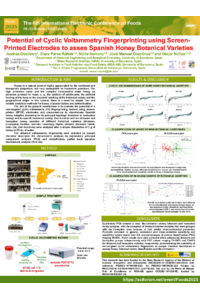
Honey is a natural product that is highly appreciated for its nutritional and therapeutic properties, but is very susceptible to fraudulent practices. Its high economic value and complex composition make honey an attractive product for fraud., Fraudulent practices may involve adding adulterants, artificial feeding of the bees, or incorrect labelling of the botanical variety and geographical origin. In this context, there is a need for simple, fast, and reliable analytical methods for honey characterization and authentication.
A non-targeted cyclic voltammetry (CV) fingerprinting method using screen-printed (SPCE) electrodes and chemometric analysis to discriminate Spanish honey samples according to their principal typology (blossom or honeydew honey) and its specific botanical variety was developed and validated. One hundred and ten blossom and honeydew honey samples of different botanical varieties (blossom, eucalyptus, heather, lavender, rosemary, thyme, almond, chestnut, forest, holm oak, and mountain) were analyzed after a simple dissolution of 2 g of honey in 20 mL of water. CV measurements were initiated by immersing an SPCE into the honey extract solution while scanning the potential from -1.8 to 1.0 V for three consecutive cycles using a scan rate of 0.05 V/s. The second voltammetric cycle was selected as sample chemical descriptor for chemometrics. Exploratory principal component analysis showed clear discrimination among blossom and honeydew honey samples, except for blossom heather samples, which were grouped with the honeydew ones because of their similar physicochemical properties. Partial least squares discriminant analysis provided in general calibration and cross-validation sensitivity and specificity values higher than 0.9, and percentages of correct classification (PCC) ranging 80-92%. Good results were also achieved when addressing blossom and honeydew groups independently, with PCC values ranging from 70 to 100% and 73 to 93% for blossom and honeydew varieties, respectively, demonstrating the suitability of CV fingerprints as sample chemical descriptors to assess honey botanical variety.
Keywords
Blossom honey
Honeydew honey
Honey botanical authentication
Cyclic voltammetry
Screen-printed carbon electrodes
Chemometrics
Poster
Poster Foods_Mels.pdf
Polyphasic characterisation of lactic acid bacteria diversity associated with Subappennino Dauno sheep milk from ‘Gentile di Puglia’ breed for application in Pecorino cheese and design of cereal-based fermented beverage
Monitoring of Persistent and Emergent Pollutants in black scabbard fish Aphanopus carbo by-products and protein hydrolysates