Event submissions
Published
This submission belongs to the session B. Nutritional and Functional Foods of the event The 6th International Electronic Conference on Foods
Published date
27 Oct, 2025
Academic Editor
'%3e%3cpath%20d='M12.6657%2010.9104C12.4185%2010.325%2012.0599%209.79327%2011.6097%209.34482C11.1609%208.89508%2010.6293%208.5365%2010.0442%208.28888C10.0389%208.28626%2010.0337%208.28495%2010.0285%208.28233C10.8446%207.69279%2011.3752%206.73249%2011.3752%205.64904C11.3752%203.8542%209.92103%202.39999%208.1262%202.39999C6.33136%202.39999%204.87715%203.8542%204.87715%205.64904C4.87715%206.73249%205.40774%207.69279%206.22393%208.28364C6.21869%208.28626%206.21345%208.28757%206.20821%208.29019C5.62129%208.5378%205.09463%208.89284%204.64265%209.34613C4.1929%209.79493%203.83432%2010.3266%203.58671%2010.9117C3.34345%2011.4845%203.21226%2012.0987%203.20023%2012.7209C3.19988%2012.7349%203.20233%2012.7488%203.20744%2012.7619C3.21255%2012.7749%203.22022%2012.7867%203.22998%2012.7968C3.23975%2012.8068%203.25142%2012.8147%203.26431%2012.8202C3.2772%2012.8256%203.29105%2012.8284%203.30504%2012.8284H4.09109C4.14874%2012.8284%204.19459%2012.7825%204.1959%2012.7262C4.2221%2011.7148%204.62823%2010.7676%205.34617%2010.0497C6.08899%209.30683%207.0755%208.89808%208.1262%208.89808C9.17689%208.89808%2010.1634%209.30683%2010.9062%2010.0497C11.6242%2010.7676%2012.0303%2011.7148%2012.0565%2012.7262C12.0578%2012.7838%2012.1037%2012.8284%2012.1613%2012.8284H12.9474C12.9613%2012.8284%2012.9752%2012.8256%2012.9881%2012.8202C13.001%2012.8147%2013.0126%2012.8068%2013.0224%2012.7968C13.0322%2012.7867%2013.0398%2012.7749%2013.0449%2012.7619C13.0501%2012.7488%2013.0525%2012.7349%2013.0522%2012.7209C13.0391%2012.0947%2012.9094%2011.4855%2012.6657%2010.9104ZM8.1262%207.9024C7.52486%207.9024%206.9589%207.6679%206.53312%207.24211C6.10733%206.81633%205.87283%206.25037%205.87283%205.64904C5.87283%205.0477%206.10733%204.48174%206.53312%204.05596C6.9589%203.63018%207.52486%203.39567%208.1262%203.39567C8.72753%203.39567%209.29349%203.63018%209.71927%204.05596C10.1451%204.48174%2010.3796%205.0477%2010.3796%205.64904C10.3796%206.25037%2010.1451%206.81633%209.71927%207.24211C9.29349%207.6679%208.72753%207.9024%208.1262%207.9024Z'%20fill='%235D1EE1'/%3e%3c/g%3e%3c/svg%3e) Antonello Santini
Antonello SantiniCitation
Laura Sanjulián, Salvador Fernández-Rico, Nerea González-Rodríguez, Cristina Fente, Alexandre Lamas, Patricia Regal, Influence of dairy production systems on milk fatty acid and mineral profiles, in Proceedings of The 6th International Electronic Conference on Foods, 28 October–30 October 2025, MDPI: Basel, Switzerland
Share
Email
Facebook
Twitter
LinkedIn
Influence of dairy production systems on milk fatty acid and mineral profiles
'%3e%3cpath%20d='M12.6647%2010.9104C12.4176%2010.325%2012.0589%209.7933%2011.6088%209.34485C11.16%208.89511%2010.6283%208.53653%2010.0432%208.28891C10.038%208.28629%2010.0327%208.28498%2010.0275%208.28236C10.8437%207.69282%2011.3743%206.73252%2011.3743%205.64907C11.3743%203.85423%209.92005%202.40002%208.12522%202.40002C6.33038%202.40002%204.87618%203.85423%204.87618%205.64907C4.87618%206.73252%205.40677%207.69282%206.22296%208.28367C6.21772%208.28629%206.21248%208.2876%206.20724%208.29022C5.62031%208.53783%205.09365%208.89287%204.64167%209.34616C4.19192%209.79496%203.83334%2010.3266%203.58573%2010.9117C3.34247%2011.4846%203.21128%2012.0987%203.19925%2012.721C3.1989%2012.735%203.20135%2012.7489%203.20646%2012.7619C3.21157%2012.7749%203.21924%2012.7868%203.22901%2012.7968C3.23877%2012.8068%203.25045%2012.8148%203.26334%2012.8202C3.27623%2012.8256%203.29007%2012.8284%203.30406%2012.8284H4.09012C4.14776%2012.8284%204.19362%2012.7825%204.19493%2012.7262C4.22113%2011.7148%204.62726%2010.7676%205.34519%2010.0497C6.08802%209.30686%207.07452%208.89811%208.12522%208.89811C9.17592%208.89811%2010.1624%209.30686%2010.9052%2010.0497C11.6232%2010.7676%2012.0293%2011.7148%2012.0555%2012.7262C12.0568%2012.7839%2012.1027%2012.8284%2012.1603%2012.8284H12.9464C12.9604%2012.8284%2012.9742%2012.8256%2012.9871%2012.8202C13%2012.8148%2013.0117%2012.8068%2013.0214%2012.7968C13.0312%2012.7868%2013.0389%2012.7749%2013.044%2012.7619C13.0491%2012.7489%2013.0515%2012.735%2013.0512%2012.721C13.0381%2012.0947%2012.9084%2011.4856%2012.6647%2010.9104ZM8.12522%207.90243C7.52388%207.90243%206.95792%207.66793%206.53214%207.24215C6.10636%206.81636%205.87185%206.2504%205.87185%205.64907C5.87185%205.04773%206.10636%204.48177%206.53214%204.05599C6.95792%203.63021%207.52388%203.3957%208.12522%203.3957C8.72655%203.3957%209.29252%203.63021%209.7183%204.05599C10.1441%204.48177%2010.3786%205.04773%2010.3786%205.64907C10.3786%206.2504%2010.1441%206.81636%209.7183%207.24215C9.29252%207.66793%208.72655%207.90243%208.12522%207.90243Z'%20fill='%235D1EE1'/%3e%3c/g%3e%3c/svg%3e)
Laura Sanjulián 1
Salvador Fernández-Rico 1
Nerea González-Rodríguez 1

Cristina Fente 1

Alexandre Lamas 1

Patricia Regal 1
1. Food Hygiene, Inspection and Control Laboratory (LHICA), Department of Analytical Chemistry, Nutrition and Bromatology, Veterinary School, Campus Terra, Universidade de Santiago de Compostela, 27002, Lugo, Spain
Abstract
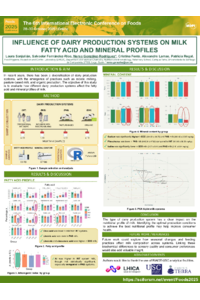
Introduction: In recent years, there has been a diversification of dairy production systems, with the emergence of practices such as robotic milking, pasture-based milk, and organic production. The objective of this study is to evaluate how different dairy production systems affect the fatty acid and mineral profiles of milk.
Methods: A total of 40 bulk tank milk samples were collected from four production systems: conventional intensive (n=10), intensive with robotic milking (n=10), pasture-based (n=10), and organic. Fatty acid profiles were analyzed using GC-FID, while mineral content (Na, Ca, K, P, Mg, and I) was determined by ICP-MS. Statistical analysis was performed using R (version 4.4.2), employing ANOVA combined with Fisher’s LSD test for multiple comparisons.
Results: Significant differences were observed in the fatty acid profiles among the different production systems. Oleic acid levels were significantly lower (p < 0.05) in milk from intensive systems, while linoleic acid levels were significantly lower in pasture-based milk (p < 0.05). Conversely, levels of linolenic acid and eicosenoic acid were significantly higher (p < 0.05) in organic milk. Although not statistically significant, the atherogenic index was higher in milk from intensive systems compared to the other production types, particularly when compared to pasture-based systems. Regarding minerals, sodium levels were significantly higher (p < 0.05) in organic (364.51±38.73 mg/kg) and pasture-based milk (360.42±25.87 mg/kg). Phosphorus levels were lower in pasture-based milk (945.09±47.92 mg/kg) compared to milk from intensive systems (991.95±58.56 mg/kg). Iodine levels were significantly lower in organic (0.07±0.04 mg/kg) and pasture-based production (0.10±0.04 mg/kg).
Conclusion: The type of dairy production systems has a clear impact on the nutritional profile of milk. Identifying the optimal production conditions to achieve the best nutritional profile may help improve consumer health.
Keywords
milk
fatty acids
minerals
production system
organic
grazing.
Poster
sciforum-131026.pdf
Proteolytic activity of Geotrichum candidum isolated from Natural Bloomy Rind Artisanal Minas Cheese
Effect of Free and Encapsulated Olive Leaf Extract on the Functional and Quality Characteristics of Cantal-Type Cheese During Refrigerated Storage