Event submissions
Published
This submission belongs to the session D. Food Microbiology of the event The 6th International Electronic Conference on Foods
Published date
27 Oct, 2025
Academic Editor
'%3e%3cpath%20d='M12.6657%2010.9104C12.4185%2010.325%2012.0599%209.79327%2011.6097%209.34482C11.1609%208.89508%2010.6293%208.5365%2010.0442%208.28888C10.0389%208.28626%2010.0337%208.28495%2010.0285%208.28233C10.8446%207.69279%2011.3752%206.73249%2011.3752%205.64904C11.3752%203.8542%209.92103%202.39999%208.1262%202.39999C6.33136%202.39999%204.87715%203.8542%204.87715%205.64904C4.87715%206.73249%205.40774%207.69279%206.22393%208.28364C6.21869%208.28626%206.21345%208.28757%206.20821%208.29019C5.62129%208.5378%205.09463%208.89284%204.64265%209.34613C4.1929%209.79493%203.83432%2010.3266%203.58671%2010.9117C3.34345%2011.4845%203.21226%2012.0987%203.20023%2012.7209C3.19988%2012.7349%203.20233%2012.7488%203.20744%2012.7619C3.21255%2012.7749%203.22022%2012.7867%203.22998%2012.7968C3.23975%2012.8068%203.25142%2012.8147%203.26431%2012.8202C3.2772%2012.8256%203.29105%2012.8284%203.30504%2012.8284H4.09109C4.14874%2012.8284%204.19459%2012.7825%204.1959%2012.7262C4.2221%2011.7148%204.62823%2010.7676%205.34617%2010.0497C6.08899%209.30683%207.0755%208.89808%208.1262%208.89808C9.17689%208.89808%2010.1634%209.30683%2010.9062%2010.0497C11.6242%2010.7676%2012.0303%2011.7148%2012.0565%2012.7262C12.0578%2012.7838%2012.1037%2012.8284%2012.1613%2012.8284H12.9474C12.9613%2012.8284%2012.9752%2012.8256%2012.9881%2012.8202C13.001%2012.8147%2013.0126%2012.8068%2013.0224%2012.7968C13.0322%2012.7867%2013.0398%2012.7749%2013.0449%2012.7619C13.0501%2012.7488%2013.0525%2012.7349%2013.0522%2012.7209C13.0391%2012.0947%2012.9094%2011.4855%2012.6657%2010.9104ZM8.1262%207.9024C7.52486%207.9024%206.9589%207.6679%206.53312%207.24211C6.10733%206.81633%205.87283%206.25037%205.87283%205.64904C5.87283%205.0477%206.10733%204.48174%206.53312%204.05596C6.9589%203.63018%207.52486%203.39567%208.1262%203.39567C8.72753%203.39567%209.29349%203.63018%209.71927%204.05596C10.1451%204.48174%2010.3796%205.0477%2010.3796%205.64904C10.3796%206.25037%2010.1451%206.81633%209.71927%207.24211C9.29349%207.6679%208.72753%207.9024%208.1262%207.9024Z'%20fill='%235D1EE1'/%3e%3c/g%3e%3c/svg%3e) Efstathios Giaouris
Efstathios GiaourisCitation
Alejandro Pérez-Rodríguez, Carlos Alberto Montenegro-Herrera, César Mateo Flores-Ortíz, Liliana Morales-Barrera, Eliseo Cristiani-Urbina, A newly isolated Kluyveromyces marxianus strain capable of producing oleic acid-rich oil for human consumption from whey, in Proceedings of The 6th International Electronic Conference on Foods, 28 October–30 October 2025, MDPI: Basel, Switzerland
Share
Email
Facebook
Twitter
LinkedIn
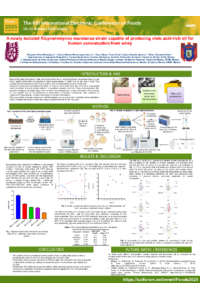
A newly isolated Kluyveromyces marxianus strain capable of producing oleic acid-rich oil for human consumption from whey

Alejandro Pérez-Rodríguez 1,2
'%3e%3cpath%20d='M12.6647%2010.9104C12.4176%2010.325%2012.0589%209.7933%2011.6088%209.34485C11.16%208.89511%2010.6283%208.53653%2010.0432%208.28891C10.038%208.28629%2010.0327%208.28498%2010.0275%208.28236C10.8437%207.69282%2011.3743%206.73252%2011.3743%205.64907C11.3743%203.85423%209.92005%202.40002%208.12522%202.40002C6.33038%202.40002%204.87618%203.85423%204.87618%205.64907C4.87618%206.73252%205.40677%207.69282%206.22296%208.28367C6.21772%208.28629%206.21248%208.2876%206.20724%208.29022C5.62031%208.53783%205.09365%208.89287%204.64167%209.34616C4.19192%209.79496%203.83334%2010.3266%203.58573%2010.9117C3.34247%2011.4846%203.21128%2012.0987%203.19925%2012.721C3.1989%2012.735%203.20135%2012.7489%203.20646%2012.7619C3.21157%2012.7749%203.21924%2012.7868%203.22901%2012.7968C3.23877%2012.8068%203.25045%2012.8148%203.26334%2012.8202C3.27623%2012.8256%203.29007%2012.8284%203.30406%2012.8284H4.09012C4.14776%2012.8284%204.19362%2012.7825%204.19493%2012.7262C4.22113%2011.7148%204.62726%2010.7676%205.34519%2010.0497C6.08802%209.30686%207.07452%208.89811%208.12522%208.89811C9.17592%208.89811%2010.1624%209.30686%2010.9052%2010.0497C11.6232%2010.7676%2012.0293%2011.7148%2012.0555%2012.7262C12.0568%2012.7839%2012.1027%2012.8284%2012.1603%2012.8284H12.9464C12.9604%2012.8284%2012.9742%2012.8256%2012.9871%2012.8202C13%2012.8148%2013.0117%2012.8068%2013.0214%2012.7968C13.0312%2012.7868%2013.0389%2012.7749%2013.044%2012.7619C13.0491%2012.7489%2013.0515%2012.735%2013.0512%2012.721C13.0381%2012.0947%2012.9084%2011.4856%2012.6647%2010.9104ZM8.12522%207.90243C7.52388%207.90243%206.95792%207.66793%206.53214%207.24215C6.10636%206.81636%205.87185%206.2504%205.87185%205.64907C5.87185%205.04773%206.10636%204.48177%206.53214%204.05599C6.95792%203.63021%207.52388%203.3957%208.12522%203.3957C8.72655%203.3957%209.29252%203.63021%209.7183%204.05599C10.1441%204.48177%2010.3786%205.04773%2010.3786%205.64907C10.3786%206.2504%2010.1441%206.81636%209.7183%207.24215C9.29252%207.66793%208.72655%207.90243%208.12522%207.90243Z'%20fill='%235D1EE1'/%3e%3c/g%3e%3c/svg%3e)
Carlos Alberto Montenegro-Herrera 1
César Mateo Flores-Ortíz 3

Liliana Morales-Barrera 1

Eliseo Cristiani-Urbina 1
1. Departamento de Ingeniería Bioquímica, Escuela Nacional de Ciencias Biológicas, Instituto Politécnico Nacional, Ciudad de México 07738, Mexico
2. Departamento de Ciencias Básicas, Unidad Profesional Interdisciplinaria de Biotecnología, Instituto Politécnico Nacional, Ciudad de México, 07340, Mexico
3. Unidad de Biotecnología y Prototipos, Facultad de Estudios Superiores-Iztacala, Universidad Nacional Autónoma de México, Estado de México 54090, Mexico
Abstract
Microbial oils have been extensively considered valuable bioactive compounds due to their favorable effects on human health and, therefore, hold promising prospects for use in producing food additives and multifunctional fat replacers. The microbial conversion of whey into oils has garnered enormous attention because whey is a by-product of the dairy industry generated in significant quantities during cheese and casein manufacture. This represents a significant challenge for the dairy industry because its disposal can be costly and environmentally problematic due to its high biological oxygen demand and potential to pollute water sources.
We sought to isolate oleaginous microorganisms that are safe for human health and exhibit high levels of oil production from whey. The best-performing microorganism was then molecularly identified, and both its oil production and fatty acid composition were characterized.
Fifteen microbial strains were isolated from whey that were capable of accumulating triglycerides. Batch fermentation studies conducted with the 15 microbial isolates revealed that a yeast strain, designated as CM9b, produced the highest oil production (2.68 g/L) and oil yield (49%) from whey. Isolate CM9b was molecularly identified as Kluyveromyces marxianus, a type of yeast that is generally regarded as safe (GRAS) and widely used in the food industry. The main fatty acids in the oil derived from K. marxianus were oleic, palmitic, stearic, and linoleic acid. The fatty acid composition of the oil from K. marxianus was very similar to that of avocado oil. The advantages of cultivating K. marxianus on whey include its high percentage of oleic acid (53%) and the balance of other fatty acids (68% monounsaturated fatty acids, 32% saturated fatty acids), its capacity to generate oils in a short time, the controlled environment of production, and the relatively limited surface area required. Thus, K. marxianus shows potential as an alternative and economical source of oleic acid for the food industry.
Keywords
Whey
Microbial oils
Yeast
Oleic acid
Human health
Food Industry
Poster
sciforum-131085 A newly isolated Kluyveromyces marxianus strain capable of producing oleic acid-rich oil for human consumption from whey .pdf
Functional Sour Beer Development Using Apple Pomace: Evaluation of Pre-Fermentation and Co-Fermentation with Levilactobacillus brevis
Microbiological Quality of Dehydrated Pig and Cattle Ears Commercialized as Dog Treats in Curitiba, Brazil