Event submissions
Published
This submission belongs to the session C. Food Quality and Safety of the event The 6th International Electronic Conference on Foods
Published date
27 Oct, 2025
Academic Editor
'%3e%3cpath%20d='M12.6657%2010.9104C12.4185%2010.325%2012.0599%209.79327%2011.6097%209.34482C11.1609%208.89508%2010.6293%208.5365%2010.0442%208.28888C10.0389%208.28626%2010.0337%208.28495%2010.0285%208.28233C10.8446%207.69279%2011.3752%206.73249%2011.3752%205.64904C11.3752%203.8542%209.92103%202.39999%208.1262%202.39999C6.33136%202.39999%204.87715%203.8542%204.87715%205.64904C4.87715%206.73249%205.40774%207.69279%206.22393%208.28364C6.21869%208.28626%206.21345%208.28757%206.20821%208.29019C5.62129%208.5378%205.09463%208.89284%204.64265%209.34613C4.1929%209.79493%203.83432%2010.3266%203.58671%2010.9117C3.34345%2011.4845%203.21226%2012.0987%203.20023%2012.7209C3.19988%2012.7349%203.20233%2012.7488%203.20744%2012.7619C3.21255%2012.7749%203.22022%2012.7867%203.22998%2012.7968C3.23975%2012.8068%203.25142%2012.8147%203.26431%2012.8202C3.2772%2012.8256%203.29105%2012.8284%203.30504%2012.8284H4.09109C4.14874%2012.8284%204.19459%2012.7825%204.1959%2012.7262C4.2221%2011.7148%204.62823%2010.7676%205.34617%2010.0497C6.08899%209.30683%207.0755%208.89808%208.1262%208.89808C9.17689%208.89808%2010.1634%209.30683%2010.9062%2010.0497C11.6242%2010.7676%2012.0303%2011.7148%2012.0565%2012.7262C12.0578%2012.7838%2012.1037%2012.8284%2012.1613%2012.8284H12.9474C12.9613%2012.8284%2012.9752%2012.8256%2012.9881%2012.8202C13.001%2012.8147%2013.0126%2012.8068%2013.0224%2012.7968C13.0322%2012.7867%2013.0398%2012.7749%2013.0449%2012.7619C13.0501%2012.7488%2013.0525%2012.7349%2013.0522%2012.7209C13.0391%2012.0947%2012.9094%2011.4855%2012.6657%2010.9104ZM8.1262%207.9024C7.52486%207.9024%206.9589%207.6679%206.53312%207.24211C6.10733%206.81633%205.87283%206.25037%205.87283%205.64904C5.87283%205.0477%206.10733%204.48174%206.53312%204.05596C6.9589%203.63018%207.52486%203.39567%208.1262%203.39567C8.72753%203.39567%209.29349%203.63018%209.71927%204.05596C10.1451%204.48174%2010.3796%205.0477%2010.3796%205.64904C10.3796%206.25037%2010.1451%206.81633%209.71927%207.24211C9.29349%207.6679%208.72753%207.9024%208.1262%207.9024Z'%20fill='%235D1EE1'/%3e%3c/g%3e%3c/svg%3e) Susana Casal
Susana CasalCitation
Adrish Dutta, Marketa Houdkova, Ladislav Kokoska, Evaluation of the in vitro combinatory growth-inhibitory effects of thymol and thymoquinone against foodborne pathogens using the broth volatilization chequerboard method in the vapour phase, in Proceedings of The 6th International Electronic Conference on Foods, 28 October–30 October 2025, MDPI: Basel, Switzerland
Share
Email
Facebook
Twitter
LinkedIn
Evaluation of the in vitro combinatory growth-inhibitory effects of thymol and thymoquinone against foodborne pathogens using the broth volatilization chequerboard method in the vapour phase
'%3e%3cpath%20d='M12.6647%2010.9104C12.4176%2010.325%2012.0589%209.7933%2011.6088%209.34485C11.16%208.89511%2010.6283%208.53653%2010.0432%208.28891C10.038%208.28629%2010.0327%208.28498%2010.0275%208.28236C10.8437%207.69282%2011.3743%206.73252%2011.3743%205.64907C11.3743%203.85423%209.92005%202.40002%208.12522%202.40002C6.33038%202.40002%204.87618%203.85423%204.87618%205.64907C4.87618%206.73252%205.40677%207.69282%206.22296%208.28367C6.21772%208.28629%206.21248%208.2876%206.20724%208.29022C5.62031%208.53783%205.09365%208.89287%204.64167%209.34616C4.19192%209.79496%203.83334%2010.3266%203.58573%2010.9117C3.34247%2011.4846%203.21128%2012.0987%203.19925%2012.721C3.1989%2012.735%203.20135%2012.7489%203.20646%2012.7619C3.21157%2012.7749%203.21924%2012.7868%203.22901%2012.7968C3.23877%2012.8068%203.25045%2012.8148%203.26334%2012.8202C3.27623%2012.8256%203.29007%2012.8284%203.30406%2012.8284H4.09012C4.14776%2012.8284%204.19362%2012.7825%204.19493%2012.7262C4.22113%2011.7148%204.62726%2010.7676%205.34519%2010.0497C6.08802%209.30686%207.07452%208.89811%208.12522%208.89811C9.17592%208.89811%2010.1624%209.30686%2010.9052%2010.0497C11.6232%2010.7676%2012.0293%2011.7148%2012.0555%2012.7262C12.0568%2012.7839%2012.1027%2012.8284%2012.1603%2012.8284H12.9464C12.9604%2012.8284%2012.9742%2012.8256%2012.9871%2012.8202C13%2012.8148%2013.0117%2012.8068%2013.0214%2012.7968C13.0312%2012.7868%2013.0389%2012.7749%2013.044%2012.7619C13.0491%2012.7489%2013.0515%2012.735%2013.0512%2012.721C13.0381%2012.0947%2012.9084%2011.4856%2012.6647%2010.9104ZM8.12522%207.90243C7.52388%207.90243%206.95792%207.66793%206.53214%207.24215C6.10636%206.81636%205.87185%206.2504%205.87185%205.64907C5.87185%205.04773%206.10636%204.48177%206.53214%204.05599C6.95792%203.63021%207.52388%203.3957%208.12522%203.3957C8.72655%203.3957%209.29252%203.63021%209.7183%204.05599C10.1441%204.48177%2010.3786%205.04773%2010.3786%205.64907C10.3786%206.2504%2010.1441%206.81636%209.7183%207.24215C9.29252%207.66793%208.72655%207.90243%208.12522%207.90243Z'%20fill='%235D1EE1'/%3e%3c/g%3e%3c/svg%3e)
Adrish Dutta 1

Marketa Houdkova 1

Ladislav Kokoska 1
1. Department of Crop Sciences and Agroforestry, Faculty of Tropical AgriSciences, Czech University of Life Sciences Prague, Kamycka 129, Prague, 165 21, Czech Republic
Abstract
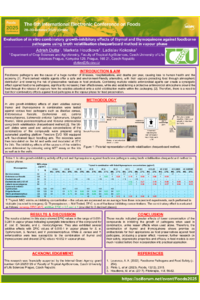
Foodborne pathogens are the cause of a huge number of illnesses, hospitalizations, and deaths per year, causing losses related to human health and the economy. Plant-derived volatile agents offer a safe and environment-friendly alternative, with their vapours protecting food through atmospheric distribution and lowering the risk of preservative residues in food products. Their combinations can exhibit synergistic antimicrobial effects against foodborne pathogens, enhancing their efficacy and lowering the risk of microbial resistance and toxicity, by releasing vapours of the compounds from solid volatilization matrix inside the packaging, thereby protecting food by creating a protective antimicrobial atmosphere around the food without direct contact. Therefore, there is a need to test their combinatory effects against food pathogens in the vapour phase for food preservation. Herein, the growth-inhibitory effects of plant volatiles, namely, thymol and thymoquinone in combination, were tested against various food pathogens such as Bacillus cereus, Enterococcus faecalis, Escherichia coli, Listeria monocytogenes, Salmonella enterica Typhimurium, Shigella flexneri, Vibrio parahaemolyticus, and Yersinia enterocolitica using the broth volatilization chequerboard method. The results obtained showed ΣFIC values in the range of 0.375-0.039 for the liquid phase and 0.281-0.031 for the vapour phase, indicating synergistic interactions of the compound for E. coli, E. faecalis, and L. monocytogenes. They also exhibited several additive effects with ΣFIC 1-0.53 and 1-0.515 for liquid and vapour phases, respectively, for S. e. Typhimurium, S. flexneri, and V. parahaemolyticus. These results indicated greater effects of lower concentration of the compounds in inhibiting the growth of pathogens when used in combination, unlike lesser effects when used alone. Therefore, this combination shows promise as food preservatives producing synergistic antibacterial effect against food pathogens, e.g., in the form of aerosolized sanitizers. However, further research on their safety, organoleptic properties and efficacy in food models is very much needed before their incorporation into practical application.
Keywords
Combinatory effects
plant-derived volatiles
food pathogens
atmospheric packaging
vapour phase
antibacterials
Poster
ADRISH DUTTA Poster.pdf
Fermentation of brewer’s spent grain with Pleurotus ostreatus: A pathway to nutritional enhancement
Mitigating Listeria Risk in Mung bean Sprouts Using Aerated Nanobubble Water