Event submissions
Published
This submission belongs to the session B. Nutritional and Functional Foods of the event The 6th International Electronic Conference on Foods
Published date
27 Oct, 2025
Academic Editor
'%3e%3cpath%20d='M12.6657%2010.9104C12.4185%2010.325%2012.0599%209.79327%2011.6097%209.34482C11.1609%208.89508%2010.6293%208.5365%2010.0442%208.28888C10.0389%208.28626%2010.0337%208.28495%2010.0285%208.28233C10.8446%207.69279%2011.3752%206.73249%2011.3752%205.64904C11.3752%203.8542%209.92103%202.39999%208.1262%202.39999C6.33136%202.39999%204.87715%203.8542%204.87715%205.64904C4.87715%206.73249%205.40774%207.69279%206.22393%208.28364C6.21869%208.28626%206.21345%208.28757%206.20821%208.29019C5.62129%208.5378%205.09463%208.89284%204.64265%209.34613C4.1929%209.79493%203.83432%2010.3266%203.58671%2010.9117C3.34345%2011.4845%203.21226%2012.0987%203.20023%2012.7209C3.19988%2012.7349%203.20233%2012.7488%203.20744%2012.7619C3.21255%2012.7749%203.22022%2012.7867%203.22998%2012.7968C3.23975%2012.8068%203.25142%2012.8147%203.26431%2012.8202C3.2772%2012.8256%203.29105%2012.8284%203.30504%2012.8284H4.09109C4.14874%2012.8284%204.19459%2012.7825%204.1959%2012.7262C4.2221%2011.7148%204.62823%2010.7676%205.34617%2010.0497C6.08899%209.30683%207.0755%208.89808%208.1262%208.89808C9.17689%208.89808%2010.1634%209.30683%2010.9062%2010.0497C11.6242%2010.7676%2012.0303%2011.7148%2012.0565%2012.7262C12.0578%2012.7838%2012.1037%2012.8284%2012.1613%2012.8284H12.9474C12.9613%2012.8284%2012.9752%2012.8256%2012.9881%2012.8202C13.001%2012.8147%2013.0126%2012.8068%2013.0224%2012.7968C13.0322%2012.7867%2013.0398%2012.7749%2013.0449%2012.7619C13.0501%2012.7488%2013.0525%2012.7349%2013.0522%2012.7209C13.0391%2012.0947%2012.9094%2011.4855%2012.6657%2010.9104ZM8.1262%207.9024C7.52486%207.9024%206.9589%207.6679%206.53312%207.24211C6.10733%206.81633%205.87283%206.25037%205.87283%205.64904C5.87283%205.0477%206.10733%204.48174%206.53312%204.05596C6.9589%203.63018%207.52486%203.39567%208.1262%203.39567C8.72753%203.39567%209.29349%203.63018%209.71927%204.05596C10.1451%204.48174%2010.3796%205.0477%2010.3796%205.64904C10.3796%206.25037%2010.1451%206.81633%209.71927%207.24211C9.29349%207.6679%208.72753%207.9024%208.1262%207.9024Z'%20fill='%235D1EE1'/%3e%3c/g%3e%3c/svg%3e) Manuel Viuda-Martos
Manuel Viuda-MartosCitation
Agustín Serrudo, María Natalia Oviedo, Roxana Elizabeth Gonzalez, Pamela Yanina Quintas, Impact of roasting on the Amino Acid profile of pumpkin seeds (Cucurbita moschata), in Proceedings of The 6th International Electronic Conference on Foods, 28 October–30 October 2025, MDPI: Basel, Switzerland
Share
Email
Facebook
Twitter
LinkedIn
Impact of roasting on the Amino Acid profile of pumpkin seeds (Cucurbita moschata)
'%3e%3cpath%20d='M12.6647%2010.9104C12.4176%2010.325%2012.0589%209.7933%2011.6088%209.34485C11.16%208.89511%2010.6283%208.53653%2010.0432%208.28891C10.038%208.28629%2010.0327%208.28498%2010.0275%208.28236C10.8437%207.69282%2011.3743%206.73252%2011.3743%205.64907C11.3743%203.85423%209.92005%202.40002%208.12522%202.40002C6.33038%202.40002%204.87618%203.85423%204.87618%205.64907C4.87618%206.73252%205.40677%207.69282%206.22296%208.28367C6.21772%208.28629%206.21248%208.2876%206.20724%208.29022C5.62031%208.53783%205.09365%208.89287%204.64167%209.34616C4.19192%209.79496%203.83334%2010.3266%203.58573%2010.9117C3.34247%2011.4846%203.21128%2012.0987%203.19925%2012.721C3.1989%2012.735%203.20135%2012.7489%203.20646%2012.7619C3.21157%2012.7749%203.21924%2012.7868%203.22901%2012.7968C3.23877%2012.8068%203.25045%2012.8148%203.26334%2012.8202C3.27623%2012.8256%203.29007%2012.8284%203.30406%2012.8284H4.09012C4.14776%2012.8284%204.19362%2012.7825%204.19493%2012.7262C4.22113%2011.7148%204.62726%2010.7676%205.34519%2010.0497C6.08802%209.30686%207.07452%208.89811%208.12522%208.89811C9.17592%208.89811%2010.1624%209.30686%2010.9052%2010.0497C11.6232%2010.7676%2012.0293%2011.7148%2012.0555%2012.7262C12.0568%2012.7839%2012.1027%2012.8284%2012.1603%2012.8284H12.9464C12.9604%2012.8284%2012.9742%2012.8256%2012.9871%2012.8202C13%2012.8148%2013.0117%2012.8068%2013.0214%2012.7968C13.0312%2012.7868%2013.0389%2012.7749%2013.044%2012.7619C13.0491%2012.7489%2013.0515%2012.735%2013.0512%2012.721C13.0381%2012.0947%2012.9084%2011.4856%2012.6647%2010.9104ZM8.12522%207.90243C7.52388%207.90243%206.95792%207.66793%206.53214%207.24215C6.10636%206.81636%205.87185%206.2504%205.87185%205.64907C5.87185%205.04773%206.10636%204.48177%206.53214%204.05599C6.95792%203.63021%207.52388%203.3957%208.12522%203.3957C8.72655%203.3957%209.29252%203.63021%209.7183%204.05599C10.1441%204.48177%2010.3786%205.04773%2010.3786%205.64907C10.3786%206.2504%2010.1441%206.81636%209.7183%207.24215C9.29252%207.66793%208.72655%207.90243%208.12522%207.90243Z'%20fill='%235D1EE1'/%3e%3c/g%3e%3c/svg%3e)
Agustín Serrudo 1
María Natalia Oviedo 2
Roxana Elizabeth Gonzalez 3
Pamela Yanina Quintas 4
1. Facultad de Ciencias Exactas y Naturales (FCEN), Universidad Nacional de Cuyo (CUYO), Mendoza, M5500, Argentina
2. Laboratorio de Química Analítica para Investigación y Desarrollo (QUIANID), Facultad de Ciencias Exactas y Naturales, Universidad Nacional de Cuyo / Instituto Interdisciplinario de Ciencias Básicas (ICB), CONICET UNCUYO, Mendoza, M5500, Argentina
3. EEA La Consulta, Instituto Nacional de Tecnología Agropecuaria (INTA), Mendoza, M5567, Argentina.
4. Instituto de Investigación y Desarrollo en Ingeniería de Procesos, Biotecnología y Energías Alternativas, PROBIEN (CONICET-UNCo), Facultad de Ingeniería, Universidad Nacional del Comahue, Neuquén, Q8300, Argentina.
Abstract
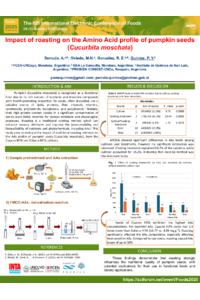
Pumpkin (Cucurbita moschata) is recognized as a functional food due to its rich content of nutrients and bioactive compounds with health-promoting properties. Its seeds, often discarded, are a valuable source of lipids, proteins, fiber, minerals, vitamins, carotenoids, phytosterols, tocopherols, and polyphenols. Notably, their high protein content results in a significant concentration of amino acids (AAs), essential for various metabolic and physiological processes. Roasting is a traditional cooking method that can enhance sensory attributes and improve the bioaccessibility and bioavailability of nutrients and phytochemicals, including AAs. This study aims to evaluate the impact of traditional roasting methods on the AA profile of pumpkin seeds (Cucurbita moschata), from the Cuyano INTA and Cokena INTA cultivars. Seeds were roasted in a non-stick pan (180ºC, 10 min) and an oven (180ºC, 15 min). Protein-bound AAs were extracted following AOAC method 994.12 and quantified by means of RP-UHPLC. Twenty AAs, including the essential ones, were identified. ANOVA showed significant differences in AA levels among cultivars and treatments; however, no significant interaction was observed. Cooking treatment explained 60.69% of the variation, while cultivar accounted for 15.23%, indicating that roasting method was the dominant factor. Seeds of Cuyano INTA exhibited the highest AA concentrations. For essential AAs, Cuyano INTA seeds had 1.8 times higher levels than Cokena INTA (14.77 vs. 8.39 mg g⁻¹). Roasting significantly affected the AA composition, especially affecting heat-sensitive AAs. Compared to raw seeds, roasting caused AAs losses of up to 50%. These findings demonstrate that roasting strongly influences the nutritional quality of pumpkin seeds, with potential implications for their use in functional foods and dietary applications.
Keywords
Amino acids
Roasting
Pumpkin seeds
Poster
Amino acids_Quintas.pdf
Screening of Antagonistic Lactic Acid Bacteria Isolated from Fermented Goat Milk in Morocco’s Souss-Massa Region
Nitrite reduction in smoked sausage: does it impact on the inhibition of C. botulinum and L. monocytogenes?