Event submissions
Published
This submission belongs to the session D. Food Microbiology of the event The 6th International Electronic Conference on Foods
Published date
27 Oct, 2025
Academic Editor
'%3e%3cpath%20d='M12.6657%2010.9104C12.4185%2010.325%2012.0599%209.79327%2011.6097%209.34482C11.1609%208.89508%2010.6293%208.5365%2010.0442%208.28888C10.0389%208.28626%2010.0337%208.28495%2010.0285%208.28233C10.8446%207.69279%2011.3752%206.73249%2011.3752%205.64904C11.3752%203.8542%209.92103%202.39999%208.1262%202.39999C6.33136%202.39999%204.87715%203.8542%204.87715%205.64904C4.87715%206.73249%205.40774%207.69279%206.22393%208.28364C6.21869%208.28626%206.21345%208.28757%206.20821%208.29019C5.62129%208.5378%205.09463%208.89284%204.64265%209.34613C4.1929%209.79493%203.83432%2010.3266%203.58671%2010.9117C3.34345%2011.4845%203.21226%2012.0987%203.20023%2012.7209C3.19988%2012.7349%203.20233%2012.7488%203.20744%2012.7619C3.21255%2012.7749%203.22022%2012.7867%203.22998%2012.7968C3.23975%2012.8068%203.25142%2012.8147%203.26431%2012.8202C3.2772%2012.8256%203.29105%2012.8284%203.30504%2012.8284H4.09109C4.14874%2012.8284%204.19459%2012.7825%204.1959%2012.7262C4.2221%2011.7148%204.62823%2010.7676%205.34617%2010.0497C6.08899%209.30683%207.0755%208.89808%208.1262%208.89808C9.17689%208.89808%2010.1634%209.30683%2010.9062%2010.0497C11.6242%2010.7676%2012.0303%2011.7148%2012.0565%2012.7262C12.0578%2012.7838%2012.1037%2012.8284%2012.1613%2012.8284H12.9474C12.9613%2012.8284%2012.9752%2012.8256%2012.9881%2012.8202C13.001%2012.8147%2013.0126%2012.8068%2013.0224%2012.7968C13.0322%2012.7867%2013.0398%2012.7749%2013.0449%2012.7619C13.0501%2012.7488%2013.0525%2012.7349%2013.0522%2012.7209C13.0391%2012.0947%2012.9094%2011.4855%2012.6657%2010.9104ZM8.1262%207.9024C7.52486%207.9024%206.9589%207.6679%206.53312%207.24211C6.10733%206.81633%205.87283%206.25037%205.87283%205.64904C5.87283%205.0477%206.10733%204.48174%206.53312%204.05596C6.9589%203.63018%207.52486%203.39567%208.1262%203.39567C8.72753%203.39567%209.29349%203.63018%209.71927%204.05596C10.1451%204.48174%2010.3796%205.0477%2010.3796%205.64904C10.3796%206.25037%2010.1451%206.81633%209.71927%207.24211C9.29349%207.6679%208.72753%207.9024%208.1262%207.9024Z'%20fill='%235D1EE1'/%3e%3c/g%3e%3c/svg%3e) Efstathios Giaouris
Efstathios GiaourisCitation
Laura Alonso Pintre, Pilar Gómez-Cortés, Blanca Hernández-Ledesma, Jose Manuel Silvan, Adolfo Jose Martinez-Rodriguez, Microalgae Oils Mitigate Inflammation and Oxidative Stress Triggered by Helicobacter pylori Infection, in Proceedings of The 6th International Electronic Conference on Foods, 28 October–30 October 2025, MDPI: Basel, Switzerland
Share
Email
Facebook
Twitter
LinkedIn
Microalgae Oils Mitigate Inflammation and Oxidative Stress Triggered by Helicobacter pylori Infection
'%3e%3cpath%20d='M12.6647%2010.9104C12.4176%2010.325%2012.0589%209.7933%2011.6088%209.34485C11.16%208.89511%2010.6283%208.53653%2010.0432%208.28891C10.038%208.28629%2010.0327%208.28498%2010.0275%208.28236C10.8437%207.69282%2011.3743%206.73252%2011.3743%205.64907C11.3743%203.85423%209.92005%202.40002%208.12522%202.40002C6.33038%202.40002%204.87618%203.85423%204.87618%205.64907C4.87618%206.73252%205.40677%207.69282%206.22296%208.28367C6.21772%208.28629%206.21248%208.2876%206.20724%208.29022C5.62031%208.53783%205.09365%208.89287%204.64167%209.34616C4.19192%209.79496%203.83334%2010.3266%203.58573%2010.9117C3.34247%2011.4846%203.21128%2012.0987%203.19925%2012.721C3.1989%2012.735%203.20135%2012.7489%203.20646%2012.7619C3.21157%2012.7749%203.21924%2012.7868%203.22901%2012.7968C3.23877%2012.8068%203.25045%2012.8148%203.26334%2012.8202C3.27623%2012.8256%203.29007%2012.8284%203.30406%2012.8284H4.09012C4.14776%2012.8284%204.19362%2012.7825%204.19493%2012.7262C4.22113%2011.7148%204.62726%2010.7676%205.34519%2010.0497C6.08802%209.30686%207.07452%208.89811%208.12522%208.89811C9.17592%208.89811%2010.1624%209.30686%2010.9052%2010.0497C11.6232%2010.7676%2012.0293%2011.7148%2012.0555%2012.7262C12.0568%2012.7839%2012.1027%2012.8284%2012.1603%2012.8284H12.9464C12.9604%2012.8284%2012.9742%2012.8256%2012.9871%2012.8202C13%2012.8148%2013.0117%2012.8068%2013.0214%2012.7968C13.0312%2012.7868%2013.0389%2012.7749%2013.044%2012.7619C13.0491%2012.7489%2013.0515%2012.735%2013.0512%2012.721C13.0381%2012.0947%2012.9084%2011.4856%2012.6647%2010.9104ZM8.12522%207.90243C7.52388%207.90243%206.95792%207.66793%206.53214%207.24215C6.10636%206.81636%205.87185%206.2504%205.87185%205.64907C5.87185%205.04773%206.10636%204.48177%206.53214%204.05599C6.95792%203.63021%207.52388%203.3957%208.12522%203.3957C8.72655%203.3957%209.29252%203.63021%209.7183%204.05599C10.1441%204.48177%2010.3786%205.04773%2010.3786%205.64907C10.3786%206.2504%2010.1441%206.81636%209.7183%207.24215C9.29252%207.66793%208.72655%207.90243%208.12522%207.90243Z'%20fill='%235D1EE1'/%3e%3c/g%3e%3c/svg%3e)
Laura Alonso Pintre 1
Pilar Gómez-Cortés 1

Blanca Hernández-Ledesma 1

Jose Manuel Silvan 1

Adolfo Jose Martinez-Rodriguez 1
1. Institute of Food Science Research (CIAL, CSIC-UAM, CEI UAM + CSIC), Nicolás Cabrera 9, 28049 Madrid, Spain
Abstract
Helicobacter pylori (H. pylori) is one of the most prevalent pathogenic bacteria worldwide, infecting over 50% of the global population. Its infection is linked to oxidative stress and chronic inflammation. Although antibiotic-based eradication therapy is the standard treatment, rising antibiotic resistance and the adverse effects associated with these drugs underscore the need for alternative therapeutic approaches.
Microalgae have gained attention due to their adaptability, sustainability, and high nutritional value, as well as their potential health benefits. This study aimed to evaluate the antioxidant, anti-inflammatory, and antibacterial properties of lipid extracts from various microalgae species (Chlorella vulgaris, Nannochloropsis gaditana, Arthrospira platensis and Tetraselmis chuii) against H. pylori infection. Oils were obtained from pretreated microalgal biomass, using freeze-thaw cycles and ultrasounds. The protective effects against H. pylori-induced oxidative stress and inflammation were evaluated in an infected human gastric cell model by measuring reactive oxygen species (ROS) and interleukin-8 (IL-8) levels. Additionally, antioxidant activity was assessed using DPPH and ABTS assays. Antibacterial effects were determined by quantifying H. pylori colony-forming units (CFU).
The lipid extracts demonstrated protective effects against H. pylori-induced oxidative stress and cellular inflammation. Furthermore, the microalgae oils exhibited direct antibacterial activity against H. pylori, with Nannochloropsis gaditana having the greatest effect. The lipid extracts also exhibited strong in vitro radical-scavenging activity and Chlorella vulgaris showed the highest potency. These findings suggest that microalgae oils could serve as a promising therapeutic strategy to combat H. pylori infection and its associated symptoms.
Keywords
Helicobacter pylori
microalgae oil
antibacterial activity
antioxidant activity
anti-inflammatory activity
Poster
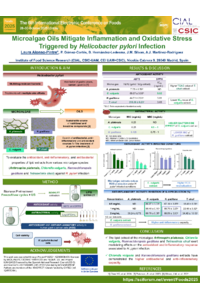
Alonso-Pintre Poster IECF.pdf
Nitrite reduction in smoked sausage: does it impact on the inhibition of C. botulinum and L. monocytogenes?
Advances in Fermentation-Derived Red Pigments: A Comparative Review of Natural and Synthetic Colorants in Food Biotechnology