Event submissions
Published
This submission belongs to the session C. Food Quality and Safety of the event The 6th International Electronic Conference on Foods
Published date
27 Oct, 2025
Academic Editor
'%3e%3cpath%20d='M12.6657%2010.9104C12.4185%2010.325%2012.0599%209.79327%2011.6097%209.34482C11.1609%208.89508%2010.6293%208.5365%2010.0442%208.28888C10.0389%208.28626%2010.0337%208.28495%2010.0285%208.28233C10.8446%207.69279%2011.3752%206.73249%2011.3752%205.64904C11.3752%203.8542%209.92103%202.39999%208.1262%202.39999C6.33136%202.39999%204.87715%203.8542%204.87715%205.64904C4.87715%206.73249%205.40774%207.69279%206.22393%208.28364C6.21869%208.28626%206.21345%208.28757%206.20821%208.29019C5.62129%208.5378%205.09463%208.89284%204.64265%209.34613C4.1929%209.79493%203.83432%2010.3266%203.58671%2010.9117C3.34345%2011.4845%203.21226%2012.0987%203.20023%2012.7209C3.19988%2012.7349%203.20233%2012.7488%203.20744%2012.7619C3.21255%2012.7749%203.22022%2012.7867%203.22998%2012.7968C3.23975%2012.8068%203.25142%2012.8147%203.26431%2012.8202C3.2772%2012.8256%203.29105%2012.8284%203.30504%2012.8284H4.09109C4.14874%2012.8284%204.19459%2012.7825%204.1959%2012.7262C4.2221%2011.7148%204.62823%2010.7676%205.34617%2010.0497C6.08899%209.30683%207.0755%208.89808%208.1262%208.89808C9.17689%208.89808%2010.1634%209.30683%2010.9062%2010.0497C11.6242%2010.7676%2012.0303%2011.7148%2012.0565%2012.7262C12.0578%2012.7838%2012.1037%2012.8284%2012.1613%2012.8284H12.9474C12.9613%2012.8284%2012.9752%2012.8256%2012.9881%2012.8202C13.001%2012.8147%2013.0126%2012.8068%2013.0224%2012.7968C13.0322%2012.7867%2013.0398%2012.7749%2013.0449%2012.7619C13.0501%2012.7488%2013.0525%2012.7349%2013.0522%2012.7209C13.0391%2012.0947%2012.9094%2011.4855%2012.6657%2010.9104ZM8.1262%207.9024C7.52486%207.9024%206.9589%207.6679%206.53312%207.24211C6.10733%206.81633%205.87283%206.25037%205.87283%205.64904C5.87283%205.0477%206.10733%204.48174%206.53312%204.05596C6.9589%203.63018%207.52486%203.39567%208.1262%203.39567C8.72753%203.39567%209.29349%203.63018%209.71927%204.05596C10.1451%204.48174%2010.3796%205.0477%2010.3796%205.64904C10.3796%206.25037%2010.1451%206.81633%209.71927%207.24211C9.29349%207.6679%208.72753%207.9024%208.1262%207.9024Z'%20fill='%235D1EE1'/%3e%3c/g%3e%3c/svg%3e) Susana Casal
Susana CasalCitation
Romain Canuel, Sara García-Vela, Laurent Bazinet, Recovered organic acids from cranberry juice deacidification as a natural strategy for fresh-cut lettuce preservation within a circular economy framework, in Proceedings of The 6th International Electronic Conference on Foods, 28 October–30 October 2025, MDPI: Basel, Switzerland
Share
Email
Facebook
Twitter
LinkedIn
Recovered organic acids from cranberry juice deacidification as a natural strategy for fresh-cut lettuce preservation within a circular economy framework
'%3e%3cpath%20d='M12.6647%2010.9104C12.4176%2010.325%2012.0589%209.7933%2011.6088%209.34485C11.16%208.89511%2010.6283%208.53653%2010.0432%208.28891C10.038%208.28629%2010.0327%208.28498%2010.0275%208.28236C10.8437%207.69282%2011.3743%206.73252%2011.3743%205.64907C11.3743%203.85423%209.92005%202.40002%208.12522%202.40002C6.33038%202.40002%204.87618%203.85423%204.87618%205.64907C4.87618%206.73252%205.40677%207.69282%206.22296%208.28367C6.21772%208.28629%206.21248%208.2876%206.20724%208.29022C5.62031%208.53783%205.09365%208.89287%204.64167%209.34616C4.19192%209.79496%203.83334%2010.3266%203.58573%2010.9117C3.34247%2011.4846%203.21128%2012.0987%203.19925%2012.721C3.1989%2012.735%203.20135%2012.7489%203.20646%2012.7619C3.21157%2012.7749%203.21924%2012.7868%203.22901%2012.7968C3.23877%2012.8068%203.25045%2012.8148%203.26334%2012.8202C3.27623%2012.8256%203.29007%2012.8284%203.30406%2012.8284H4.09012C4.14776%2012.8284%204.19362%2012.7825%204.19493%2012.7262C4.22113%2011.7148%204.62726%2010.7676%205.34519%2010.0497C6.08802%209.30686%207.07452%208.89811%208.12522%208.89811C9.17592%208.89811%2010.1624%209.30686%2010.9052%2010.0497C11.6232%2010.7676%2012.0293%2011.7148%2012.0555%2012.7262C12.0568%2012.7839%2012.1027%2012.8284%2012.1603%2012.8284H12.9464C12.9604%2012.8284%2012.9742%2012.8256%2012.9871%2012.8202C13%2012.8148%2013.0117%2012.8068%2013.0214%2012.7968C13.0312%2012.7868%2013.0389%2012.7749%2013.044%2012.7619C13.0491%2012.7489%2013.0515%2012.735%2013.0512%2012.721C13.0381%2012.0947%2012.9084%2011.4856%2012.6647%2010.9104ZM8.12522%207.90243C7.52388%207.90243%206.95792%207.66793%206.53214%207.24215C6.10636%206.81636%205.87185%206.2504%205.87185%205.64907C5.87185%205.04773%206.10636%204.48177%206.53214%204.05599C6.95792%203.63021%207.52388%203.3957%208.12522%203.3957C8.72655%203.3957%209.29252%203.63021%209.7183%204.05599C10.1441%204.48177%2010.3786%205.04773%2010.3786%205.64907C10.3786%206.2504%2010.1441%206.81636%209.7183%207.24215C9.29252%207.66793%208.72655%207.90243%208.12522%207.90243Z'%20fill='%235D1EE1'/%3e%3c/g%3e%3c/svg%3e)
Romain Canuel 1
Sara García-Vela 1

Laurent Bazinet 1
1. Laboratoire de Transformation Alimentaire et Procédés ÉlectroMembranaires (LTAPEM/Laboratory of Food Processing and ElectroMembrane Processes), Institute of Nutrition and Functional Foods (INAF), Department of Food Sciences, Université Laval, QC, Canada
Abstract
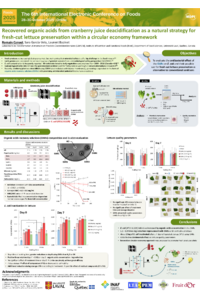
Food-borne diseases caused by bacterial pathogens remain a major concern for the food industry and public health. Fresh-cut produce, such as lettuce, are important vehicles for bacterial contamination and have been linked to multiple pathogenic E. coli outbreaks. Currently, sodium hypochlorite (SH) is the most widely used chemical sanitizer for minimally processed produce, but its limited efficacy and potential to generate carcinogenic derivatives highlight the need for safer and natural alternatives.
The present study aimed to investigate the bactericidal effect of organic acid recovery solutions (OARs), mainly composed of citric and malic acid, that were co-produced during cranberry juice deacidification via bipolar membrane electrodialysis. Previously, four OARs with increasing acid concentrations (from 6.3 to 42.3 mg/mL) were generated. The present work evaluates their in vitro activity against E. coli (ATCC 11229) using agar-well diffusion and liquid growth inhibition assays. In addition, fresh-cut romaine lettuce leaves were inoculated (~ 6 log CFU/g) using the same bacterial strain and subjected to sanitizing treatments (1 or 4 min) with the OARs, water (negative control), or 200 ppm SH (positive control). Populations surviving on lettuce and sensory qualities were monitored after treatment and for up to 7 days during storage at 4°C.
In vitro results demonstrated that E. coli strain inhibition correlated strongly with organic acid concentration (r > 0.9) in solid and liquid media, and a bactericidal effect (MBC/MIC ≤ 4) was outlined. On fresh-cut romaine lettuce, with increasing acid concentration, OARs showed a significantly higher reduction (0.88–1.12 log) than water (0.35 log) or SH (0.77 log) within a minimal contact time (1 min). Regardless of the type of treatment, the quality parameters were unchanged (texture, weight loss, and color), which highlights the suitability of using the OARs on lettuce. This innovative strategy showcased the promising potential of OARs for fresh-cut produce microbial safety while aligning with circular economy principles.
Keywords
organic acids
lettuce
E. coli
disinfection
food safety
circular economy
Poster
Poster Foods 2025.pdf
Valorizing Agro-Industrial Waste: Enhancement of Bread Nutritional Quality through Date Seed Fiber Fortification
Short-Term metabolomic insights into Melatonin-induced sugar regulation in sweet cherries during storage