Event submissions
Published
This submission belongs to the session B. Nutritional and Functional Foods of the event The 6th International Electronic Conference on Foods
Published date
27 Oct, 2025
Academic Editor
'%3e%3cpath%20d='M12.6657%2010.9104C12.4185%2010.325%2012.0599%209.79327%2011.6097%209.34482C11.1609%208.89508%2010.6293%208.5365%2010.0442%208.28888C10.0389%208.28626%2010.0337%208.28495%2010.0285%208.28233C10.8446%207.69279%2011.3752%206.73249%2011.3752%205.64904C11.3752%203.8542%209.92103%202.39999%208.1262%202.39999C6.33136%202.39999%204.87715%203.8542%204.87715%205.64904C4.87715%206.73249%205.40774%207.69279%206.22393%208.28364C6.21869%208.28626%206.21345%208.28757%206.20821%208.29019C5.62129%208.5378%205.09463%208.89284%204.64265%209.34613C4.1929%209.79493%203.83432%2010.3266%203.58671%2010.9117C3.34345%2011.4845%203.21226%2012.0987%203.20023%2012.7209C3.19988%2012.7349%203.20233%2012.7488%203.20744%2012.7619C3.21255%2012.7749%203.22022%2012.7867%203.22998%2012.7968C3.23975%2012.8068%203.25142%2012.8147%203.26431%2012.8202C3.2772%2012.8256%203.29105%2012.8284%203.30504%2012.8284H4.09109C4.14874%2012.8284%204.19459%2012.7825%204.1959%2012.7262C4.2221%2011.7148%204.62823%2010.7676%205.34617%2010.0497C6.08899%209.30683%207.0755%208.89808%208.1262%208.89808C9.17689%208.89808%2010.1634%209.30683%2010.9062%2010.0497C11.6242%2010.7676%2012.0303%2011.7148%2012.0565%2012.7262C12.0578%2012.7838%2012.1037%2012.8284%2012.1613%2012.8284H12.9474C12.9613%2012.8284%2012.9752%2012.8256%2012.9881%2012.8202C13.001%2012.8147%2013.0126%2012.8068%2013.0224%2012.7968C13.0322%2012.7867%2013.0398%2012.7749%2013.0449%2012.7619C13.0501%2012.7488%2013.0525%2012.7349%2013.0522%2012.7209C13.0391%2012.0947%2012.9094%2011.4855%2012.6657%2010.9104ZM8.1262%207.9024C7.52486%207.9024%206.9589%207.6679%206.53312%207.24211C6.10733%206.81633%205.87283%206.25037%205.87283%205.64904C5.87283%205.0477%206.10733%204.48174%206.53312%204.05596C6.9589%203.63018%207.52486%203.39567%208.1262%203.39567C8.72753%203.39567%209.29349%203.63018%209.71927%204.05596C10.1451%204.48174%2010.3796%205.0477%2010.3796%205.64904C10.3796%206.25037%2010.1451%206.81633%209.71927%207.24211C9.29349%207.6679%208.72753%207.9024%208.1262%207.9024Z'%20fill='%235D1EE1'/%3e%3c/g%3e%3c/svg%3e) Manuel Viuda-Martos
Manuel Viuda-MartosCitation
Mussa Makran, Leonardo Musto, Dario Mercatante, Ivan Albano, Maria Teresa Rodriguez-Estrada, Antonio Cilla, Guadalupe Garcia-Llatas, Hepatoprotective effects of a cricket-enriched pasta in an in vitro intestine–liver model under oxidative stress conditions, in Proceedings of The 6th International Electronic Conference on Foods, 28 October–30 October 2025, MDPI: Basel, Switzerland
Share
Email
Facebook
Twitter
LinkedIn
Hepatoprotective effects of a cricket-enriched pasta in an in vitro intestine–liver model under oxidative stress conditions

Mussa Makran 1
'%3e%3cpath%20d='M12.6647%2010.9104C12.4176%2010.325%2012.0589%209.7933%2011.6088%209.34485C11.16%208.89511%2010.6283%208.53653%2010.0432%208.28891C10.038%208.28629%2010.0327%208.28498%2010.0275%208.28236C10.8437%207.69282%2011.3743%206.73252%2011.3743%205.64907C11.3743%203.85423%209.92005%202.40002%208.12522%202.40002C6.33038%202.40002%204.87618%203.85423%204.87618%205.64907C4.87618%206.73252%205.40677%207.69282%206.22296%208.28367C6.21772%208.28629%206.21248%208.2876%206.20724%208.29022C5.62031%208.53783%205.09365%208.89287%204.64167%209.34616C4.19192%209.79496%203.83334%2010.3266%203.58573%2010.9117C3.34247%2011.4846%203.21128%2012.0987%203.19925%2012.721C3.1989%2012.735%203.20135%2012.7489%203.20646%2012.7619C3.21157%2012.7749%203.21924%2012.7868%203.22901%2012.7968C3.23877%2012.8068%203.25045%2012.8148%203.26334%2012.8202C3.27623%2012.8256%203.29007%2012.8284%203.30406%2012.8284H4.09012C4.14776%2012.8284%204.19362%2012.7825%204.19493%2012.7262C4.22113%2011.7148%204.62726%2010.7676%205.34519%2010.0497C6.08802%209.30686%207.07452%208.89811%208.12522%208.89811C9.17592%208.89811%2010.1624%209.30686%2010.9052%2010.0497C11.6232%2010.7676%2012.0293%2011.7148%2012.0555%2012.7262C12.0568%2012.7839%2012.1027%2012.8284%2012.1603%2012.8284H12.9464C12.9604%2012.8284%2012.9742%2012.8256%2012.9871%2012.8202C13%2012.8148%2013.0117%2012.8068%2013.0214%2012.7968C13.0312%2012.7868%2013.0389%2012.7749%2013.044%2012.7619C13.0491%2012.7489%2013.0515%2012.735%2013.0512%2012.721C13.0381%2012.0947%2012.9084%2011.4856%2012.6647%2010.9104ZM8.12522%207.90243C7.52388%207.90243%206.95792%207.66793%206.53214%207.24215C6.10636%206.81636%205.87185%206.2504%205.87185%205.64907C5.87185%205.04773%206.10636%204.48177%206.53214%204.05599C6.95792%203.63021%207.52388%203.3957%208.12522%203.3957C8.72655%203.3957%209.29252%203.63021%209.7183%204.05599C10.1441%204.48177%2010.3786%205.04773%2010.3786%205.64907C10.3786%206.2504%2010.1441%206.81636%209.7183%207.24215C9.29252%207.66793%208.72655%207.90243%208.12522%207.90243Z'%20fill='%235D1EE1'/%3e%3c/g%3e%3c/svg%3e)
Leonardo Musto 1
Dario Mercatante 2
Ivan Albano 3
Maria Teresa Rodriguez-Estrada 2,4

Antonio Cilla 1

Guadalupe Garcia-Llatas 1
1. Nutrition and Food Science Area, Faculty of Pharmacy and Food Sciences, University of Valencia, Avda. Vicente Andrés Estellés s/n, 46100, Burjassot, Valencia, Spain
2. Department of Agricultural and Food Sciences, Alma Mater Studiorum-Università di Bologna, Viale Fanin 40, 40127, Bologna, Italy
3. Italian Cricket Farm, Via Vigone 20, 10060, Scalenghe, Italy
4. CIRI-Agrifood (Interdepartmental Centre of Industrial Agrifood Research), Alma Mater Studiorum-Università di Bologna, Piazza Goidanich 60, 47521, Cesena, Italy
Abstract
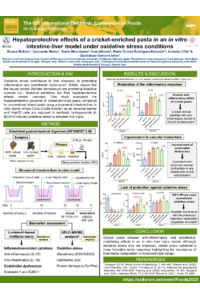
Oxidative stress contributes to liver diseases by promoting inflammation and endothelial dysfunction. Edible insects like the house cricket (Acheta domesticus) are promising bioactive sources, but their hepatoprotective effects remain unknown. This study evaluated the hepatoprotective potential of 10% cricket-enriched pasta compared to conventional wheat pasta using an in vitro bicameral intestine–liver model. Simulated gastrointestinal digestion (INFOGEST 2.0) was performed to obtain the bioaccessible fractions (BFs) of pasta samples. Caco-2 cells were cultured on Transwell® inserts until differentiation (12 days), while HepG2 hepatocytes were seeded basolaterally and cultured for 48 h. After 24 h of apical exposure to the BFs (1/30, v/v diluted in DMEM), HepG2 cells were treated with tert-butyl hydroperoxide (800 µM) for 24 h to induce oxidative stress. Inflammatory cytokines (IL-10 and IL-1β), endothelial dysfunction markers (endothelin-1 and ICAM-1), and intracellular oxidative stress indicators (GSH/GSSG ratio, ophthalmic acid, o-Tyr/Phe ratio) were measured. Both pasta samples reduced the inflammatory response by increasing the anti-inflammatory IL-10 levels, with cricket pasta inducing a significantly greater increase (744%) compared to wheat pasta (255%). Only cricket pasta reduced the pro-inflammatory IL-1β secretion (20%). Regarding endothelial dysfunction, both pasta samples lowered endothelin-1 levels, with cricket pasta showing a greater effect (55% vs. 23%). Moreover, only cricket pasta significantly decreased ICAM-1 levels (10%), indicating enhanced endothelial protection. Neither pasta improved intracellular oxidative stress markers. However, wheat pasta increased ophthalmic acid (63%) and showed a non-significant trend toward a higher o-Tyr/Phe ratio (30%), both suggesting elevated oxidative stress. In contrast, cricket pasta maintained lower levels of these markers, supporting a more favorable redox profile. In conclusion, cricket-enriched pasta showed anti-inflammatory and endothelial-modulating effects in an in vitro liver injury model. Although oxidative stress was not improved, cricket pasta exhibited a more favorable redox response, underscoring the importance of food matrix composition in functional food design.
Keywords
Edible insects
Functional foods
Bioactive compounds
Oxidative stress
Hepatoprotection
Poster
Póster_congreso_Foods_2025_DEF.pdf
Development,Sensory Evaluation and Characterization of Buckwheat-Based Gluten-Free Synbiotic Products Using Ayurvedic Herbs Having Prebiotic Potential
Valorisation of agri-food waste through the use of colorimetry