Event submissions
Published
This submission belongs to the session B. Nutritional and Functional Foods of the event The 6th International Electronic Conference on Foods
Published date
27 Oct, 2025
Academic Editor
'%3e%3cpath%20d='M12.6657%2010.9104C12.4185%2010.325%2012.0599%209.79327%2011.6097%209.34482C11.1609%208.89508%2010.6293%208.5365%2010.0442%208.28888C10.0389%208.28626%2010.0337%208.28495%2010.0285%208.28233C10.8446%207.69279%2011.3752%206.73249%2011.3752%205.64904C11.3752%203.8542%209.92103%202.39999%208.1262%202.39999C6.33136%202.39999%204.87715%203.8542%204.87715%205.64904C4.87715%206.73249%205.40774%207.69279%206.22393%208.28364C6.21869%208.28626%206.21345%208.28757%206.20821%208.29019C5.62129%208.5378%205.09463%208.89284%204.64265%209.34613C4.1929%209.79493%203.83432%2010.3266%203.58671%2010.9117C3.34345%2011.4845%203.21226%2012.0987%203.20023%2012.7209C3.19988%2012.7349%203.20233%2012.7488%203.20744%2012.7619C3.21255%2012.7749%203.22022%2012.7867%203.22998%2012.7968C3.23975%2012.8068%203.25142%2012.8147%203.26431%2012.8202C3.2772%2012.8256%203.29105%2012.8284%203.30504%2012.8284H4.09109C4.14874%2012.8284%204.19459%2012.7825%204.1959%2012.7262C4.2221%2011.7148%204.62823%2010.7676%205.34617%2010.0497C6.08899%209.30683%207.0755%208.89808%208.1262%208.89808C9.17689%208.89808%2010.1634%209.30683%2010.9062%2010.0497C11.6242%2010.7676%2012.0303%2011.7148%2012.0565%2012.7262C12.0578%2012.7838%2012.1037%2012.8284%2012.1613%2012.8284H12.9474C12.9613%2012.8284%2012.9752%2012.8256%2012.9881%2012.8202C13.001%2012.8147%2013.0126%2012.8068%2013.0224%2012.7968C13.0322%2012.7867%2013.0398%2012.7749%2013.0449%2012.7619C13.0501%2012.7488%2013.0525%2012.7349%2013.0522%2012.7209C13.0391%2012.0947%2012.9094%2011.4855%2012.6657%2010.9104ZM8.1262%207.9024C7.52486%207.9024%206.9589%207.6679%206.53312%207.24211C6.10733%206.81633%205.87283%206.25037%205.87283%205.64904C5.87283%205.0477%206.10733%204.48174%206.53312%204.05596C6.9589%203.63018%207.52486%203.39567%208.1262%203.39567C8.72753%203.39567%209.29349%203.63018%209.71927%204.05596C10.1451%204.48174%2010.3796%205.0477%2010.3796%205.64904C10.3796%206.25037%2010.1451%206.81633%209.71927%207.24211C9.29349%207.6679%208.72753%207.9024%208.1262%207.9024Z'%20fill='%235D1EE1'/%3e%3c/g%3e%3c/svg%3e) Antonello Santini
Antonello SantiniCitation
Alejandro Esli Hernández-Mora, José Andrés Herrera-Corredor, María Magdalena Crosby-Galván, Libia Iris Trejo-Téllez, Fernando Carlos Gómez-Merino, Proximate composition and energy content of fibrous byproducts from raw and roasted cachichín (Oecopetalum mexicanum) seeds, in Proceedings of The 6th International Electronic Conference on Foods, 28 October–30 October 2025, MDPI: Basel, Switzerland
Share
Email
Facebook
Twitter
LinkedIn
Proximate composition and energy content of fibrous byproducts from raw and roasted cachichín (Oecopetalum mexicanum) seeds

Alejandro Esli Hernández-Mora 1
'%3e%3cpath%20d='M12.6647%2010.9104C12.4176%2010.325%2012.0589%209.7933%2011.6088%209.34485C11.16%208.89511%2010.6283%208.53653%2010.0432%208.28891C10.038%208.28629%2010.0327%208.28498%2010.0275%208.28236C10.8437%207.69282%2011.3743%206.73252%2011.3743%205.64907C11.3743%203.85423%209.92005%202.40002%208.12522%202.40002C6.33038%202.40002%204.87618%203.85423%204.87618%205.64907C4.87618%206.73252%205.40677%207.69282%206.22296%208.28367C6.21772%208.28629%206.21248%208.2876%206.20724%208.29022C5.62031%208.53783%205.09365%208.89287%204.64167%209.34616C4.19192%209.79496%203.83334%2010.3266%203.58573%2010.9117C3.34247%2011.4846%203.21128%2012.0987%203.19925%2012.721C3.1989%2012.735%203.20135%2012.7489%203.20646%2012.7619C3.21157%2012.7749%203.21924%2012.7868%203.22901%2012.7968C3.23877%2012.8068%203.25045%2012.8148%203.26334%2012.8202C3.27623%2012.8256%203.29007%2012.8284%203.30406%2012.8284H4.09012C4.14776%2012.8284%204.19362%2012.7825%204.19493%2012.7262C4.22113%2011.7148%204.62726%2010.7676%205.34519%2010.0497C6.08802%209.30686%207.07452%208.89811%208.12522%208.89811C9.17592%208.89811%2010.1624%209.30686%2010.9052%2010.0497C11.6232%2010.7676%2012.0293%2011.7148%2012.0555%2012.7262C12.0568%2012.7839%2012.1027%2012.8284%2012.1603%2012.8284H12.9464C12.9604%2012.8284%2012.9742%2012.8256%2012.9871%2012.8202C13%2012.8148%2013.0117%2012.8068%2013.0214%2012.7968C13.0312%2012.7868%2013.0389%2012.7749%2013.044%2012.7619C13.0491%2012.7489%2013.0515%2012.735%2013.0512%2012.721C13.0381%2012.0947%2012.9084%2011.4856%2012.6647%2010.9104ZM8.12522%207.90243C7.52388%207.90243%206.95792%207.66793%206.53214%207.24215C6.10636%206.81636%205.87185%206.2504%205.87185%205.64907C5.87185%205.04773%206.10636%204.48177%206.53214%204.05599C6.95792%203.63021%207.52388%203.3957%208.12522%203.3957C8.72655%203.3957%209.29252%203.63021%209.7183%204.05599C10.1441%204.48177%2010.3786%205.04773%2010.3786%205.64907C10.3786%206.2504%2010.1441%206.81636%209.7183%207.24215C9.29252%207.66793%208.72655%207.90243%208.12522%207.90243Z'%20fill='%235D1EE1'/%3e%3c/g%3e%3c/svg%3e)
José Andrés Herrera-Corredor 1
María Magdalena Crosby-Galván 2
Libia Iris Trejo-Téllez 3
Fernando Carlos Gómez-Merino 1
1. Sustainable Agri-food Innovation; Colegio de Postgraduados, Campus Córdoba, Amatlán de los Reyes, Veracruz, México. C. P. 94953.
2. Genetic Resources and Productivity - Livestock, Colegio de Postgraduados Campus Montecillo, Texcoco, Estado de México, México. C. P. 56264.
3. Edaphology, Colegio de Postgraduados Campus Montecillo, Texcoco, Estado de México, México. C. P. 56264.
Abstract
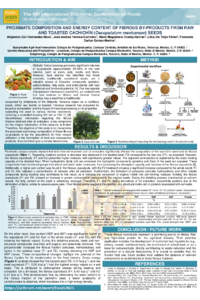
Cachichín (Oecopetalum mexicanum) is a fruit tree endemic to southern Mexico and Central America, whose seed is still considered underutilized, but valued for its bioactive composition and potential therapeutic effects, including hypoglycemic properties, blood pressure regulation, and antioxidant activity. Previous research has explored its biochemical, phytochemical, and mineral profiles, as well as the impact of applied thermal treatments, thus confirming its nutritional potential. Nevertheless, information regarding the fibrous fraction obtained following oil extraction, a key component for the integral valorization of this resource, is limited. Therefore, we evaluated the proximal composition (moisture, ash, protein, NDF/ADF fiber) and energy content (gross energy on wet and dry matter bases) of raw (T1) and control-toasted (134 °C, 25 min) (T2) cachichín seeds, and their fibrous byproducts from raw (F1) and control-toasted (F2) seeds after oil extraction. All analyses were performed using standardized methods (AOAC). Treatment F1 exhibited the highest energy concentration on both a fresh basis (5.06 kcal g-1 FBW) and dry basis (5.43 kcal g-1 DBW) compared to treatment T1. Fibrous byproducts (F1, F2), though higher in moisture, showed increased protein (F1: 10.45 %; F2: 11.16 %) and fiber content (NDF in F1: 66 % increase compared to T1; F2: 52% increase compared to T2). Therefore, cachichín seeds possess high energetic and nutritional value. These fibrous co-products represent a promising source of high-value dietary fiber and protein for the agri-food industry. Their potential application includes the development of functional food ingredients (e.g., bakery products, cereals, nutritional bars), animal feed enrichment, or as a base for nutraceuticals, directly contributing to waste reduction and the promotion of a circular bioeconomy. It is crucial to consider that, for human food consumption, future studies should validate the absence of relevant antinutrients or contaminants in these fibrous fractions.
Keywords
Fibrous by-products
proximate composition
gross energy
cachichín
Oecopetalum mexicanum
Poster
Poster_135592_SciForum_Alejandro Esli Hernández Mora.pdf
A Study on the Emulsification of Algal Oil using Quillaja Saponin
Analysis of chemical, physicochemical, and sensorial properties of healthy cocoa cream formulated with sweet potato (Ipomoea batata) and house cricket (Acheta domesticus) flour