Event submissions
Published
This submission belongs to the session G. Food Biotechnology of the event The 6th International Electronic Conference on Foods
Published date
27 Oct, 2025
Academic Editor
'%3e%3cpath%20d='M12.6657%2010.9104C12.4185%2010.325%2012.0599%209.79327%2011.6097%209.34482C11.1609%208.89508%2010.6293%208.5365%2010.0442%208.28888C10.0389%208.28626%2010.0337%208.28495%2010.0285%208.28233C10.8446%207.69279%2011.3752%206.73249%2011.3752%205.64904C11.3752%203.8542%209.92103%202.39999%208.1262%202.39999C6.33136%202.39999%204.87715%203.8542%204.87715%205.64904C4.87715%206.73249%205.40774%207.69279%206.22393%208.28364C6.21869%208.28626%206.21345%208.28757%206.20821%208.29019C5.62129%208.5378%205.09463%208.89284%204.64265%209.34613C4.1929%209.79493%203.83432%2010.3266%203.58671%2010.9117C3.34345%2011.4845%203.21226%2012.0987%203.20023%2012.7209C3.19988%2012.7349%203.20233%2012.7488%203.20744%2012.7619C3.21255%2012.7749%203.22022%2012.7867%203.22998%2012.7968C3.23975%2012.8068%203.25142%2012.8147%203.26431%2012.8202C3.2772%2012.8256%203.29105%2012.8284%203.30504%2012.8284H4.09109C4.14874%2012.8284%204.19459%2012.7825%204.1959%2012.7262C4.2221%2011.7148%204.62823%2010.7676%205.34617%2010.0497C6.08899%209.30683%207.0755%208.89808%208.1262%208.89808C9.17689%208.89808%2010.1634%209.30683%2010.9062%2010.0497C11.6242%2010.7676%2012.0303%2011.7148%2012.0565%2012.7262C12.0578%2012.7838%2012.1037%2012.8284%2012.1613%2012.8284H12.9474C12.9613%2012.8284%2012.9752%2012.8256%2012.9881%2012.8202C13.001%2012.8147%2013.0126%2012.8068%2013.0224%2012.7968C13.0322%2012.7867%2013.0398%2012.7749%2013.0449%2012.7619C13.0501%2012.7488%2013.0525%2012.7349%2013.0522%2012.7209C13.0391%2012.0947%2012.9094%2011.4855%2012.6657%2010.9104ZM8.1262%207.9024C7.52486%207.9024%206.9589%207.6679%206.53312%207.24211C6.10733%206.81633%205.87283%206.25037%205.87283%205.64904C5.87283%205.0477%206.10733%204.48174%206.53312%204.05596C6.9589%203.63018%207.52486%203.39567%208.1262%203.39567C8.72753%203.39567%209.29349%203.63018%209.71927%204.05596C10.1451%204.48174%2010.3796%205.0477%2010.3796%205.64904C10.3796%206.25037%2010.1451%206.81633%209.71927%207.24211C9.29349%207.6679%208.72753%207.9024%208.1262%207.9024Z'%20fill='%235D1EE1'/%3e%3c/g%3e%3c/svg%3e) Yonghui Li
Yonghui LiCitation
Carolina Sol Plumari, Antares Ayelén Martinez, Ana Noelia Rinaldoni, Alejandro Orden, Undifferentiated Cells of Gardenia jasminoides as a Potential Sustainable Source of Food Ingredients, in Proceedings of The 6th International Electronic Conference on Foods, 28 October–30 October 2025, MDPI: Basel, Switzerland
Share
Email
Facebook
Twitter
LinkedIn
Undifferentiated Cells of Gardenia jasminoides as a Potential Sustainable Source of Food Ingredients
'%3e%3cpath%20d='M12.6647%2010.9104C12.4176%2010.325%2012.0589%209.7933%2011.6088%209.34485C11.16%208.89511%2010.6283%208.53653%2010.0432%208.28891C10.038%208.28629%2010.0327%208.28498%2010.0275%208.28236C10.8437%207.69282%2011.3743%206.73252%2011.3743%205.64907C11.3743%203.85423%209.92005%202.40002%208.12522%202.40002C6.33038%202.40002%204.87618%203.85423%204.87618%205.64907C4.87618%206.73252%205.40677%207.69282%206.22296%208.28367C6.21772%208.28629%206.21248%208.2876%206.20724%208.29022C5.62031%208.53783%205.09365%208.89287%204.64167%209.34616C4.19192%209.79496%203.83334%2010.3266%203.58573%2010.9117C3.34247%2011.4846%203.21128%2012.0987%203.19925%2012.721C3.1989%2012.735%203.20135%2012.7489%203.20646%2012.7619C3.21157%2012.7749%203.21924%2012.7868%203.22901%2012.7968C3.23877%2012.8068%203.25045%2012.8148%203.26334%2012.8202C3.27623%2012.8256%203.29007%2012.8284%203.30406%2012.8284H4.09012C4.14776%2012.8284%204.19362%2012.7825%204.19493%2012.7262C4.22113%2011.7148%204.62726%2010.7676%205.34519%2010.0497C6.08802%209.30686%207.07452%208.89811%208.12522%208.89811C9.17592%208.89811%2010.1624%209.30686%2010.9052%2010.0497C11.6232%2010.7676%2012.0293%2011.7148%2012.0555%2012.7262C12.0568%2012.7839%2012.1027%2012.8284%2012.1603%2012.8284H12.9464C12.9604%2012.8284%2012.9742%2012.8256%2012.9871%2012.8202C13%2012.8148%2013.0117%2012.8068%2013.0214%2012.7968C13.0312%2012.7868%2013.0389%2012.7749%2013.044%2012.7619C13.0491%2012.7489%2013.0515%2012.735%2013.0512%2012.721C13.0381%2012.0947%2012.9084%2011.4856%2012.6647%2010.9104ZM8.12522%207.90243C7.52388%207.90243%206.95792%207.66793%206.53214%207.24215C6.10636%206.81636%205.87185%206.2504%205.87185%205.64907C5.87185%205.04773%206.10636%204.48177%206.53214%204.05599C6.95792%203.63021%207.52388%203.3957%208.12522%203.3957C8.72655%203.3957%209.29252%203.63021%209.7183%204.05599C10.1441%204.48177%2010.3786%205.04773%2010.3786%205.64907C10.3786%206.2504%2010.1441%206.81636%209.7183%207.24215C9.29252%207.66793%208.72655%207.90243%208.12522%207.90243Z'%20fill='%235D1EE1'/%3e%3c/g%3e%3c/svg%3e)
Carolina Sol Plumari 1
Antares Ayelén Martinez 2
Ana Noelia Rinaldoni 2
Alejandro Orden 2
1. Universidad Nacional de San Luis, San Luis D5700HHW, Argentina
2. Universidad Nacional de San Luis - INTEQUI (CONICET), San Luis D5700HHW, Argentina
Abstract
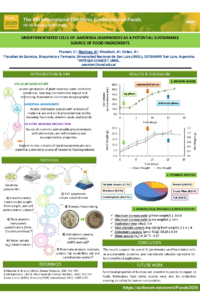
This study, within the framework of cellular agriculture, explores in vitro cultures of Gardenia jasminoides as a potential sustainable source of functional food ingredients. Cellular agriculture enables the production of plant biomass under controlled conditions, reducing environmental impact and minimizing dependence on climate and geography. G. jasminoides (commonly known as cape jasmine) is a widely distributed species with a history of medicinal use and a rich phytochemical profile, including flavonoids, phenolic acids, and iridoids with antioxidant, anti-inflammatory, and neuroprotective properties.
Undifferentiated cells (callus) of G. jasminoides were cultured in Murashige-and-Skoog medium supplemented with 2 ppm 1-naphthaleneacetic acid and 0.5 ppm kinetin. Friable biomass was obtained and transferred to liquid medium for growth evaluation. Growth kinetics based on dry weight, fresh weight, and cell sedimentation volume showed a typical curve, with a lag phase of approximately three days, followed by an exponential phase lasting 7–9 days, and a stationary phase starting around days 10–12. The early onset of the stationary phase may be attributed to the relatively high initial inoculum size (8.5 g). Maximum biomass yield reached 265 g fresh weight/L, equivalent to 14.5 g dry weight/L, with a duplication time of 8.4 days.
Total phenolic content was 6.1 ± 1.4 mg GAE/g fresh weight, and antioxidant capacity, determined using the ABTS assay, was 18.20 ± 0.59 μmol TE/g. Proximate analysis of the freeze-dried biomass revealed high protein content (24.9%), low fat (0.066%), and significant levels of crude fiber (8.54%) and ash (8.95%). Carbohydrates were the predominant component, accounting for up to 49.5%. Water activity (aw) was 0.37 at 25 °C, confirming the effectiveness of freeze-drying in preserving product stability and microbiological safety.
These results support the use of G. jasminoides undifferentiated cells as a sustainable, bioactive, and nutritionally valuable ingredient for functional food applications.
Keywords
Cellular Agriculture
Gardenia jasminoides
Proximate Composition
Functional Food Ingredients
Plant Biomass
Poster
Martinez et al. Poster.pdf
Extra Virgin Olive Oils from Rio Grande do Sul: A Comprehensive Study of Their Identity, Quality Parameters, and Sensory Attributes
Elucidating the Regulatory Mechanism of the Global Transcription Factor Cra on Cytidine Synthesis in Escherichia coli