Event submissions
Published
This submission belongs to the session B. Nutritional and Functional Foods of the event The 6th International Electronic Conference on Foods
Published date
27 Oct, 2025
Academic Editor
'%3e%3cpath%20d='M12.6657%2010.9104C12.4185%2010.325%2012.0599%209.79327%2011.6097%209.34482C11.1609%208.89508%2010.6293%208.5365%2010.0442%208.28888C10.0389%208.28626%2010.0337%208.28495%2010.0285%208.28233C10.8446%207.69279%2011.3752%206.73249%2011.3752%205.64904C11.3752%203.8542%209.92103%202.39999%208.1262%202.39999C6.33136%202.39999%204.87715%203.8542%204.87715%205.64904C4.87715%206.73249%205.40774%207.69279%206.22393%208.28364C6.21869%208.28626%206.21345%208.28757%206.20821%208.29019C5.62129%208.5378%205.09463%208.89284%204.64265%209.34613C4.1929%209.79493%203.83432%2010.3266%203.58671%2010.9117C3.34345%2011.4845%203.21226%2012.0987%203.20023%2012.7209C3.19988%2012.7349%203.20233%2012.7488%203.20744%2012.7619C3.21255%2012.7749%203.22022%2012.7867%203.22998%2012.7968C3.23975%2012.8068%203.25142%2012.8147%203.26431%2012.8202C3.2772%2012.8256%203.29105%2012.8284%203.30504%2012.8284H4.09109C4.14874%2012.8284%204.19459%2012.7825%204.1959%2012.7262C4.2221%2011.7148%204.62823%2010.7676%205.34617%2010.0497C6.08899%209.30683%207.0755%208.89808%208.1262%208.89808C9.17689%208.89808%2010.1634%209.30683%2010.9062%2010.0497C11.6242%2010.7676%2012.0303%2011.7148%2012.0565%2012.7262C12.0578%2012.7838%2012.1037%2012.8284%2012.1613%2012.8284H12.9474C12.9613%2012.8284%2012.9752%2012.8256%2012.9881%2012.8202C13.001%2012.8147%2013.0126%2012.8068%2013.0224%2012.7968C13.0322%2012.7867%2013.0398%2012.7749%2013.0449%2012.7619C13.0501%2012.7488%2013.0525%2012.7349%2013.0522%2012.7209C13.0391%2012.0947%2012.9094%2011.4855%2012.6657%2010.9104ZM8.1262%207.9024C7.52486%207.9024%206.9589%207.6679%206.53312%207.24211C6.10733%206.81633%205.87283%206.25037%205.87283%205.64904C5.87283%205.0477%206.10733%204.48174%206.53312%204.05596C6.9589%203.63018%207.52486%203.39567%208.1262%203.39567C8.72753%203.39567%209.29349%203.63018%209.71927%204.05596C10.1451%204.48174%2010.3796%205.0477%2010.3796%205.64904C10.3796%206.25037%2010.1451%206.81633%209.71927%207.24211C9.29349%207.6679%208.72753%207.9024%208.1262%207.9024Z'%20fill='%235D1EE1'/%3e%3c/g%3e%3c/svg%3e) Manuel Viuda-Martos
Manuel Viuda-MartosCitation
Elsa M. Gonçalves, Diogo Gonçalves, Patrícia Fradinho, Sandra Gomes, Nuno Alvarenga, Marisa Nicolai, Maria L. Palma, Paula Pereira, Evaluation of the Functional and Rheological Properties of Grape Pomace Flour with Different Particle Sizes, in Proceedings of The 6th International Electronic Conference on Foods, 28 October–30 October 2025, MDPI: Basel, Switzerland
Share
Email
Facebook
Twitter
LinkedIn
Evaluation of the Functional and Rheological Properties of Grape Pomace Flour with Different Particle Sizes

Elsa M. Gonçalves 1,2
'%3e%3cpath%20d='M12.6647%2010.9104C12.4176%2010.325%2012.0589%209.7933%2011.6088%209.34485C11.16%208.89511%2010.6283%208.53653%2010.0432%208.28891C10.038%208.28629%2010.0327%208.28498%2010.0275%208.28236C10.8437%207.69282%2011.3743%206.73252%2011.3743%205.64907C11.3743%203.85423%209.92005%202.40002%208.12522%202.40002C6.33038%202.40002%204.87618%203.85423%204.87618%205.64907C4.87618%206.73252%205.40677%207.69282%206.22296%208.28367C6.21772%208.28629%206.21248%208.2876%206.20724%208.29022C5.62031%208.53783%205.09365%208.89287%204.64167%209.34616C4.19192%209.79496%203.83334%2010.3266%203.58573%2010.9117C3.34247%2011.4846%203.21128%2012.0987%203.19925%2012.721C3.1989%2012.735%203.20135%2012.7489%203.20646%2012.7619C3.21157%2012.7749%203.21924%2012.7868%203.22901%2012.7968C3.23877%2012.8068%203.25045%2012.8148%203.26334%2012.8202C3.27623%2012.8256%203.29007%2012.8284%203.30406%2012.8284H4.09012C4.14776%2012.8284%204.19362%2012.7825%204.19493%2012.7262C4.22113%2011.7148%204.62726%2010.7676%205.34519%2010.0497C6.08802%209.30686%207.07452%208.89811%208.12522%208.89811C9.17592%208.89811%2010.1624%209.30686%2010.9052%2010.0497C11.6232%2010.7676%2012.0293%2011.7148%2012.0555%2012.7262C12.0568%2012.7839%2012.1027%2012.8284%2012.1603%2012.8284H12.9464C12.9604%2012.8284%2012.9742%2012.8256%2012.9871%2012.8202C13%2012.8148%2013.0117%2012.8068%2013.0214%2012.7968C13.0312%2012.7868%2013.0389%2012.7749%2013.044%2012.7619C13.0491%2012.7489%2013.0515%2012.735%2013.0512%2012.721C13.0381%2012.0947%2012.9084%2011.4856%2012.6647%2010.9104ZM8.12522%207.90243C7.52388%207.90243%206.95792%207.66793%206.53214%207.24215C6.10636%206.81636%205.87185%206.2504%205.87185%205.64907C5.87185%205.04773%206.10636%204.48177%206.53214%204.05599C6.95792%203.63021%207.52388%203.3957%208.12522%203.3957C8.72655%203.3957%209.29252%203.63021%209.7183%204.05599C10.1441%204.48177%2010.3786%205.04773%2010.3786%205.64907C10.3786%206.2504%2010.1441%206.81636%209.7183%207.24215C9.29252%207.66793%208.72655%207.90243%208.12522%207.90243Z'%20fill='%235D1EE1'/%3e%3c/g%3e%3c/svg%3e)
Diogo Gonçalves 3

Patrícia Fradinho 4
Sandra Gomes 1

Nuno Alvarenga 1,2

Marisa Nicolai 5
Maria L. Palma 5

Paula Pereira 3,5,6
1. INIAV - Instituto Nacional de Investigação Agrária e Veterinária, Unidade de Tecnologia e Inovação, 2780-157 Oeiras, Portugal
2. GeoBioTec - Geobiociências, Geoengenharias e Geotecnologias, FCT-UNL, 2829-516 Caparica, Portugal.
3. EPCV, School of Phycology and Life Science, Department of Live Sciences, Universidade Lusófona, Campo Grande 376, 1749-024 Lisboa, Portugal
4. Colab4Food - Collaborative Laboratory for Innovation in the Agri-Food sector, 4485-655 Vairão, Portugal
5. CERENA, Center for Natural Resources and Environment, Instituto Superior Técnico (IST), Universidade de Lisboa, Av. Rovisco Pais, 1049-001 Lisboa, Portugal
6. CBIOS – Research Center for Biosciences & Health Technologies, Universidade Lusófona, Campo Grande 376, 1749-024 Lisboa, Portugal
Abstract
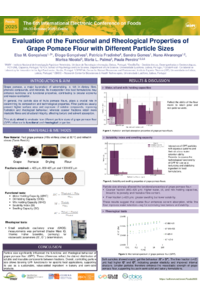
Grape pomace, a by-product of the winemaking industry, contains nutritionally relevant compounds, including proteins, lipids, carbohydrates, phenolic compounds, vitamins, and dietary fibers. Given its functional and technological potential, this by-product has been valorized as a flour for use in food formulations. The particle size of the flour directly influences its physicochemical and rheological properties, affecting its performance in food matrices. This study evaluated the functionality of grape pomace flour with different particle sizes. Samples were subjected to drying, milling, and sieving, followed by the analysis of water absorption capacity (WAC; g water/g flour), oil absorption capacity (OAC; g oil/g flour), milk absorption capacity (MAC; g milk/g flour), water solubility (%), moisture retention capacity (g/g), and rheological properties (M.A.R.S iQ Air Rheometer, Thermo Scientific), including viscosity (Pa·s), elasticity, and flow behavior (Pa).
The results showed that the flour exhibited a high absorption capacity for all the tested solvents (water, oil, and milk), with values exceeding 1.5 g solvent/g flour, indicating strong potential for retention and interaction with both polar and non-polar components. These properties are particularly relevant for applications in food products requiring emulsifying stability. The gelling capacity was more pronounced at ratios of 1:1.5 and 1:2 (flour-to-water), with a significant increase in viscosity, suggesting the formation of a cohesive three-dimensional structure. Rheological analyses revealed a viscoelastic behavior suitable for structured food systems such as gels, emulsions, and moldable doughs. Moreover, samples with finer particle sizes showed improved functional performance, indicating greater technological potential for incorporation into value-added food formulations with specific texture and stability requirements.
Keywords
Grape pomace
flours
particle size
functional properties
rheology.
Poster
Poster_6Conf Foods_PF.pdf
Dielectric Measurements for Monitoring the Storage of Vegetable Oils
Oil Uptake Lessening and Functionality Amelioration of Deep-Fried Fish Fillets Using Egg White Protein Edible Coating